
Unveiling the Hidden Impacts: How Radiation Affects Tiny Ecosystems and What It Means for Our Future

"A new study reveals surprising effects of chronic radiation on microbial communities, challenging previous assumptions and highlighting the importance of ecological interactions."
Our planet's ecosystems are intricately connected webs of life, where the fate of one species is often intertwined with the well-being of others. While environmental protection efforts often focus on preserving these ecosystems, there's a critical aspect that often gets overlooked: the impact of radiation. Most research has traditionally focused on individual species, neglecting the complex interactions that define how ecosystems truly function. How does radiation exposure affect the delicate balance of life, especially when exposure is long-term and subtle?
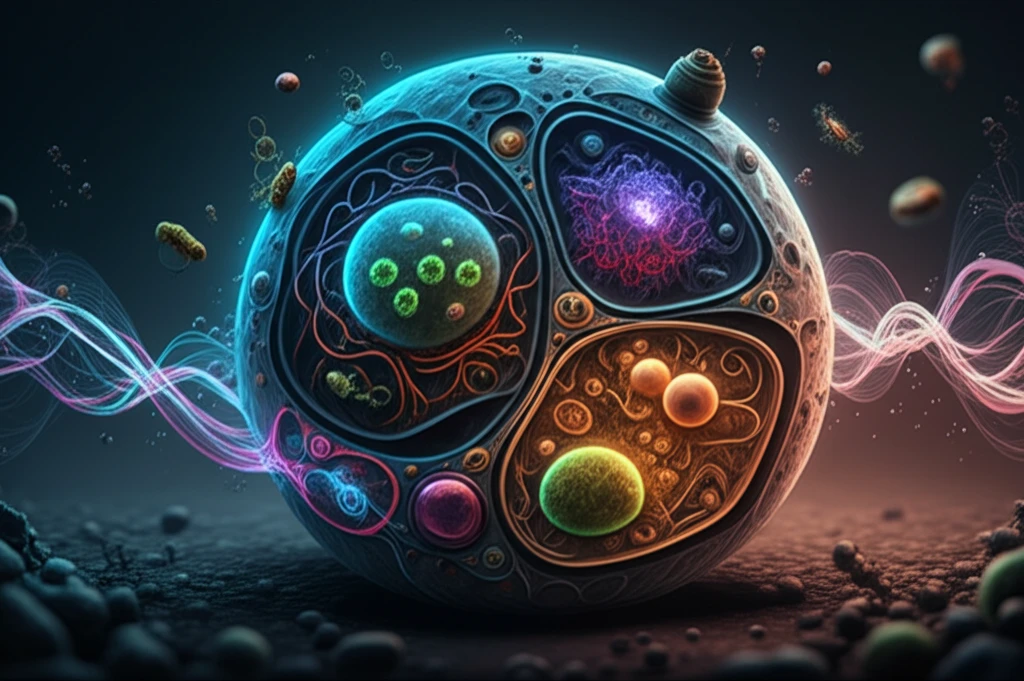
To unravel this mystery, scientists are turning to 'microcosms' – miniature, simplified ecosystems that allow us to study ecological interactions in a controlled laboratory setting. These microcosms, containing essential components like producers, consumers, and decomposers, offer a window into the complex dynamics of nature without the overwhelming complexity of a full-scale environment. One such microcosm, developed by Kawabata et al., consists of three key players: Euglena (a producer), Tetrahymena (a consumer), and E. coli (a decomposer). This simplified system allows researchers to observe and simulate the effects of radiation on species interactions in a manageable way.
Previous research using this microcosm has yielded surprising results. While single-species studies suggested that E. coli is the most radiation-sensitive and Tetrahymena the most resistant, the co-cultured microcosm revealed a different story. In this interconnected system, E. coli was still the first to decline under radiation exposure, but unexpectedly, Tetrahymena, the supposedly resistant species, was next, followed by Euglena. This suggested that the impact of radiation wasn't just about direct sensitivity, but also about the indirect effects of ecological interactions. Now, new research seeks to refine these models, incorporating complexities like predation resistance to create a more accurate picture of how chronic radiation exposure truly reshapes these miniature worlds.
The Scope of Chronic Radiation Exposure
Chronic ionizing radiation exposure poses significant risks to human health and ecosystem functioning across multiple occupational sectors. Nuclear power industry workers, miners, pilots, astronauts, and certain medical professionals face protracted occupational exposures to ionizing radiation on a regular basis. Even at low dose-rates, chronic irradiation can induce cell senescence and alter gene expression through previously uncharacterized epigenetic pathways, representing a newly recognized aspect of radiation biology. While most data on chronic radiation effects derives from laboratory experiments, some observations exist from wildlife living in radiation-contaminated environments.
Challenges in Studying Chronic Radiation
The biological effects of chronic ionizing radiation exposure prove difficult to study yet remain critically important for protecting occupationally-exposed individuals and victims of radiological accidents or malicious events. Research includes understanding targeted effects alongside emerging observations of radiation adaptation in organisms. Molecular mechanisms underlying wildlife responses to radiation require further investigation, particularly for identifying reliable biomarkers that evaluate ecosystem changes. Currently, information on low-dose chronic exposure effects remains fragmentary, highlighting an urgent need to establish comprehensive dose-effect relationships.
Understanding Radiation Types and Historical Cases
Ionizing radiation encompasses three primary types with distinct penetration capabilities: alpha particles stopped by paper, beta particles requiring aluminum foil for blocking, and gamma radiation demanding lead shielding for attenuation. Historical cases like Radium Jaw, formally known as radiation-induced osteonecrosis, emerged in the early 20th century from internal absorption of radioactive radium, causing severe bone death and chronic jaw infections. Medical applications have also revealed chronic effects, with up to 20% of patients receiving pelvic radiation developing chronic radiation proctitis. Contemporary research now investigates how space-like irradiation impacts brain function, extending our understanding beyond terrestrial exposure scenarios.
The Unexpected Twist: Chronic Radiation and Microbial Ecosystems
Recent experiments exposing microcosms to chronic gamma radiation (at rates of 1.2Gy/day, 5Gy/day, 10Gy/day, and 23Gy/day) have challenged earlier predictions. The initial models suggested that Tetrahymena, the most radiation-resistant species in isolation, would be the most vulnerable in the long run due to the decline of its food source, E. coli. However, the experimental results painted a different picture: E. coli populations decreased with increasing radiation dose, but Tetrahymena populations remained relatively stable or even slightly increased. This discrepancy indicated that the relationship between Tetrahymena and E. coli was more intricate than a simple predator-prey dynamic.
- The two phenotypes are genetically distinct.
- The resistant phenotype is harder to predate upon.
- The resistant phenotype grows at a lower rate than the normal.
- The normal phenotype rises in number if resistant types are reduced by higher dose rates
Molecular Insights into Chronic Radiation Injury
Recent research has unveiled the complex molecular landscape of chronic radiation injury, revealing key mechanisms including genomic instability, inflammaging, and senescence-associated secretory phenotype. Studies in Chernobyl-affected areas demonstrate measurable mutation rate changes in plants exposed to elevated background radiation over extended periods. Late radiation enteropathy, though less common than acute effects, presents more serious clinical consequences primarily due to pathological changes outside the mucosal compartment. Chronic radiation dermatitis following breast cancer radiotherapy involves persistent inflammation, microvascular injury, fibrosis, and tissue remodeling as interconnected pathological processes.
Challenges in Chronic Radiation Syndrome Recognition
Chronic Radiation Syndrome presents diagnostic complexities that challenge conventional medical understanding and clinical recognition. The condition's pathoanatomy involves distinct developmental phases and recovery stages that differ fundamentally from acute radiation effects. Hematopoietic changes in affected individuals demonstrate dynamic patterns requiring specialized diagnostic approaches beyond standard radiation assessment protocols. Comprehensive clinical documentation remains limited, suggesting potential underrecognition of chronic radiation effects in medical practice.
Comparing Radiation Types and Exposure Scenarios
Different forms of ionizing radiation—alpha, beta, gamma, and X-rays—exhibit varying penetration powers that determine their biological impact on different body systems. Data on multi-stressor combinations involving chronic ionizing radiation exposure remains limited, making extrapolation from acute to chronic irradiation scenarios potentially unreliable for risk assessment. Research comparing chronic versus acute irradiation effects reveals that chronic exposure can cause significantly higher frequencies of homologous recombination, suggesting different biological response pathways. Direct comparisons between radiation exposures from various sources depend entirely on the dose metrics and exposure scenarios being evaluated.
Implications and Future Directions
The updated model provides a more nuanced understanding of how chronic radiation shapes microbial ecosystems, emphasizing the importance of considering complex interactions like predation resistance. The model showed the importance of radiation resistant phenotypes in the bacteria for radiation resistance, even if the resistant bacteria grows slower. While the microcosm is a simplification of real-world ecosystems, it offers valuable insights into the potential long-term consequences of radiation exposure. Further research is needed to validate these findings in more complex systems and to explore the genetic mechanisms underlying the development of predation resistance. Individual-based modelling approaches can also be implimented. Ultimately, understanding the ecological effects of radiation is crucial for protecting our environment and ensuring the health of our planet in the face of increasing environmental stressors.
Integrating Radiation Risk Understanding
Acute radiation syndrome involves health effects from exposures exceeding 0.7 Gy within limited timeframes, establishing clear thresholds for immediate clinical intervention. Low-dose chronic radiation exposure requires different risk assessment frameworks that account for stochastic effects and background radiation interactions. Chronic radiation-associated dysphagia in oropharyngeal cancer patients can be modeled as a function of age and radiation dose to non-target swallowing muscles, demonstrating dose-response relationships in clinical settings. Public health approaches to radiation prevention must integrate radiation safety protocols with preventive medicine strategies for comprehensive risk mitigation.
Pharmacologic Approaches to Radiation Injury Treatment
Clinical development of pharmacologic approaches to mitigate or treat chronic radiation injuries holds promise for significantly improving patient outcomes. These therapeutic strategies could benefit both radiotherapy patients undergoing treatment and victims of radiation accidents or nuclear terrorism events. Future research directions focus on developing medical countermeasures that address the specific mechanisms of chronic radiation damage. Success in this area could transform survival rates and quality of life for individuals facing chronic radiation exposure consequences.
Radioresistance and Space Mission Considerations
Low-level chronic irradiation can induce radioresistance in mammals through nonlinear effects on hematopoiesis system sensitivity, challenging traditional linear dose-response assumptions. This phenomenon has particular significance for estimating radiation risk during long-term space missions where astronauts face prolonged exposure scenarios. Chronic irradiation of human cells reduces histone levels and deregulates gene expression through epigenetic mechanisms that represent new aspects of radiation biology. Plant transcriptome analysis from Chernobyl-affected zones reveals how chronic ionizing radiation functions as an evolutionary factor, causing both direct damage and non-target effects across generations.
Ecosystem-Level Responses to Chronic Radiation
Multi-omics analysis of Vicia cracca responses to chronic radiation exposure reveals complex and multidirectional biological changes that extend beyond simple damage mechanisms. Irradiated plants demonstrate significant alterations in metabolism and gene expression patterns that reflect comprehensive physiological reprogramming. Profound changes occur in carbon metabolism, nitrogen reallocation, and photosynthetic processes, indicating systemic disruption of fundamental biological functions. These findings illustrate how chronic radiation exposure impacts organisms at molecular, cellular, and ecosystem levels simultaneously.