
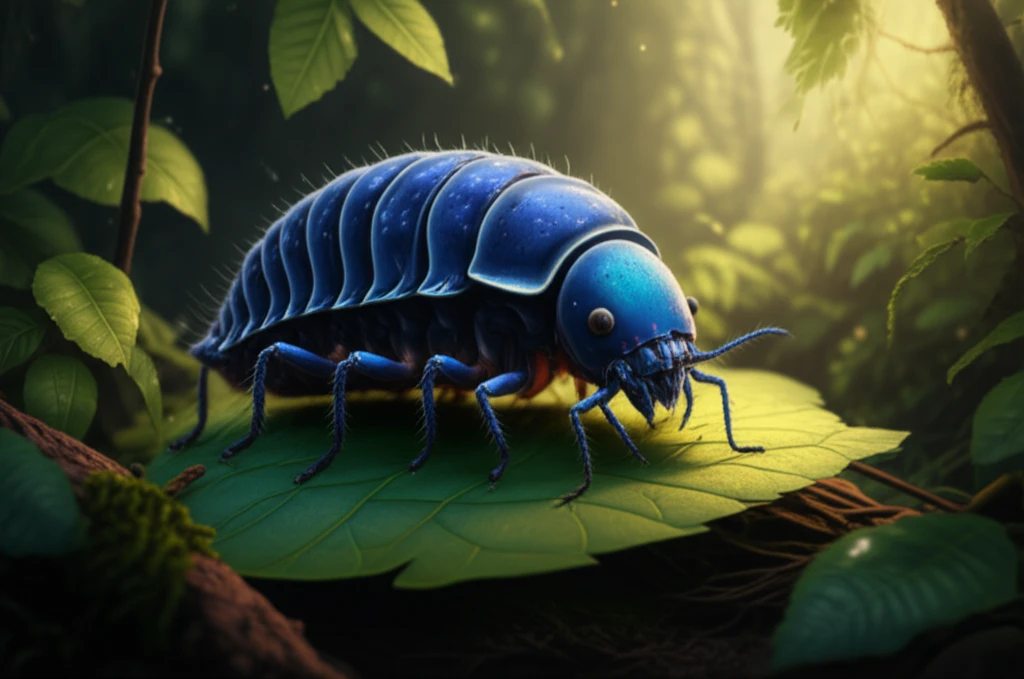
Unveiling a Jewel: A New Springtail Species Discovered in Brazil's Rainforest

"Meet Campylothorax mitrai: How biodiversity discoveries highlight the hidden wonders of the Atlantic Rainforest and the crucial role of taxonomy."
The world teems with life, and in the tropics, that life often takes on spectacular forms. Among the less-celebrated but vital inhabitants of these ecosystems are the springtails (Collembola), tiny arthropods playing a crucial role in soil health. Paronellidae, a family within the springtail order, is particularly known for its elongated appendages, distinctive color patterns, and prevalence in tropical environments.
While an estimated 460 species of Paronellidae are described worldwide, knowledge about this family in Brazil remains limited. Recent discoveries are helping to fill the gaps in our understanding of these creatures and their habitats.
Now, a new species of Campylothorax, Campylothorax mitrai, has been identified in the state of Alagoas, Brazil. This finding highlights the biodiversity still waiting to be discovered, and the importance of continuing taxonomic research, especially in threatened ecosystems like the Atlantic Rainforest.
A Brazilian Discovery in a Global Soil Record
Campylothorax mitrai sp. nov. was found in remnants of Atlantic Rainforest in Rio Largo municipality, Alagoas, Brazil. A global springtail database contains 249,912 occurrences from 44,999 samples and 2,990 sites, with records mainly collected at the sample level and standardized taxonomically. The database includes observations across seasons, years, sites, and soil layers, enabling detailed analyses of springtail communities.
Why Springtail Taxonomy Matters
Springtails are tiny, six-legged animals that are often overlooked, yet they occur in settings ranging from big cities and Antarctic ice to deep caves and rainforest canopies. The discovery of Campylothorax mitrai in Brazil's Atlantic Rainforest highlights the role of taxonomic research in documenting biodiversity, particularly in threatened ecosystems. The Biodiversity Heritage Library works collaboratively to make biodiversity literature openly available to the global biodiversity community.
Meet Campylothorax mitrai: Unique Features of a Rainforest Newcomer
Campylothorax mitrai was found in the remains of the Atlantic Rainforest at Rio Largo municipality, state of Alagoas, Brazil. This species belongs to the genus Campylothorax, previously known from only eight species distributed across the Neotropical and Ethiopian regions. C. mitrai marks the ninth member of its genus and the third to be recorded in Brazil.
- Coloration: Predominantly dark blue, a stark contrast to the pale coloration of other Brazilian Campylothorax species.
- Unique Setae Arrangement: A large, distinct seta 'E' in the labial triangle, a feature not observed in other Campylothorax species.
- Location: This is the first record of Collembola from the state of Alagoas, expanding the known distribution of the genus.
A Genus Spanning Two Biogeographic Regions
A study of first-instar Campylothorax sabanus also describes three new Campylothorax species from Hispaniola. Its authors report that the nine species assigned to the genus are distributed across the Neotropical and African regions. Separately, a global springtail data paper notes that soil biodiversity represents a major fraction of life on Earth, while knowledge of the current status and trends of soil invertebrates remains limited.
Pressures on Springtail Communities
A 2025 study reports that landscape fragmentation negatively affects springtail community diversity, structure, and niche occupancy. Research published in 2024 found that soil organic matter and tillage had positive impacts on functional and taxonomic diversity, while pesticide-use intensity—and especially the diversity of active ingredients—decreased springtail community diversity. Together, these findings show that springtail responses vary with landscape and soil-management conditions.
Prey and Habitat Pressures
A study in a Panamanian rainforest examines the spatial distribution of ants, springtails, and termites in soil. It hypothesizes that ants specializing on springtails and termites are most abundant where their prey densities are highest. A separate account of springtails in Gorongosa Park identifies human agricultural and forestry activities as threats that disrupt springtail populations and their ecosystems.
Why This Tiny Discovery Matters
The discovery of Campylothorax mitrai underscores the critical importance of taxonomic research. By identifying and classifying species, taxonomists provide a foundation for understanding biodiversity, ecological relationships, and conservation needs.
Fragmentation in Subtropical Agroecosystems
A study published in 2025 investigated how landscape fragmentation affects springtail communities in subtropical regions. The researchers collected soil-core samples across landscapes classified as having low, medium, and higher fragmentation levels. The available study summary identifies fragmentation as the focus but does not provide its specific findings, so the direction or size of its effects cannot be established from this source material.
In a world facing unprecedented environmental challenges, understanding the full scope of biodiversity is more crucial than ever. Each species, no matter how small, plays a role in the complex web of life. The Atlantic Rainforest, a biodiversity hotspot, faces ongoing threats from deforestation and habitat loss. Documenting its inhabitants is a vital step in protecting this invaluable ecosystem.
Campylothorax mitrai serves as a reminder of the hidden wonders that remain to be discovered and the importance of continued exploration and conservation efforts.