
Unsedated Colonoscopy: Is Water Exchange the Key to Pain-Free Screening?

"Explore how water exchange colonoscopy offers a less painful, potentially more effective alternative to traditional methods, and why it might be the future of colorectal cancer screening."
Colon cancer screening is a critical part of preventative healthcare, but the discomfort associated with traditional colonoscopies often deters many from undergoing this life-saving procedure. Monitored anesthesia care (MAC) has become increasingly common to alleviate pain during colonoscopies, but this approach raises concerns about cost and accessibility.
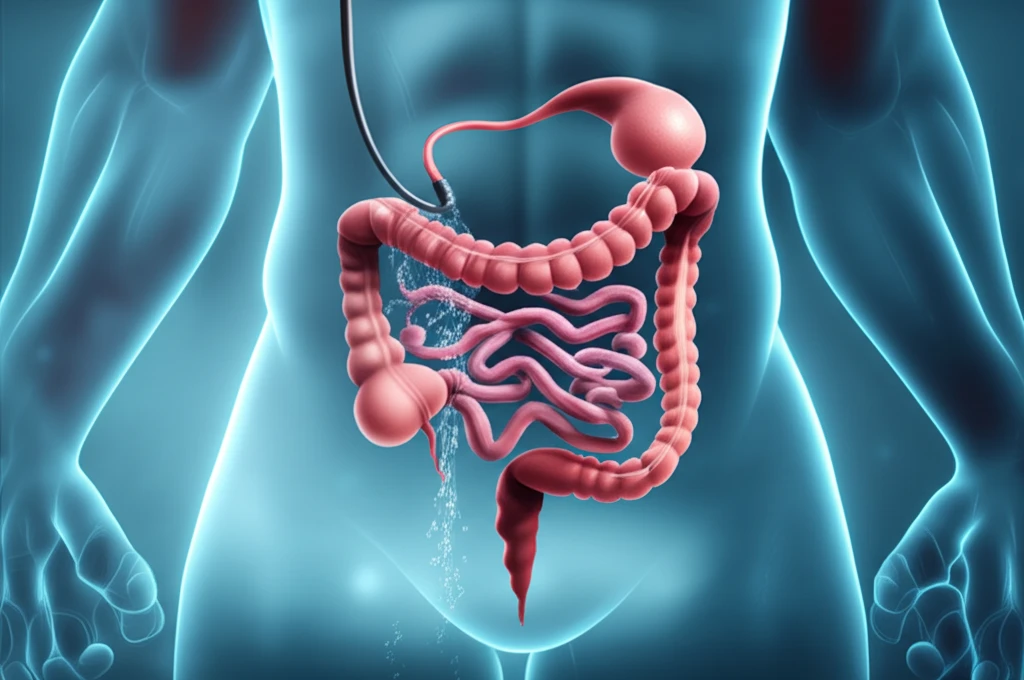
In response to these challenges, water exchange colonoscopy has emerged as a promising alternative. This technique, which uses water instead of air to distend the colon, minimizes patient discomfort and may even improve the detection of precancerous polyps. As healthcare providers and patients seek more comfortable and cost-effective screening options, water exchange colonoscopy is gaining traction as a viable solution.
Recent discussions in medical journals, including a study published in JAMA Internal Medicine, have highlighted the potential of water exchange colonoscopy to reduce the reliance on monitored anesthesia care. While some experts question the generalizability and patient acceptance of unsedated colonoscopy, the growing body of evidence suggests that this method could revolutionize colorectal cancer screening.
A Real-World Boost to Adenoma Detection
Switching from air insufflation to water exchange during outpatient colonoscopy insertion raised the adenoma detection rate by 14 percentage points in a real-world cohort of 4,322 procedures, with the largest gains concentrated in the right colon. A systematic review with network meta-analysis of randomized controlled studies likewise reported that water exchange colonoscopy increases adenoma detection rate. A separate systematic review and meta-analysis comparing water exchange with water immersion has also been cited as supporting the technique in unsedated settings. Water exchange has additionally been applied in smaller datasets to patients referred for prior incomplete colonoscopy, extending its potential impact to difficult cases. Taken together, these figures position water exchange as a measurable improvement over conventional practice.
Defining the Gold Standard Water-Assisted Technique
Water exchange (WE) is defined as simultaneous water infusion and suction of air and dirty, opaque luminal contents during insertion until distention with transparent water is achieved, and it is regarded as the gold standard water-assisted colonoscopy (WAC) technique in the current literature. A key advantage is pain: patients who completed unsedated colonoscopy using the water exchange method had lower maximum pain scores during the procedure, and a systematic review of randomized controlled trials found water exchange consistently associated with a greater reduction in pain scores than water immersion. Yet the technique is not without limitations in difficult cases - in one small dataset the colonoscope could not be passed beyond the transverse colon because of difficulty visualizing the lumen. Practical video guidance from experts such as Sergio Cadoni and Sauid Ishaq has therefore been published to help clinicians perform water exchange correctly in daily practice.
From Water Immersion in 1984 to a Recognized Technique
Water exchange colonoscopy has its roots in water immersion colonoscopy, which was initially described in the English literature in 1984; the two techniques are very similar, with water exchange arriving later as a refinement. Expert endorsement has been described as a prerequisite to general acceptance and marked a significant milestone in the history of water exchange colonoscopy. The foundational work has since broadened into water-assisted colonoscopy applied across a range of clinical contexts, including inflammatory bowel diseases such as Crohn's disease and ulcerative colitis. This trajectory - from an initial description, through expert validation, to wider clinical application - explains how an insertion technique now reaches unsedated screening populations.
The Water Exchange Advantage: Less Pain, Better Detection
The primary advantage of water exchange colonoscopy is its ability to minimize pain and discomfort during the procedure. Traditional colonoscopies use air insufflation to expand the colon, which can cause cramping and pain. Water exchange, on the other hand, uses water to gently distend the colon, reducing pressure and discomfort. A randomized clinical trial demonstrated that water exchange resulted in significantly lower pain scores compared to air insufflation.
- Reduced Pain: Water exchange minimizes discomfort during the procedure.
- Improved Detection: Studies show a higher adenoma detection rate.
- Cost-Effective: Reduces the need for monitored anesthesia care.
- Faster Recovery: Allows patients to return to work the same day.
Evidence Builds for a Less Painful Insertion
Recent reviews describe water exchange as the least painful colonoscope insertion technique and report that it increases completion of unsedated colonoscopy. A systematic review of water-aided colonoscopy summarized twelve randomized controlled trials that assessed pain and adenoma detection rates between air insufflation and water-aided methods, finding that both water immersion and water exchange reduce pain during colonoscopy, with greater relief from water exchange. Clinical guidance underscores that water exchange must not be confused with water immersion or infusion colonoscopy, a distinct water-aided technique that involves infusing water during the insertion phase to open the colonic lumen and advance to the cecum. Together, these reviews reinforce the technique's credibility while clarifying the precise definitions clinicians and researchers should apply.
A Technique Still Making Its Case
Direct counter-evidence in this area is limited; the available source material for this angle is a demonstration video that presents water exchange colonoscopy as a newer method that has been shown to reduce patient discomfort, improve bowel cleansing, and improve polyp detection. Because this represents a single instructional presentation rather than an adversarial review, it functions more as an argument for adoption than as a documented failure. The most honest reading is that while critics of unsedated colonoscopy exist, water exchange's reported benefits in this specific demonstration remain unopposed by counter-evidence within the available material. Readers should weigh this accordingly when assessing whether the technique truly delivers on its promises.
Weighing Water Exchange Against Its Alternatives
In a prospective comparative study, water exchange colonoscopy required significantly less abdominal compression than water immersion or air insufflation, and it may also minimize the risk of hand injury among endoscopy assistants. Water-aided insertion generally reduces patient discomfort as an alternative to conventional colonoscopy, and while warm water has been used in most published trials, cool water is easier to prepare and, if equally effective, could support routine adoption. A hybrid technique combining water exchange with other approaches enabled faster colonoscopy without adversely impacting sedation requirement, cecal intubation, overall bowel cleansing, or patient comfort. Multicenter randomized controlled trials comparing water exchange with carbon dioxide insufflation in unsedated colonoscopy add further comparative weight to the evidence base.
The Future of Colonoscopy: A Shift Towards Patient-Centered Screening
Water exchange colonoscopy represents a significant step forward in making colon cancer screening more patient-centered. By minimizing pain and improving detection rates, this technique has the potential to increase screening rates and ultimately reduce the burden of colorectal cancer. As healthcare providers, policymakers, and patients continue to explore ways to improve the screening process, water exchange colonoscopy is likely to play an increasingly important role in the fight against this deadly disease.
Expert Endorsement as a Mark of Maturity
Among the top 10 topics in advances in endoscopy named by the Gastrointestinal (GI) Endoscopy Editorial Board for 2018, both water exchange colonoscopy and artificial intelligence were considered important advances. This juxtaposition is telling: water exchange sits alongside AI as a headline innovation in the field, signaling that expert opinion increasingly treats it as a meaningful, evidence-backed development. The recognition reflects years of accumulated trials demonstrating benefits in pain reduction and adenoma detection. For clinicians and patients alike, this editorial-level endorsement offers a concise measure of how far the technique has come.
The Right Colon and the Interval Cancer Challenge
A water-based colonoscopy technique shows greater adenoma detection rates than standard air insufflation, with benefits most pronounced in the right colon - a region of particular concern because proximal sessile serrated lesions may contribute to interval cancers through an accelerated pathway. Water exchange colonoscopy has been shown to improve both overall and proximal adenoma detection rates, and a systematic review with network meta-analysis of randomized controlled studies corroborates the adenoma detection gain. Future work is likely to focus on whether improved proximal detection translates into fewer interval cancers, where the stakes are highest for patients undergoing screening. This makes the right colon the natural frontier for the next generation of water-exchange research.
Room Efficiency Meets Patient Comfort
A systematic review and meta-analysis by Cadoni and colleagues examined the impact of water exchange colonoscopy on endoscopy room efficiency, placing the technique in a practical, operational context beyond patient comfort alone. The review notes that colonoscopy insertion is often hampered by discomfort caused by bowing and manipulation of the bowel by the colonoscope, which can slow procedures and strain staff and resources. If water exchange reduces that discomfort, it may also smooth workflow, shorten insertion time, and ease demands on endoscopy suites. These efficiency considerations matter for health systems weighing whether to invest in training and adoption of the technique.
Pain Relief as the Real Measure of Success
Unsedated colonoscopy can be painful, poorly tolerated by patients, and associated with unsatisfactory technical performance - a combination that discourages people from completing screening. Previous studies report an advantage of water exchange over conventional air insufflation in reducing pain during unsedated colonoscopy. The evidence has grown to the point that authors argue adoption of water exchange deserves broader consideration, noting that its pain-alleviating impact occurs in 90% of investigators. For the average patient facing a screening procedure without sedation, that statistic speaks to a genuinely meaningful, human-scale benefit.