
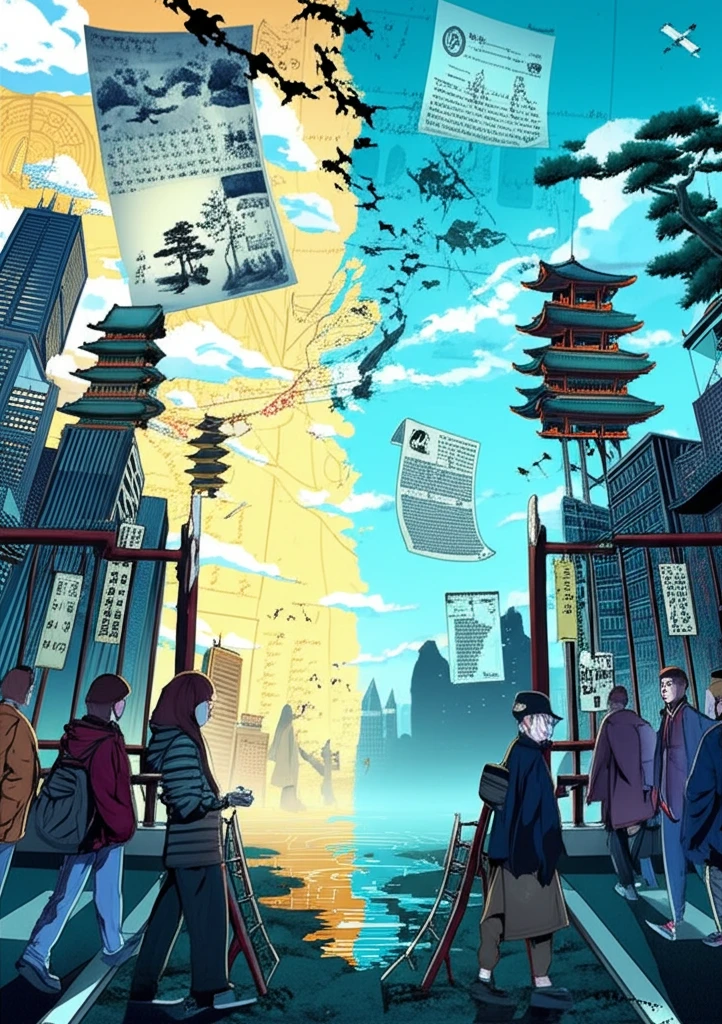
Unpacking Japan's Immigration Challenges: How History Shapes Today's Policies

"Explore the historical roots and modern implications of Japan's unique approach to immigration and citizenship."
Japan's approach to immigration and citizenship is often viewed as unique, shaped by a complex interplay of historical factors and international relations. Understanding these dynamics is crucial for grasping the challenges and opportunities that Japan faces in an increasingly globalized world.
Two significant works, Tessa Morris-Suzuki's 'Borderline Japan: Foreigners and Frontier Controls in the Postwar Era' and Erin Aeran Chung's 'Immigration and Citizenship in Japan,' offer profound insights into this intricate landscape. These books dissect how Japan's policies have evolved, particularly concerning migration, citizenship, and the integration—or lack thereof—of foreign residents.
At the heart of Japan's immigration narrative lies the historical experience of resident Koreans, whose presence and treatment have significantly influenced the nation's immigration and citizenship frameworks. By examining these historical roots, one can better understand the nuances of Japan's current immigration policies and their broader societal impacts.
A Small but Growing Foreign Workforce
Japanese immigration policy is known for its restrictiveness, with acceptance of foreign workers—especially the unskilled—very limited. The share of foreign workers in the total labor force remains only 2.5 percent, reflecting how peripheral migration has been to Japan's economy. Yet the policy is gradually opening up to skilled talent, signaling a slow but real shift.
Digital Procedures and a 10-Year Path
Japan has modernized entry procedures through services such as Visit Japan Web, which allows travelers to complete immigration, customs, and tax-free shopping formalities online before arrival. On the citizenship side, Japan enforces a 10-year residency requirement for naturalization, and under the Japanese legal system citizenship is not conferred by marriage to a Japanese citizen. These methods streamline administration but maintain strict, long-term thresholds for full membership.
From Restriction to the 2019 Turning Point
Japan's restrictive stance has deep historical roots, with unskilled labor entry long kept to a minimum. A notable policy shift occurred under the Abe administration in April 2019, when the government decided to accept low-skilled and semi-skilled foreign workers through a specified skills visa program as a response to labor shortages. That decision marked one of the first formal openings of the labor market to a broader range of foreign workers.
The Historical Underpinnings of Japan's Immigration Policies
Morris-Suzuki's 'Borderline Japan' challenges conventional wisdom by revealing that migration to Japan in the 1950s and 1960s was more significant than commonly acknowledged. The book uncovers how policies created during the U.S. occupation, initially aimed at managing former colonial subjects (primarily Koreans), shaped contemporary exclusionary immigration practices. These policies not only impacted the lives of migrants but also reinforced the myth of a homogeneous Japan, affecting its relationships with neighboring countries.
- Migration-focused approach, emphasizing on real human impact.
- Historical events and contexts, such as U.S. occupation of Japan.
- Borderline places and how they can obscure migrants' presence.
Shifting Public Opinion and Policy Review
Polls indicate that Japanese public opinion toward immigration is similar to that in other G7 countries, with a 1999 review article of opinion polls finding attitudes broadly neutral and less negative than in other developed nations. Commentary from 2021 likewise frames Japan's immigration and refugee policy as genuinely changing rather than static. This evidence complicates the common narrative that Japan is uniquely hostile to immigration.
Enforcement, Backlogs, and Persistent Restriction
Reports describe Japan working toward a 'Zero Plan' aimed at eliminating illegal immigrants, an effort framed as another side of life in Japan beyond tourism. At the same time, the country faces ongoing challenges in addressing refugees and illegal immigrants under its new policies. These enforcement priorities highlight the gap between gradual opening for workers and continued restrictiveness in other areas.
Japan Among Its G7 Peers
Comparisons with other developed economies show that Japan's public sentiment on immigration is not exceptional, tracking broadly with other G7 countries. The structural difference lies in policy design, where skilled talent is increasingly welcomed while unskilled acceptance remains tightly limited. Businesses, investors, and entrepreneurs are told that Japan's immigration policy is gradually opening up, but still within a carefully managed framework.
Contemporary Implications and Future Outlook
Understanding Japan's historical approach to immigration is essential for addressing contemporary challenges and anticipating future trends. The insights provided by Morris-Suzuki and Chung highlight the complex interplay of historical legacies, international relations, and domestic policies that shape Japan's immigration landscape. By acknowledging these factors, Japan can work towards creating more inclusive and equitable policies that reflect its evolving role in the global community.
A Managed Opening, Not an Open Door
The overall picture is of a country that has begun to open selectively—most visibly through the 2019 specified skills visa—while retaining strict control over citizenship and undocumented migration. Legal pathways are available but demanding, and even skilled entrants must navigate long residency requirements. Experts characterize the trajectory as gradual liberalization tempered by durable administrative caution.
Digitalization and New Worker Categories
Digital services such as Visit Japan Web point toward a future where arrival and immigration procedures are increasingly paperless and integrated. Policy is expected to continue expanding channels for skilled talent while enforcement programs like the Zero Plan target illegal immigration. The frontier lies in balancing these expansions with the strict citizenship and residency rules that remain unchanged.
Systemic Tension in the Immigration System
The system operates under persistent tension between labor-market needs and legal restrictiveness, with foreign workers still a tiny fraction of the workforce. Marriage does not confer citizenship, and naturalization demands a decade of residence, keeping the line between worker and citizen sharply drawn. For those navigating the process, qualified legal help is often essential to manage these complex requirements.
Legal Status, Rights, and Dual Citizenship
For foreign spouses of Japanese citizens, marriage leaves their citizenship unchanged, and the legal system does not confer nationality through marriage. Discussions of dual citizenship—being a citizen of two countries at once, sharing the rights and responsibilities of both—are central to the personal choices facing migrants and their families. The 10-year residency path to citizenship shapes the real-world timelines and trade-offs these individuals must weigh.