
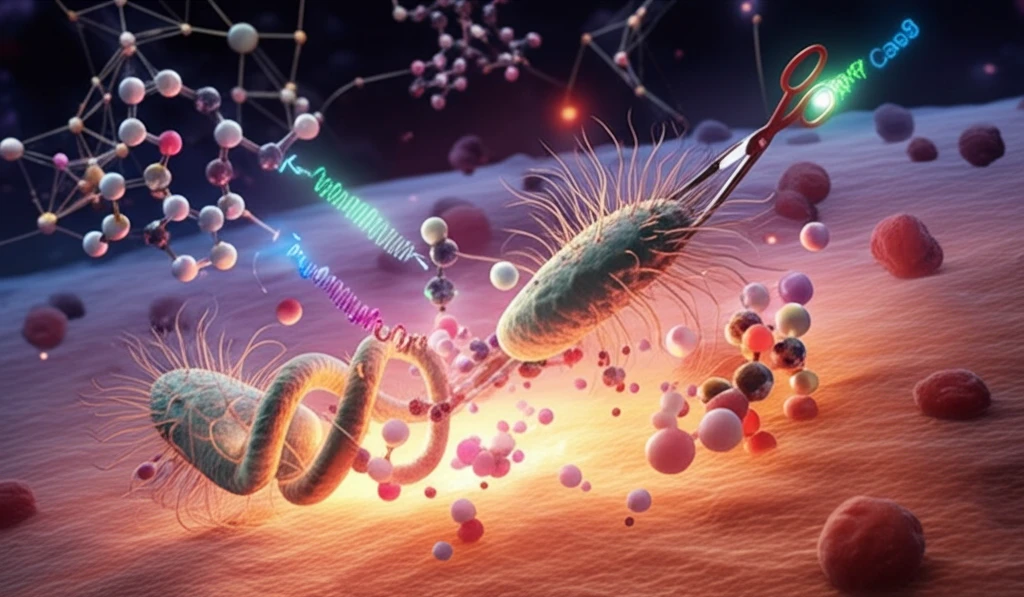
Unlocking Toxoplasma's Secrets: How New Glycomics Tools Could Revolutionize Parasite Research

"Scientists develop innovative CRISPR/Cas9 and glycomics techniques to investigate Toxoplasma gondii, paving the way for novel therapies and a deeper understanding of parasitic infections."
Toxoplasma gondii, a single-celled parasitic protozoan, infects a significant portion of the human population worldwide. While many infections are asymptomatic, Toxoplasma can cause severe health problems, including birth defects, blindness, and encephalitis, particularly in individuals with weakened immune systems. The parasite's ability to persist within its host and reactivate makes developing effective treatments and preventive strategies a major challenge.
Glycosylation, the process of adding sugar molecules (glycans) to proteins and lipids, plays a crucial role in various biological processes, including cell-cell interactions, immune responses, and pathogen virulence. Toxoplasma relies on glycosylation to assemble complex structures on its cell surface and internal components. These structures are essential for the parasite's survival and interaction with host cells. However, the unique characteristics of Toxoplasma glycans have hindered in-depth research into their functions and potential as therapeutic targets.
Now, a team of researchers has developed a suite of innovative tools combining CRISPR/Cas9 gene editing and glycomics analysis to dissect the complex world of Toxoplasma glycobiology. This breakthrough promises to accelerate our understanding of the parasite's glycosylation pathways and identify new vulnerabilities that can be exploited for drug development.
A Widely Prevalent Parasite
Toxoplasma gondii has infected more than 60% of the world's population, with prevalence ranging from 2% to 51% in Indonesia alone, and women of childbearing age (15-45 years) identified as one of the key risk groups for transmission. At least 350 host species of T. gondii have been described to date, and the parasite must invade the cells of warm-blooded hosts to survive and replicate. Infections by this protozoan parasite are widely prevalent worldwide in both animals and humans.
Glycans Resemble Other Eukaryotes but Resist Study
Toxoplasma glycosylates many cellular proteins and lipids, as do nearly all other eukaryotes, yet species-specific variations have prohibited deeper investigations into their roles in parasite biology and virulence. Unlike most eukaryotes, Toxoplasma propagates inside intracellular parasitophorous vacuoles, adding complexity to biochemical study. Standard glycomics approaches rely on mass spectrometry and analysis of glycosyltransferases and glycogenes, which are only now being paired with CRISPR/Cas9 gene editing to make these glycans tractable.
From Life-Cycle Studies to Gene Editing
Early work established the structure and life cycle of T. gondii across tachyzoites, bradyzoites, and oocysts, providing the foundation for understanding its persistence and replication. A more recent milestone was applying CRISPR/Cas9 to parasite glycobiology: a guide RNA directs the Cas9 protein to a particular DNA sequence, where it chops the strand so the cell repairs the damage, often causing the gene to malfunction. Combining CRISPR/Cas9 with glycomics tools opened new avenues for studying glycosyltransferases and protein glycosylation in this parasite.
CRISPR/Cas9 and Glycomics: A Powerful Combination
The Toxoplasma genome encodes a vast array of genes, called glycogenes, which are thought to assemble a variety of glycans, including N-glycans, O-glycans, and polysaccharides. To investigate the roles of specific glycans in Toxoplasma, the researchers combined genetic and glycomic techniques to map the connections between 67 glycogenes, their enzyme products, the glycans to which they contribute, and cellular functions. To analyze the structure, the team adopted mass spectrometry.
- Identified novel Glc0-2-Man6-GlcNAc2-type N-glycans.
- Discovered a novel HexNAc-GalNAc-mucin-type O-glycan and Tn-antigen.
- Identified the glycosyltransferases for assembling a novel nuclear O-Fuc-type and cell surface Glc-Fuc-type O-glycans.
- Demonstrated the importance of these glycans for in vitro growth.
CRISPR/Cas9 and Glycomics Converge on Toxoplasma
The paper 'CRISPR/Cas9 and glycomics tools for Toxoplasma glycobiology' demonstrates how CRISPR/Cas, glycomics, and mass spectrometry can be combined to probe glycosyltransferases, glycogenes, and protein glycosylation in the parasite. Recent reviews also examine how Toxoplasma exports proteins and effectors into host cells and how the molecular biology of chronic infection shapes immune control. Together these lines of work aim to connect glycan structure to parasite biology and virulence.
Species-Specific Variation and Intracellular Obstacles
A key limitation is that although Toxoplasma glycans resemble those of other eukaryotes, species-specific variations have prohibited deeper investigations into their roles in parasite biology and virulence. The parasite's unusual propagation inside intracellular parasitophorous vacuoles, unlike most eukaryotes, makes glycan analysis technically difficult. These obstacles help explain why glycan function has lagged behind other areas of toxoplasma research.
A Eukaryote Unlike Most
Unlike most eukaryotes, Toxoplasma propagates within intracellular parasitophorous vacuoles, yet, like nearly all other eukaryotes, it glycosylates many cellular proteins and lipids. The parasite is a single-celled eukaryotic organism with a considerable host range that must invade the cells of warm-blooded hosts to survive and replicate. Comparing its glycan machinery with that of better-studied eukaryotes highlights both shared pathways and the species-specific variations that complicate research.
Implications and Future Directions
These new tools and findings pave the way for a deeper understanding of Toxoplasma glycobiology and the development of novel therapeutic strategies to combat this widespread parasitic infection. By manipulating specific glycans, researchers may be able to disrupt the parasite's ability to invade host cells, evade the immune system, or establish chronic infections. The availability of these resources to the scientific community will undoubtedly accelerate progress in this field and ultimately lead to new and improved treatments for toxoplasmosis.
Connecting Glycans to Virulence
Experts note that Toxoplasma glycans resemble those of other eukaryotes, but species-specific variations have prevented deeper investigations into their roles in parasite biology and virulence. The integration of CRISPR/Cas9 with modern glycomics and mass spectrometry is positioned as the way forward for functional glycan studies. Such tools promise to clarify how glycosyltransferases and glycogenes contribute to the parasite's remarkable success.
Gene Editing Opens New Glycobiology Frontiers
CRISPR-Cas9 offers a mechanism in which a guide RNA directs the Cas9 protein to a particular DNA sequence, where it chops the strand and the cell repairs the damage, causing the gene to malfunction. Applying this approach to candidate glycosyltransferases and glycogenes should allow researchers to knock out specific glycan pathways and test their roles in infection. Future work will likely expand these tools to probe the biological roles of glycosylation in the parasite's life cycle and virulence.
A Global Parasite, a Hard-To-Study Glycome
With more than 60% of the world's population infected and at least 350 host species described, T. gondii persists within host cells for the life of the host. The intracellular lifestyle that makes the parasite so successful also poses systemic challenges, since propagation within parasitophorous vacuoles differs from most eukaryotes and complicates glycan analysis. Overcoming these challenges will require coordinated advances across gene editing, mass spectrometry, and parasite culture models.
Public Health Relevance of Toxoplasma Infection
Because Toxoplasma infections are widely prevalent in humans and animals worldwide, understanding parasite glycobiology carries real public health stakes. Women of childbearing age (15-45 years) are a recognized risk group for transmission, and prevalence in Indonesia alone ranges from 2% to 51%. Advances in glycomics and gene editing could ultimately inform strategies to disrupt the parasite's biology and reduce human disease burden.