
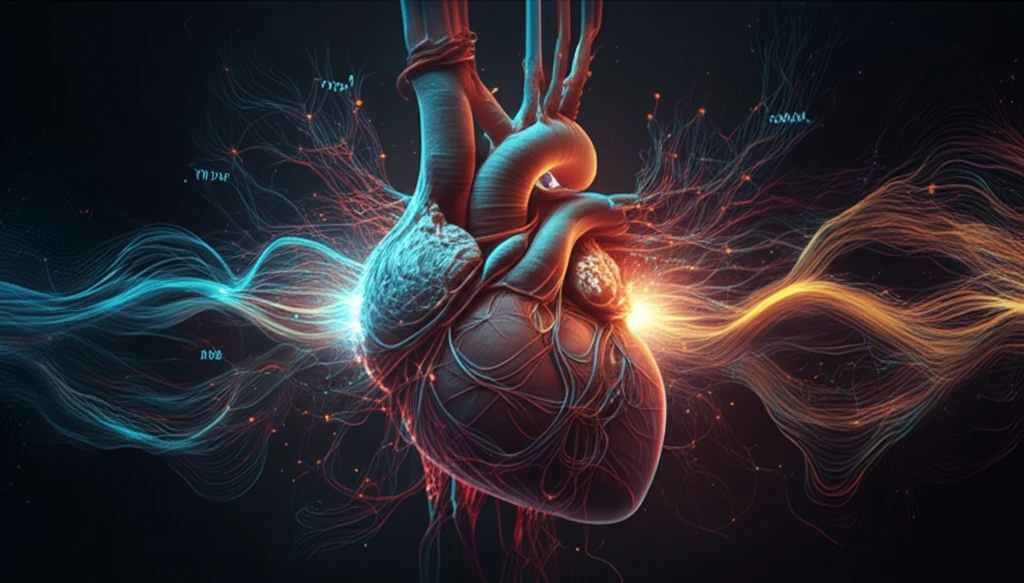
Unlocking the Secrets of Heart and Lung Development: How a Single Gene Holds the Key

"Scientists discover the pivotal role of the Tbx5 gene in coordinating the development of the heart and lungs, offering new insights into congenital diseases and evolutionary biology."
The transition from aquatic to terrestrial life marked a pivotal moment in vertebrate evolution, demanding significant adaptations in both the respiratory and cardiovascular systems. Lungs, the organs responsible for extracting oxygen from the air, and the heart, which pumps oxygenated blood throughout the body, had to evolve in a coordinated fashion to support this new lifestyle. This intricate co-development hinges on the seamless integration of cardiac and pulmonary structures, particularly the atrial septum, which separates oxygenated and deoxygenated blood within the heart.
For years, scientists have been working to understand how these vital systems develop in unison. One area of focus has been on the second heart field (SHF), also known as cardiopulmonary progenitors (CPPs). These cells are like master builders, giving rise to key structures in both the heart and lungs. Researchers have long suspected that transcription factors—proteins that control gene expression—within the SHF play a direct role in orchestrating this complex developmental process. The Tbx5 gene, crucial for cardiac septation, has always been in the spotlight, but the exact way it directs the morphogenesis has remained unclear.
Now, a groundbreaking study is challenging long-held assumptions about Tbx5, revealing that it doesn't directly drive heart development but acts as a key regulator in a sophisticated signaling network. This study uncovers the surprising role of Tbx5 in initiating lung development and coordinating the critical interplay between the developing heart and lungs.
Gas Exchange at the Core
The main function of the lung is to support gas exchange, and defects in lung development or diseases affecting the structure and function of the lung can have fatal consequences. Because even small disruptions in the genes that build the lung carry life-or-death stakes, understanding how this organ forms is a matter of urgent clinical importance.
Balancing Barrier and Surface Area
The objective of lung development is to generate an organ of gas exchange that provides both a thin gas diffusion barrier and a large gas diffusion surface area. Meeting both demands simultaneously places strict constraints on the developing tissue, and approaches that optimize one dimension often fail to capture the full complexity of the other.
Foxa2: The Gene That Holds the Breath of Life
A foundational milestone came with the discovery of the gene Foxa2, which controls other genes that allow the lungs of a foetus to grow and function properly. Researchers believe that understanding its function could lead to new treatments, not only for premature babies but also for others with lung problems.
TBX5: The Master Conductor of Cardiopulmonary Orchestration
The study reveals that Tbx5 doesn't directly control heart morphogenesis. Instead, it orchestrates the production of Wnt ligands, signaling molecules that kickstart a bidirectional communication loop. This loop involves the cardiopulmonary mesoderm, the tissue that gives rise to the heart and lungs, and the foregut endoderm, which eventually forms the lining of the respiratory and digestive tracts. This signaling cascade is vital for specifying the pulmonary lineage and ensuring the proper formation of the atrial septum.
- Tbx5 directly activates Wnt2 and Wnt2b expression in the cardiopulmonary mesoderm.
- This Wnt signaling is essential for initiating lung development in mammals and amphibians.
- Tbx5 is required for proper Shh signaling, which plays a vital role in cardiac morphogenesis.
- This intricate signaling loop is conserved across species, highlighting its evolutionary importance.
The Developmental Lung Cell Atlas
Researchers from the Wellcome Sanger Institute and collaborators have combined single-cell sequencing of early-stage cells with spatial technologies to generate an in-depth Developmental Lung Cell Atlas. This dataset has identified 144 distinct cell states, offering a new reference for how the lung is assembled cell by cell.
Interdependence Resists Simple Answers
During lung development, the mesenchyme and epithelium are dependent on each other for instructive morphogenic cues that direct proliferation, cellular differentiation and organogenesis. This mutual dependence means no gene or cell type acts in isolation, which complicates simple cause-and-effect models and helps explain why some proposed mechanisms fail to translate.
Heart and Limb: One Gene, Different Partners
Studies of TBX5, a T-box containing transcription factor in forelimb and heart development, show that the same gene engages different interactions in different tissues, as defined by the clinical features of Holt-Oram syndrome. Comparing heart and lung development likewise reveals how shared regulatory machinery can be repurposed to build very different organs.
Implications for Understanding Congenital Diseases and Evolution
These findings provide a new framework for understanding the co-evolution of pulmonary and cardiac structures that was required for terrestrial life. It also sheds light on the underlying mechanisms of congenital heart defects like Holt-Oram syndrome. The discovery that Tbx5 initiates a mesoderm-endoderm-mesoderm signaling loop offers potential new avenues for therapeutic interventions targeting these conditions. By understanding the intricate choreography of heart and lung development, we can pave the way for better diagnostics, treatments, and ultimately, prevention of congenital diseases.
One Gene, Many Doors
The gene Foxa2 controls others that allow the lungs of a foetus to grow and function properly, and researchers believe understanding its function could lead to new treatments not only for premature babies but also for others. Together, findings on Foxa2, TBX5 and the cellular atlas point to a small set of regulators coordinating the full architecture of the heart and lung.
Spatial Resolution Ahead
The combination of single-cell sequencing with spatial technologies offers a promising path forward by mapping where each of the 144 cell states sits within the developing organ. Future work will likely extend these maps to the level of 3D chromatin organization, where structure is known to influence cardiac development and promote heart failure.
Context Shapes Outcomes
Breakthroughs in developmental biology do not occur in a vacuum, as socioeconomic conditions shape health from the very beginning. Research has shown that poverty impedes cognitive function, and similar environmental and systemic forces can influence who receives timely care and who ultimately benefits from new treatments, from lung cancer screening to neonatal medicine.
Breath by Breath
The human stakes are visible in everyday care, from a nurse listening to a woman's heart with a stethoscope to the growing attention given to lung cancer in women. Behind each advance in understanding developmental genes lies the promise of better outcomes for premature babies whose lungs are not yet ready to function on their own.