
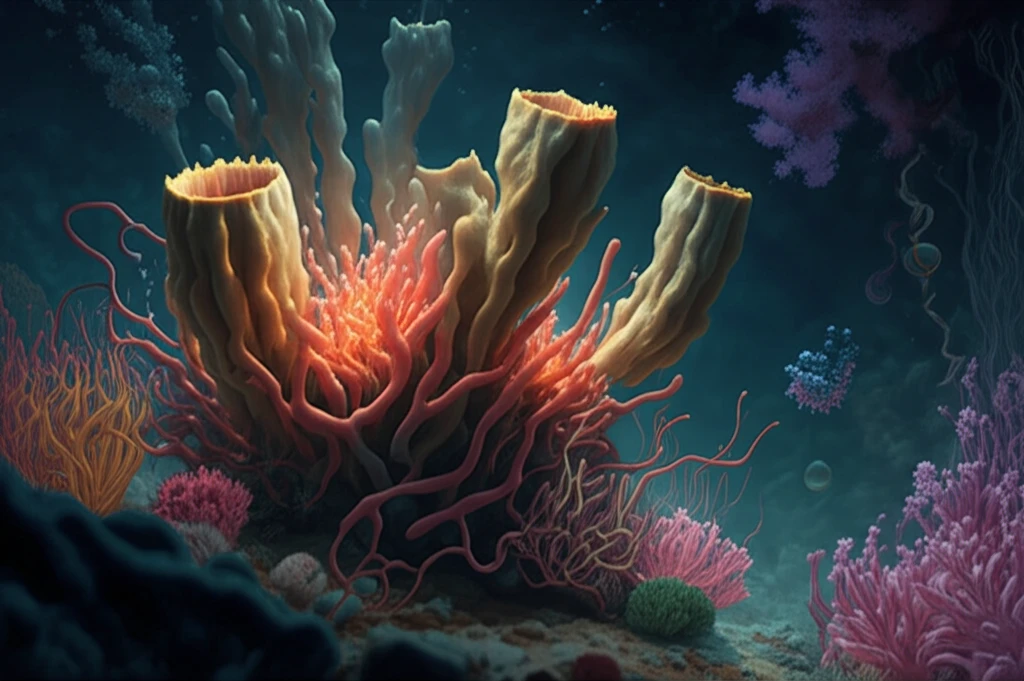
Unlocking the Ocean's Secrets: How Marine Sponges Could Revolutionize Medicine

"Dive into the fascinating world of marine sponges and their potential to unlock new treatments for cancer, infections, and more."
For centuries, the ocean has been a source of wonder and mystery. Beyond the breathtaking landscapes and diverse ecosystems, it holds secrets that could revolutionize medicine and improve human health. Among these secrets are marine sponges, simple yet extraordinary organisms that produce a remarkable array of chemical compounds.
These compounds, known as secondary metabolites, are not directly involved in the sponge's primary functions like growth and reproduction. Instead, they serve as defense mechanisms against predators, competitors, and pathogens. What's fascinating is that many of these compounds exhibit potent biological activities, making them promising candidates for drug development.
One particularly intriguing class of compounds found in marine sponges is cyclic guanidine alkaloids (CGAs). These complex molecules have attracted significant attention due to their unique chemical structures and broad range of bioactivities, including antitumoral and antimicrobial properties. Now, scientists are diving deep into understanding how these CGAs are created, opening doors to potentially life-saving medications.
Biodiversity and Ecological Weight of Marine Sponges
Marine sponges belong to the phylum Porifera — simple multicellular organisms defined by a porous body structure and the absence of true tissues and organs. Their distribution is uneven even along a single coastline: surveys of the Brazilian coast found the highest species counts in the Northeast and Southeast regions, with 343 and 229 species respectively. Ecologically, sponges punch well above their weight, serving as habitat providers whose bodies shelter crustaceans, worms, echinoderms, and many other small organisms. Their structural design also reaches beyond biology, with the diagonally-reinforced square lattice of the deep-water sponge Euplectella aspergillum inspiring new thinking in engineering and construction.
Culturing, Sampling, and the Obstacles Between
Producing sponge biomass for research relies on both in situ and lab-based aquaculture methods, which are also applied to sponge-related bioremediation of environmental contaminants such as heavy metals, pesticides, and microplastics. But cultivation itself faces obstacles: in dissociated cell cultures, sponge cells can be easily confused with unicellular organisms, a problem that has hindered the development of sponge-cell lines and led researchers to develop a molecular detection method for identifying cells of species like Dysidea avara. Even routine sample handling introduces error — preservation on ice can destabilize RNA and force immediate processing, whereas snap-freezing samples in liquid nitrogen eases those problems. Culture-dependent and culture-independent approaches have both shown that sponge-associated marine actinobacteria are an important source of bioactive compounds.
Ancient Animals, Deep Research Roots
Marine sponges are among the oldest known multicellular organisms, though sources differ on their age: some report a first appearance in the fossil record about 580 million years ago, while others place their origins at more than 600 million years. Wherever that first date falls, they are ancient denizens of reefs across the world's oceans and common Caribbean citizens, gracing the underwater world in a staggering array of colors and shapes. The scientific interest in them is equally longstanding — there is a long history of sponge aquaculture research, though for many decades these efforts were concentrated on bath-sponge production. That scholarly tradition is also reflected in classic taxonomic works such as the Natural History of the Marine Sponges of Southern New England, a detailed study that has been digitally reconstructed to preserve its original format.
Cracking the Code: Biosynthesis of Cyclic Guanidine Alkaloids
Sponges belonging to the Crambeidae family are particularly rich in CGAs, showcasing unique chemical architectures like bicyclic crambescins, tricyclic batzelladines, and pentacyclic crambescidins. These compounds have demonstrated promising antitumoral and antimicrobial activities, sparking interest in their potential therapeutic applications. Despite the growing interest, the metabolic pathways responsible for producing these complex molecules remained largely unknown – until now.
- The recurrent presence of a central and a-substituted guanidinopyrrolidine structure in CGAs.
- Inconsistencies in establishing the "Birch's C2 patterning" of a classical polyketide origin.
- The existence of simpler, closely related guanidine alkaloids in plants.
New Orders, Reviews, and Regenerative Biology
The field remains discovery-driven: researchers at the Museum of Evolution at Uppsala University have reported a completely new order of marine sponges. Reviewers surveying the current state of the science are weighing the pros and cons of today's sponge research and pointing toward ecobiotechnological approaches for the feasible ecological exploitation and biotechnological application of sponges. Basic biology is advancing as well, with new work on cellular dynamics and regenerative mechanisms in marine sponges, including research tracing the spatiotemporal evolution of Ediacaran–Cambrian (ca. 551–523 Ma) sponges in South China and their simulated contributions to marine oxygenation. These threads show taxonomy, biotechnology, and physiology moving forward in parallel.
Doubts About Fossils, Difficulties in the Field
Skepticism and practical hurdles temper the enthusiasm around sponges. One long-running debate questions whether supposed Precambrian sponge fossils are genuine: because sponges are regarded as the most basal and most primitive branch of multicellular animals, evolutionists would expect them to be the earliest animals in the fossil record — a claim critics label the myth of Precambrian sponges. Even on modern specimens, researchers face a more mundane obstacle: accurate identification is very difficult because form and color are variable within many species, so field identifications are often best guesses. Sponges' status as sessile filter feeders, which rely heavily on water movement to bring in a good supply of debris and marine snow, also shapes how and whether they can be studied and cultivated.
Sponges and Corals: Different Feeders, Different Reefs
In side-by-side comparison, corals and sponges differ sharply in how they feed. Corals can catch small fish and animals such as plankton using stinging cells on their tentacles, but they obtain most of their nutrients not from hunting but from photosynthetic unicellular algae called zooxanthellae. Sponges, by contrast, are sessile filter feeders that depend on water movement rather than predation. These physiological differences underpin the distinct ecological roles the two groups play on the reef.
A New Era of Marine-Inspired Medicine
These findings not only deepen our understanding of the complex metabolic pathways in marine organisms but also pave the way for new approaches to drug discovery. By unraveling the biosynthesis of CGAs, scientists can potentially develop methods for producing these valuable compounds in larger quantities and with greater efficiency. This could lead to the development of novel therapies for a wide range of diseases, from cancer to infectious diseases. The ocean's medicine cabinet is vast, and marine sponges are proving to be key to unlocking its potential.
Microbial Reservoirs and the Birth of Marine Drugs
A global study revealed the extraordinary microbial complexity inside sponges: genetic analysis detected some 40,000 microbes, including one single sponge species that contained 12,000 different microbes — far more than the roughly 15,000 microbial species found in the water surrounding the sponges. Even sponge behavior has surprised experts: sea sponges have been observed sneezing to clear their pores, ejecting particle-rich mucus into their surroundings, something Prof Sally Leys of the University of Alberta called never seen before. The medical payoff of such discoveries has deep roots — the story of marine drugs dates back to the late 1960s, when scientists accidentally discovered the anticancer compound Ara-C from a Caribbean sponge, sparking decades of marine drug discovery research.
Oxygen, Hypoxia, and Sponges in the Future Ocean
Sponges occupy a pivotal position in thinking about both the deep past and the near future of animal life. Researchers emphasize that the hypoxia tolerance of marine animals concerns both the deep history and the near future of animal life, and that sponges (phylum Porifera) are of particular importance to this topic for a number of reasons. This makes the phylum a natural focus for understanding how animal life weathered ancient low-oxygen episodes and how marine ecosystems may respond to oxygen stress in a changing ocean.
Heat-Wave Threats, Tropical-Disease Hopes
The same climate pressures that stress reefs also hit sponges hard. Marine heat waves are increasing as the climate warms, and a 2022 marine heat wave was linked to the mass bleaching of more than 50 million Cymbastella lamellata sponges in Fiordland, causing almost half of them to die. Even as warming imperils sponge populations, sponge research points toward new medical payoffs: researchers from the Tokyo University of Science and the University of the Ryukyus, led by Associate Professor Kanami, report that marine sponges could hold the answer to treating leishmaniasis, a neglected tropical disease. The pairing underscores a systemic challenge — protecting the very organisms that may supply tomorrow's medicines.
From Jetty Pylons to Cancer Screens and Skyscrapers
Sponge research touches people in concrete ways. A study based at Busselton Jetty will collect and analyze approximately 20 sponge species, building an extract library for in vitro anticancer screening of the sponges attached to the jetty pylons. Elsewhere, more than two decades of studying structure-function relationships in sponge skeletal systems have led researchers such as Weaver to replicate the sponge's skeletal architecture in simulations and experiments — designs intended to inform the next generation of skyscrapers and bridges. Both threads show a single organism inspiring both medicine cabinets and engineering blueprints.