
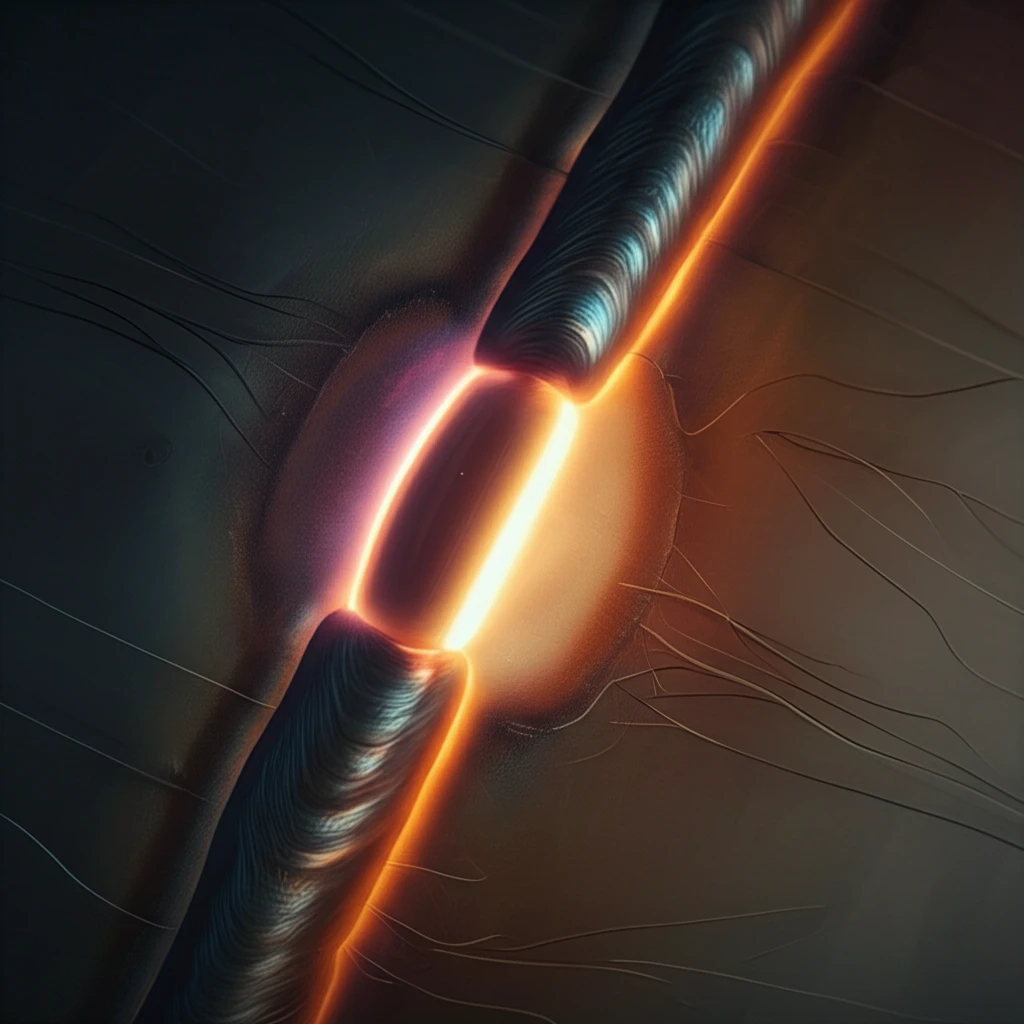
Unlocking Steel's Secrets: How Welding Affects Strength and Durability

"A deep dive into the impact of welding on S355 steel, revealing essential insights for construction and engineering professionals looking to optimize structural integrity."
Welding, a cornerstone of modern construction and manufacturing, is a process that inherently introduces changes to the materials being joined. For structural steel, like the commonly used S355 grade, these changes can significantly impact its strength and durability. Understanding the influence of welding on steel's mechanical properties is crucial for engineers and builders to ensure the safety and longevity of welded structures.
The creation of a welded joint involves localized heating, which inevitably leads to residual stresses within the material. These stresses can reach levels close to or even exceeding the yield strength of the steel. Exceeding this yield point can alter the fundamental strength parameters of the joined materials, potentially compromising the structural integrity if not properly understood and managed.
While standardized material data is readily available, it often doesn't account for the changes induced by the welding process. This discrepancy can lead to inaccuracies in structural calculations, potentially resulting in either over- or under-designed structures. The presence of welds also introduces notches and potential initiation points for fatigue cracks, making it essential to consider these factors in the design and assessment of welded structures.
The Welding Industry by the Numbers
Austenitic 300-series grades such as 304 and 316 stainless steel can be welded to each other using standard processes, which simplifies fabrication across many industries. Yet the craft carries measurable occupational risk: welders had a nonfatal injury rate of 4.8 per 100 full-time workers in the U.S. in 2022, and eye injuries account for 25% of welding accidents, often from UV exposure, according to OSHA 2023 data. Automation is already reshaping the field, with robotic welding adopted in 35% of U.S. factories by 2023 to reduce manual errors. Industry market reports aggregate statistics from peer-reviewed studies, official statistics, industry databases, and recognized institutions. Standards such as AS 1163 further set specifications for cold-formed structural steel pipe, helping ensure weldable structural materials meet consistent quality requirements.
Proven Methods and Their Known Limits
S355 steel has the right amount of carbon to allow standard welding methods while keeping its mechanical qualities for structural uses. The grade designation encodes its performance expectations: S355 denotes a yield strength of 355 MPa, J2 indicates that impact toughness at -20°C meets the requirements, and H means hollow steel. Even so, weld quality is not automatic—welding slag, a common byproduct, must be controlled, removed, and prevented to avoid defects. Advanced processes test these limits, as research on 2 mm thick Strenx 700 cold-rolled steel sheets shows how laser welding affects microstructure, mechanical properties, and fatigue behavior.
From Forge to Fusion
Steel, an alloy of iron and carbon, demonstrates improved mechanical properties compared with pure iron, and its combination of elastic modulus, yield strength, and low raw material cost made it one of the most commonly manufactured materials in the world. The oldest joining approach, forge welding, fuses two separate pieces of metal using only heat and pressure, with no filler. Ancient civilizations such as the Egyptians and Greeks worked metal with the discovery of copper, bronze, silver, gold, and iron, before metalworking progressed to include steel. Modern arc welding emerged much later, starting in the late 19th century. Welding eventually extended into demanding environments, as shown by research on friction taper plug welding of S355 steel in underwater wet conditions.
The Science Behind Welding's Impact
A recent study investigated the effects of welding on the mechanical properties of S355 steel, focusing on how the thermal cycle of the welding process alters its strength parameters. Researchers created samples from standard welded nodes of a railway wagon bogie, a structure subjected to significant stress and wear. These samples were then meticulously analyzed to determine the changes in their mechanical properties resulting from the welding process.
Advances at the Cutting Edge
Recent experiments on structural steel S355 used a 10 kW IPG fiber laser to weld specimens at different welding speeds, focal point positions, laser powers, and heat inputs, mapping the weldability window for the material. In stainless steel welding research, a notable line of inquiry presents the thermal resistance of a ceramic backing made from metakaolin-based geopolymer. On the equipment side, hands-on reviews of capacitor welders such as the AWithZ UF20B report consistently good welds, including success repairing thin stainless steel right out of the box.
When Welds Fail and How to Catch It
Welding reliability is not guaranteed, which is why inspection before, during, and after welding is critical—even pre-weld checklists help confirm that conditions are right before work begins. The designation system itself underscores the need for verification: in S355JR, S stands for structural steel and 355 for the minimum yield strength in MPa, and the grade is widely considered the European equivalent of St 52. Material selection also carries critical limitations, as a filter plate material guide notes when matching a material's properties to its intended service conditions. Identifying and controlling such limitations is what separates durable joints from premature failures.
Choosing the Right Process and Material
In the thick-plate sector, submerged arc welding (SAW) is the most common process, especially in the manufacture of steel towers for wind turbines, while laser hybrid welding offers process advantages over conventional arc-based methods. Process choice also has mechanical consequences: residual stresses in multi-pass welded S355 and S690 H-sections were significantly reduced compared with single-pass welds of similar dimensions. Material grade matters as well—S355M high-strength low-alloy (HSLA) plate offers higher yield strength and better corrosion resistance than traditional carbon steel while maintaining good weldability and formability. Even at the consumer level, welders weigh features against cost when comparing stick welders such as the Titanium 225 and Everlast 210.
Implications for Engineering and Construction
This research underscores the importance of considering the effects of welding on the mechanical properties of S355 steel in structural design and construction. Engineers must account for the changes induced by the welding process to ensure the safety, reliability, and longevity of welded structures. Factors such as welding parameters, heat input, and joint design should be carefully optimized to minimize detrimental effects and maximize structural performance. Further research into mitigating the adverse effects of welding on steel properties is essential for advancing welding technology and improving structural integrity.
What the Evidence Adds Up To
Taken together, the evidence shows that S355-family structural steels perform reliably across demanding conditions. S355 steel pipe maintains its structural integrity and mechanical properties even in sub-zero conditions, retaining its yield strength and tensile strength for applications in cold environments. Grade designations such as S355J2 (1.0577) encode much of that expected behavior, with comprehensive references covering its marking, chemical composition, mechanical properties, and applications.
Automation, Intelligence, and the Next Generation
Market outlooks for hot rolled S-355 steel point to sustained demand, since the grade is preferred for structural applications requiring durable and reliable materials thanks to its high strength and excellent weldability. On the technology side, non-contact laser welding of stainless steel is trending toward intelligent control systems that use sensors and artificial intelligence for adaptive welding. The workforce must evolve alongside the equipment: the future of welding engineering beyond 2030 is defined by intelligence, sustainability, and collaboration, with frameworks like the Engineers 2030 vision calling for an education system that blends technical mastery with digital and ethical awareness.
A Global Industry, a Shared Standard
Suppliers of EN 10025-2 S355J2 plates in markets such as India demonstrate how standardized specifications enable high-strength steel with excellent mechanical properties, durability, and weldability across global supply chains. On the equipment side, manufacturers such as Kepuni provide pipe welding machines, and in the field of stainless steel welding, fully automatic orbital welding systems are increasingly central to precision work, as showcased at events like the Vietnam International Metal Weld 2024.
Steel That Works in the Real World
In real-world service, decisions made at the weld joint determine long-term performance. After 10 years in coastal, high-salt environments, weathering steel developed only a 50–80 μm compact rust layer with structural strength fully retained. Research on Strenx 700MC steel shows that evaluating real weld joints can identify the heat-affected zone sublayer critical to the steel's initial strength, with the amount of impact energy visibly influencing both parent material and weld properties. Across construction, infrastructure, and heavy machinery, S-355 structural steel remains a preferred choice precisely because of its excellent weldability, formability, and mechanical properties.