
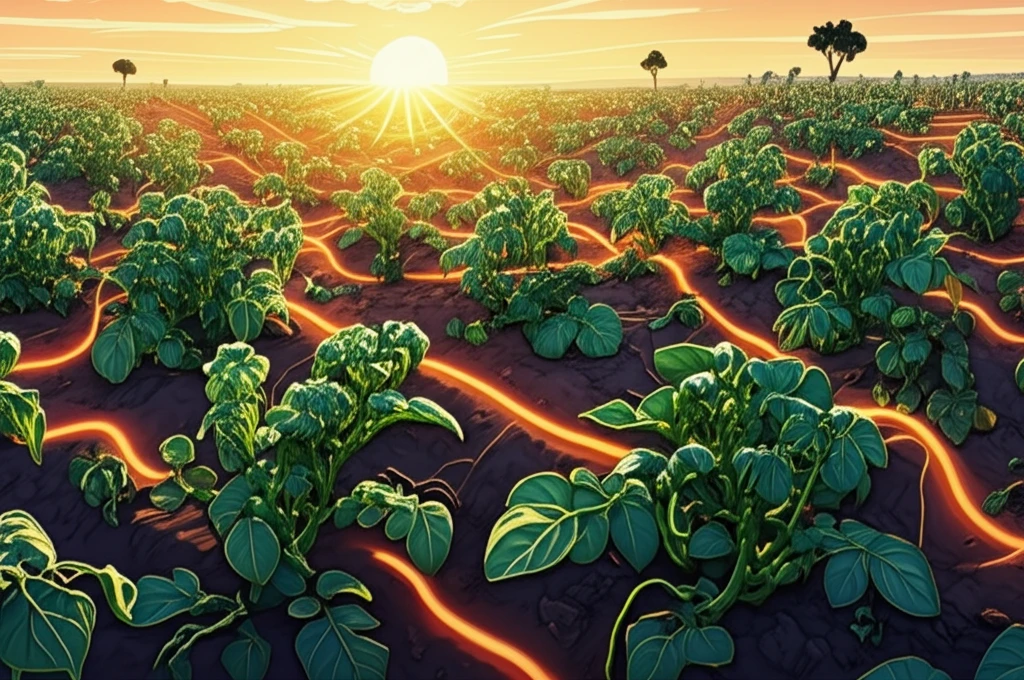
Unlocking Potato Potential: Simple Traits for Heat-Resistant Harvests

"Discover how identifying key traits in potato plants can help you grow thriving, heat-resistant crops and secure your harvest"
Potatoes are a nutritional powerhouse, essential for combating hunger and malnutrition worldwide. With a high harvesting index, they promise substantial yields. However, climate change and expanding cultivation into warmer regions pose significant challenges, making heat-tolerant potato varieties a top breeding priority.
While global potato production has increased, yield rates in developing countries remain stagnant due to environmental stresses like heat, drought, and salinity. Potatoes thrive in cool conditions, ideally between 17 and 21°C. Temperatures above this range can disrupt crucial physiological processes, impacting yield and quality.
Global warming scenarios predict reduced potato yields in key production areas. Developing heat-tolerant varieties is vital for maintaining production levels. In Mediterranean climates, breeding for heat resistance is essential for consistent yields amidst rising temperatures.
Heat Stress: A Growing Threat to Potato Production
Heat tolerance in potatoes is a polygenic trait, meaning cultivars exhibit a wide range of variations in their response to heat stress. Most existing research has focused on limited germplasm data, leaving much of the genetic diversity unexplored. Researchers such as Li at Agriculture and Agri-Food Canada are working to understand and improve heat tolerance, with varietal data intended to help breeders incorporate heat-tolerant parents into their programs. Twenty heat-tolerant potato lines were evaluated during the 2021-2022 winter season in Bangladesh to identify superior lines for variety development under heat conditions.
Breeding Challenges and Selection Constraints
Currently, only a limited number of heat-tolerant potato cultivars are recognised, primarily bred for very specific conditions. This limitation has intensified conventional breeding efforts to find new, tolerant genotypes. In order to develop heat-tolerant potatoes, researchers have found it necessary to select under heat-stress conditions and consider traits affected by heat stress. A key limitation is the difficulty of achieving normal or ideal potato growing conditions (25/15°C) under greenhouse settings, complicating controlled studies.
From Early Genomics to Modern Breeding
Analysis of potato genotypes with contrasting heat tolerance has revealed that genes associated with photosynthesis, hormonal activity, sugar transportation, and transcription factors are expressed differentially under heat stress. While some potatoes are quite tolerant of drought stress, they all have significant problems with heat and flooding. The historical vulnerability of potatoes to environmental stress is underscored by the Irish potato blight of the 1840s, which caused catastrophic crop failure and famine.
Key Traits for Heat Tolerance in Potatoes
Identifying traits related to heat tolerance is crucial for selecting resilient potato genotypes. A recent study evaluated the responses of 17 potato genotypes to high-temperature stress, aiming to pinpoint candidate traits associated with heat tolerance. This research focused on readily measurable characteristics that could help breeders efficiently screen for heat resistance.
- Haulm Dry Weight (HDW): Measures the dry weight of the potato plant's above-ground parts, indicating overall plant vigor.
- Leaf Area Index (LAI): Represents the total leaf area per unit of ground area, reflecting the plant's ability to capture sunlight.
- Photosynthetic Rate (Pn): Indicates the rate at which the plant converts light energy into chemical energy.
- Canopy Temperature (CT): Measures the temperature of the plant canopy, which can indicate its ability to regulate heat.
Transcriptomics and Decades of Field Selection
AAFC researchers, working with Dr. Li, have investigated the transcriptomic responses of heat-stressed potatoes, examining genes and gene interaction networks that underpin heat tolerance. This work builds on an award-winning study that deepened understanding of the molecular mechanisms at play. Separately, the Texas A&M Potato Breeding Program has selected potatoes under high-temperature stress for several decades, representing one of the longest-running efforts to develop heat-tolerant varieties through sustained field-based selection.
Adoption Gaps and Competing Priorities
The Texas A&M Potato Breeding Program has been selecting potatoes under high-temperature stress for several decades, yet the pipeline from research to widely adopted heat-tolerant varieties remains slow. Meanwhile, drought-tolerant potato varieties have shown promise in other contexts, reportedly boosting yields by 20-30% for smallholder farmers in Sub-Saharan Africa and Asia. These drought-tolerant lines also help combat nutritional deficiencies, particularly with iron-rich varieties that enhance dietary nutrition, suggesting that the broader field of stress-tolerant breeding is advancing on multiple fronts even as heat-specific progress lags.
Heat-Tolerant Varieties Across Climates and Systems
Developing heat-tolerant potatoes requires selection under heat-stress conditions and consideration of affected traits, an approach the Texas A&M Potato Breeding Program has pursued for decades. In tropical climates such as Hawaii, heat-tolerant varieties including Red LaSoda have been identified as performing best in warm, humid conditions, with planting typically done from seed cuttings rather than seeds. The comparison between controlled breeding program selection and on-the-ground tropical cultivation highlights the diversity of approaches to managing heat stress in potato production.
Actionable Steps for Potato Growers
The research offers practical insights for potato growers and breeders. By focusing on easily measurable traits like haulm dry weight, leaf area index, and photosynthetic rate under normal conditions, it's possible to identify and cultivate potato varieties that can withstand heat stress. Incorporating these findings into breeding programs will accelerate the development of resilient potato crops, ensuring food security in a warming world. This approach not only addresses the challenges posed by climate change but also enhances the sustainability of potato production in diverse environments.
Farmer Perspectives and Variety Development
Research on the perception of Gujarat farmers regarding heat-tolerant potato varieties highlights the importance of varietal attributes in driving adoption. Some varieties were abandoned by farmers, suggesting that heat tolerance alone is insufficient without meeting broader performance expectations. Developing heat-tolerant potato varieties with desirable characters for future varieties will not only enhance production but may also extend cultivation to non-traditional potato-growing areas.
Genome Mapping and Gene Editing
The 2011 potato genome sequencing revealed a tetraploid structure with over 39,000 genes, transforming breeding by providing a genetic blueprint for future development. Field trials by University of Essex researchers in the US state of Illinois found that an adapted plant grew up to 30% more potatoes under heat stress, demonstrating the tangible potential of genome-informed breeding. These advances position genome mapping and gene editing as key tools for accelerating the development of heat-resistant potato varieties.
Heat Stress as a Global Food Security Threat
As climate change intensifies, heat stress poses a significant threat to global crop yields, making heat-tolerant potatoes a critical component of climate-resilient agriculture. The development and deployment of heat-resilient potato varieties is increasingly seen as essential for transforming agricultural systems to withstand rising temperatures. Addressing this challenge requires sustained research investment and coordinated efforts across breeding programs worldwide.
From Lab to Field: Delivering Resilient Potatoes
AAFC research into heat-tolerant potato genes builds on an award-winning study, with researchers actively working to translate genomic insights into practical breeding outcomes. As heat stress emerges as a critical challenge to global food security, the real-world impact of this research depends on its successful integration into farming systems. Continued engagement between researchers, breeders, and growers will be essential to ensure that heat-tolerant varieties reach the farmers who need them most.