
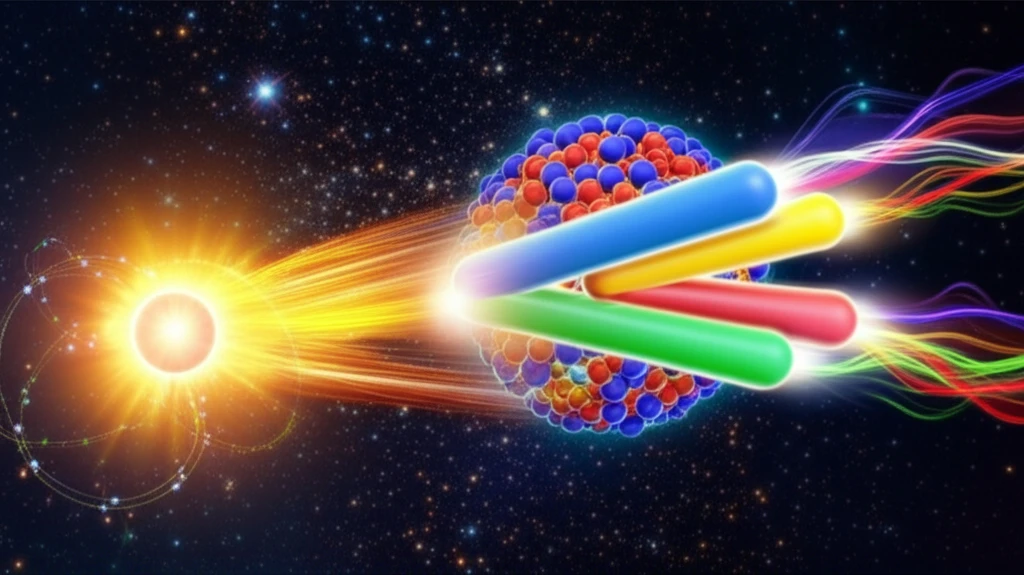
Unlocking Nuclear Secrets: How (p,d) Reactions Could Revolutionize Nuclear Physics

"New research explores using (p,d) reactions to refine our understanding of neutron capture, potentially impacting astrophysics and nuclear technology."
Neutron-capture reactions, where a neutron is absorbed by an atomic nucleus, are fundamental processes in the cosmos. They play a crucial role in the creation of heavy elements in stars and are also important in nuclear technology. However, studying these reactions, particularly with unstable isotopes (atoms with an imbalance of neutrons and protons), presents significant challenges.
Directly measuring neutron capture on unstable isotopes is often impossible due to their short lifespans and the difficulty in producing them in sufficient quantities. As a result, scientists rely on theoretical calculations to predict the likelihood of these reactions. But these calculations are only as good as the information that goes into them, and uncertainties in nuclear properties can lead to significant errors in the predictions.
To overcome these limitations, researchers are developing indirect methods to constrain these calculations. One promising technique involves studying (p,d) reactions – nuclear reactions where a proton collides with a nucleus, resulting in a deuteron (a nucleus consisting of one proton and one neutron) being emitted. By carefully analyzing these reactions, scientists hope to gain insights into the properties of the compound nucleus formed, and ultimately, to refine our understanding of neutron capture.
Surrogate Reactions and Nuclear Data
The EPJ Conferences source identifies the low-energy (d,p*γ*) reaction as a promising surrogate for the (n,*γ*) reaction. It reports that both reactions share many characteristics. This positions the reaction as a possible tool for studying neutron-capture-related processes.
No Nuclear History in the Listed Sources
The listed sources for this subsection are Microsoft webpages rather than nuclear-physics references. Microsoft describes its mission as helping people and businesses realize their full potential. Its webpages also present products and services including Microsoft 365, Copilot, Teams, Xbox, Windows, Azure, Surface, Outlook, Word, Excel, and PowerPoint, but they do not document milestones or foundational discoveries in nuclear physics.
Deciphering Nuclear Reactions: The Power of (p,d) Reactions
The heart of this research lies in the statistical Hauser-Feshbach formalism, a theoretical framework used to describe nuclear reactions. This formalism accounts for the conservation of fundamental quantities like angular momentum and parity (a property related to the symmetry of a nucleus). In essence, it allows scientists to break down a complex nuclear reaction into a series of simpler steps, each with its own probability.
- Creating the Compound Nucleus: A proton (p) interacts with a target nucleus, resulting in the formation of a compound nucleus – the same nucleus that would be formed in a neutron capture reaction.
- Analyzing the Decay: The compound nucleus then decays, emitting particles such as neutrons or photons (gamma rays). By measuring the properties of these emitted particles, scientists can gather information about the structure and properties of the compound nucleus.
- Constraining the Calculations: The data obtained from the (p,d) reaction is then used to refine the parameters in the Hauser-Feshbach calculations, reducing the uncertainties in the predicted neutron capture cross sections.
Testing the 89Y(p,d)88Y Method
The EPJ Conferences source describes a first step toward demonstrating a method based on the one-nucleon pickup reaction 89Y(p,d)88Y*. The work outlines theory developments intended to properly describe production of the compound nucleus 88Y*. It tests that description against data from a recent experiment.
Limits in Capture Applications
The listed nuclear-reaction sources state that cross sections for compound-nuclear reactions involving unstable targets are important for many applications but can often not be measured directly. One source reports that current implementations provide useful cross sections for (n,f) reactions. The same source says those implementations need improvement before they can be reliably applied to capture reactions.
Sources Unrelated to Nuclear Physics
The listed sources for this subsection concern Wiz Khalifa's song or freestyle titled “Hella O's.” They include YouTube listings, Genius lyrics, and a SoundCloud stream. These sources provide no information that supports a comparative analysis of (p,d) reactions or nuclear physics.
The Future of Nuclear Physics: More Precise Models and Exotic Isotopes
By combining experimental data from (p,d) reactions with advanced theoretical models, scientists are paving the way for a more complete and accurate understanding of nuclear processes. This knowledge will not only help us unravel the mysteries of the universe but also has practical applications in nuclear technology, medicine, and energy.
Microsoft Forms and Digital Tools
The listed sources describe Microsoft Forms as a tool for creating surveys, quizzes, and polls. They state that users can view responses as they arrive, use built-in analytics, and export form data to Excel. The sources do not provide expert commentary or synthesis about (p,d) reactions or nuclear physics.
Technology and Banking Sources
The listed sources concern First Tech Federal Credit Union and its banking services. One source describes it as serving employees and family members of leading technology companies. These sources do not report future directions or next frontiers for (p,d) reactions or nuclear physics.
Public Profiles Rather Than Nuclear Context
The listed sources are public profiles for Kim Kardashian on Instagram, TikTok, and Forbes. The Instagram snippet reports 344 million followers, 233 following, and 6,695 posts. The Forbes snippet identifies her as number 25 on its 2026 America's Richest Self-Made Women list, but these sources do not address systemic challenges in nuclear physics.
Microsoft Community Information
The listed source is a Microsoft Community Hub page for the Windows Insider Program. Its snippet references Microsoft Store accounts, support, education, devices, Teams for Education, and related services. It does not provide evidence about the human element or real-world impact of (p,d) reactions.