
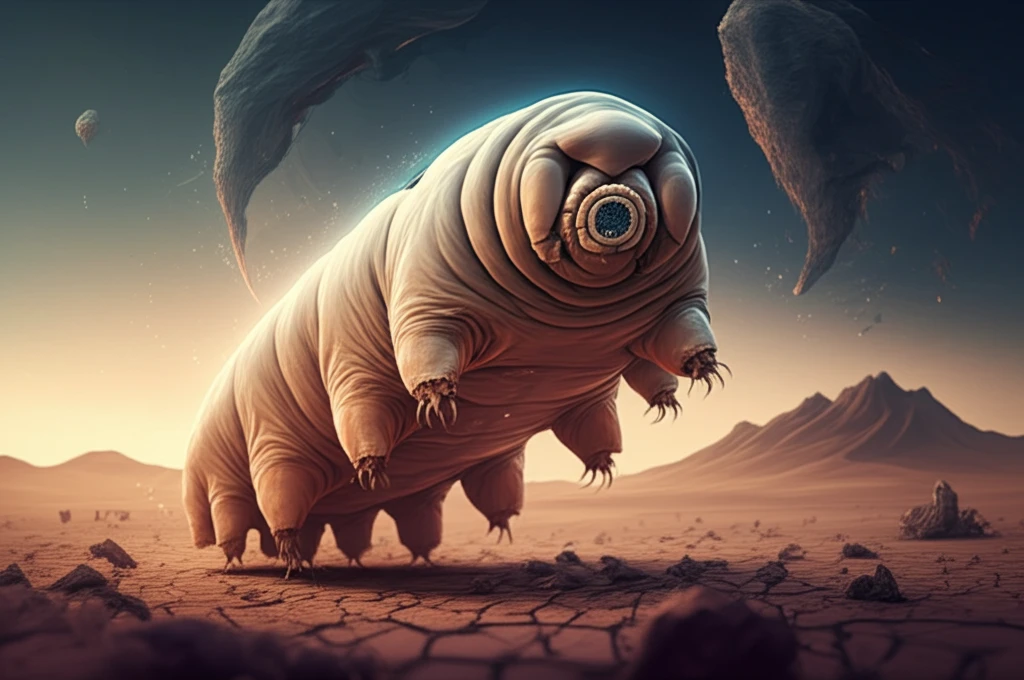
Unlocking Nature's Secrets: How Tiny Creatures Survive the Impossible and What We Can Learn

"Delving into the extreme survival strategies of microscopic organisms for breakthroughs in biomedicine and sustainable technologies."
Life finds a way, even in the most inhospitable conditions. From the vast vacuum of space to the arid landscapes of Africa, nature is full of organisms that have evolved extraordinary survival mechanisms. Among these resilient creatures are tardigrades, also known as water bears, and the larvae of the African midge, Polypedilum vanderplanki. These tiny organisms possess remarkable abilities to withstand complete desiccation, a state known as anhydrobiosis, offering invaluable insights for various applications.
Imagine an animal that can lose almost all of its body water, withstand extreme temperatures, and even survive radiation exposure. That's the reality for tardigrades, microscopic invertebrates found in diverse environments worldwide. Similarly, the larvae of Polypedilum vanderplanki can endure complete drying out, entering a dormant state until water returns. Understanding how these organisms achieve such feats could revolutionize how we preserve biological materials and engineer resilient technologies.
This article explores the fascinating world of anhydrobiosis, focusing on the survival strategies of tardigrades and Polypedilum vanderplanki larvae. By examining the molecular mechanisms that underpin their resilience, we can unlock nature's secrets and pave the way for innovations in biomedicine, materials science, and beyond. Join us as we delve into the science behind extreme survival and discover the potential of these remarkable organisms.
Tardigrades: Earth's Toughest Survivors
Tardigrades are considered among the toughest animals on Earth due to their ability to survive dehydration in anhydrobiosis at any life stage. However, the factors that influence successful recovery from this state are not well understood. Research shows that survival capacity varies significantly across different tardigrade species and even within populations. Geographic variation and energetic condition appear to influence survival rates during anhydrobiosis.
Quantifying Anhydrobiosis Tolerance
A novel approach to quantify desiccation tolerance reveals that ancestral history (phylogeny), rather than current habitat, explains most variation in anhydrobiotic performance across tardigrades. Despite the ecological and biotechnological importance of anhydrobiosis, little is known about its inter- and intra-specific variability. Current methods may not adequately account for phylogenetic constraints when assessing desiccation tolerance across species.
Early Discoveries in Desiccation Tolerance
The study of anhydrobiosis in tardigrades has evolved significantly since initial observations of these microscopic creatures surviving extreme conditions. Early research established tardigrades as models for understanding cryptobiosis, with foundational discoveries about their ability to enter suspended animation. These initial findings paved the way for modern investigations into the molecular mechanisms underlying their remarkable survival capabilities.
How Tardigrades and Midge Larvae Defy Desiccation: The Science of Anhydrobiosis
Anhydrobiosis, meaning 'life without water,' is a survival strategy employed by various organisms to withstand prolonged periods of drought. During anhydrobiosis, organisms enter a dormant state characterized by a drastic reduction in metabolic activity. This allows them to survive until water becomes available again. Tardigrades and Polypedilum vanderplanki larvae are prime examples of creatures that have mastered this art.
- Trehalose Production: Tardigrades accumulate high concentrations of trehalose, a sugar that helps stabilize cell membranes and proteins during dehydration.
- Intrinsically Disordered Proteins (IDPs): Tardigrades possess unique IDPs that protect cellular structures and maintain enzyme function during desiccation. These proteins form gels that vitrify into a glass-like solid, providing mechanical support and preventing damage.
- Reduced Metabolism: During anhydrobiosis, tardigrades drastically reduce their metabolic rate, minimizing energy expenditure and cellular damage.
Advances in Anhydrobiosis Research
Recent research continues to expand our understanding of tardigrade anhydrobiosis through integrated studies of morphology, biochemistry, and physiology. Modern approaches now examine whole genomes, transcriptomes, and proteomes to understand the complete biological picture. These comprehensive analyses reveal the complexity of desiccation tolerance mechanisms across different tardigrade species.
Recovery Challenges Despite Tough Reputation
Despite being considered the toughest animals, tardigrades show significant variation in recovery success from anhydrobiosis. Studies reveal that sex, age, presence of other individuals, and culture conditions all influence recovery outcomes. The assumption that tardigrades universally survive dehydration is challenged by evidence that many factors affect successful recovery.
Genomic Insights into Anhydrobiosis Mechanisms
Comparative genomics of different tardigrade species reveals that they employ distinct molecular mechanisms to enter anhydrobiosis. Two species studied show different approaches to achieving desiccation tolerance despite similar environmental challenges. These findings suggest that evolution has produced multiple solutions to the problem of surviving extreme dehydration.
The Future of Anhydrobiosis Research: Applications and Implications
Understanding the mechanisms that underpin anhydrobiosis in tardigrades and Polypedilum vanderplanki larvae holds immense potential for various applications. By harnessing the protective properties of trehalose, IDPs, and LEA proteins, we can develop novel strategies for preserving biological materials, engineering stress-tolerant crops, and creating innovative biomedical technologies. Imagine preserving organs for transplantation without the need for cryopreservation or developing crops that can withstand extreme drought conditions. The possibilities are vast and exciting.
Long-Term Survival Evidence
Long-term experiments demonstrate that tardigrades can survive extended periods of anhydrobiosis under semi-natural conditions. In one study, tardigrades were desiccated in lichen samples and stored in ambient laboratory conditions with successful recovery. These findings confirm that anhydrobiosis represents a viable long-term survival strategy rather than just a short-term stress response.
Microbiome Connections in Anhydrobiosis
Emerging research reveals that microbiome dynamics are closely associated with anhydrobiosis in tardigrades. This represents the first evidence linking host-microbe interactions to desiccation tolerance. Future studies will likely explore how these microbial communities contribute to survival under extreme environmental conditions.
Universal Principles of Extreme Survival
The study of tardigrade anhydrobiosis contributes to broader understanding of how life persists under extreme conditions. These microscopic organisms offer insights into fundamental biological principles of stress tolerance and cellular protection. Their survival mechanisms may inform applications in biotechnology, medicine, and astrobiology regarding life's limits.
Inspiration for Human Innovation
Tardigrades inspire technological innovation by demonstrating nature's solutions to extreme survival challenges. Their ability to suspend life processes provides models for preserving biological materials without refrigeration. Understanding these mechanisms could lead to advances in vaccine preservation, organ storage, and space exploration technologies.