
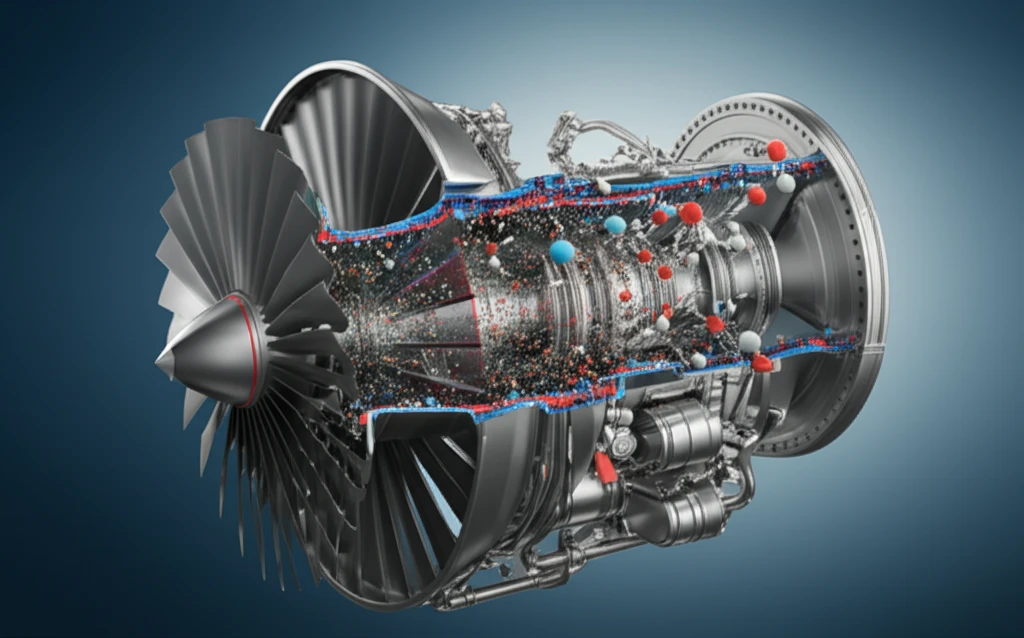
Unlocking Microscale Aerodynamics: How Perforated Plates are Revolutionizing Engineering

"Dive into the groundbreaking research exploring the impact of microscale effects on perforated plate aerodynamics and how it's transforming industries."
Perforated plates, seemingly simple structures riddled with holes, have been studied for decades, and their applications span a remarkable range of fields. From the mundane—like sound absorption panels—to the highly specialized—such as microfilters and heat exchangers—these plates play a crucial role. Recent research has focused on leveraging these plates to produce uniform turbulent flow and innovating gas turbine blade cooling techniques, heralding a new era of efficiency and performance.
One particularly promising avenue involves microchannel cooling for gas turbine blades. This approach spreads cooling networks into a series of smaller, highly distributed channels, which leads to a more uniform cooling process. By bringing the cooling fluid closer to the blade's surface, heat transfer becomes significantly more efficient. This method addresses a critical issue in gas turbine design: the traditional film cooling process, which often uses excessive amounts of cooling air, negatively affecting the engine's overall performance.
Recent studies have examined the microscale effects of using perforated plates. These experiments, conducted with air flowing through plates with perforations as small as 110 μm in diameter, reveal insights into the behavior of gases at this scale, opening the door to optimizing various engineering applications.
Drag Dominates High-Speed Energy Demand
On the Audi A2 e-tron, aerodynamic measures reduce WLTP energy consumption by up to 0.9 kWh/100 km, demonstrating the measurable impact of airflow engineering on real-world vehicles. At speeds of around 100 km/h and above, drag accounts for more than 50 percent of a vehicle's total energy demand, making aerodynamics the decisive factor in efficiency.
From Perforation to Performance
A perforated plate, also referred to in practice as a perforated sheet or perforated plate, is defined by the presence of regular perforations across its surface. These plates are standard components in equipment such as column stills, where their design and hole pattern directly influence performance, and their behavior is governed by aerodynamics, the study of how air moves around objects and how that movement impacts performance.
Aerodynamics Moves to the Microscale
Aerodynamics is classically defined as the study of forces and the resulting motion of objects through the air, a field long centered on full-scale vehicles and aircraft. A 2001 Robo-Fly project at MIT marked a turning point, with Albert Pisano of Berkeley's Electronics Research Lab noting that the work was paving the way for increased understanding of microscale aerodynamics, microscale mechanical systems, and microscale fabrication methods.
The Science of Microscale Flow
Understanding gas behavior at the microscale requires delving into the fundamental properties that govern fluid dynamics. Unlike macroscopic flows, microscale flows are significantly influenced by the relationship between gas parameters such as pressure, density, and temperature. This relationship is described by the equation of state (P/ρ = RT), which allows for the calculation of the speed of sound, a critical factor in understanding compressible flows. Further insights come from examining the mean free path, which represents the average distance a molecule travels between collisions. This parameter links molecular properties to continuum quantities, providing a bridge between microscopic and macroscopic descriptions.
- Laminar flow is characterized by smooth, orderly movement of fluid particles.
- Turbulent flow is characterized by chaotic, disordered movement of fluid particles.
- The Reynolds number is a key indicator of the transition between laminar and turbulent flow.
- The Knudsen number indicates the degree of rarefaction in the flow, where higher values suggest a significant departure from continuum behavior.
The Nanoscale Frontier in Flow Physics
Academic venues such as the journal Nanoscale and Microscale Thermophysical Engineering now publish dedicated research on heat transfer and fluid behavior at tiny scales, where classic aerodynamic assumptions begin to break down. Projects like Robo-Fly illustrate how microfabrication enables the study of aerodynamics on devices small enough to be measured in micrometers.
Plate Designs Are Not Interchangeable
In column stills, bubble caps and perforated plates are frequently compared because each plate design works differently and yields different performance characteristics. These performance differences are a reminder that a perforated plate is not a universal solution, and that perforation geometry must be matched to the specific fluid-dynamic demands of an application.
Comparing Plate Types and Wake Shapes
Just as bubble caps and perforated plates in column stills deliver different performance trade-offs, aerodynamic phenomena can look identical while differing in context: slipstream and 'dirty air' are effectively the same phenomenon, with the key difference lying in the part of the track at which it occurs. The shape of the wake also matters, with narrower wakes observed in contrast to the 'mushroom' shaped wakes generated by current race cars.
Future Directions in Microscale Aerodynamics
The ongoing research into microscale aerodynamics promises a future where engineering designs are optimized at the smallest scales. By understanding and harnessing the principles governing gas flow in micro-perforated plates, we can unlock new possibilities in energy efficiency, noise reduction, and advanced materials. This exploration not only enhances our fundamental understanding of fluid dynamics but also paves the way for practical applications that can transform industries and improve everyday life.
Microscale Aerodynamics Is an Emerging Science
Albert Pisano, director of Berkeley's Electronics Research Lab, characterized projects like Robo-Fly as paving the way for increased understanding of microscale aerodynamics, microscale mechanical systems, and microscale fabrication methods. This synthesis positions perforated microscale structures as both a manufacturing achievement and a new domain for aerodynamic research.
Fabrication Will Define the Next Frontier
The future of perforated-plate aerodynamics lies in microscale fabrication methods, the same techniques that enabled early robotic-fly research. As journals devoted to nanoscale and microscale thermophysical engineering continue to grow, new fabrication approaches are expected to unlock increasingly precise control of airflow and heat transfer at tiny scales.
The Cubic Cost of Speed
The aerodynamic power required to push through the air scales with the cube of velocity, whereas mechanical losses such as drivetrain and rolling resistance scale only linearly with velocity. This nonlinear relationship makes aerodynamics the key to EV range and explains why drag dominates energy demand on heavy-duty and high-speed vehicles alike.
Engineers Behind the Airflow
The people who design this hardware matter as much as the physics: some heavy-duty engine fans can move enough air to fill a two-car garage in seconds, a feat that starts with aerodynamics and the engineers who master it. Yet the realities of the profession are often less glamorous than expected, as many mechanical engineers report unfulfilling early-career experiences once they actually enter the job.