
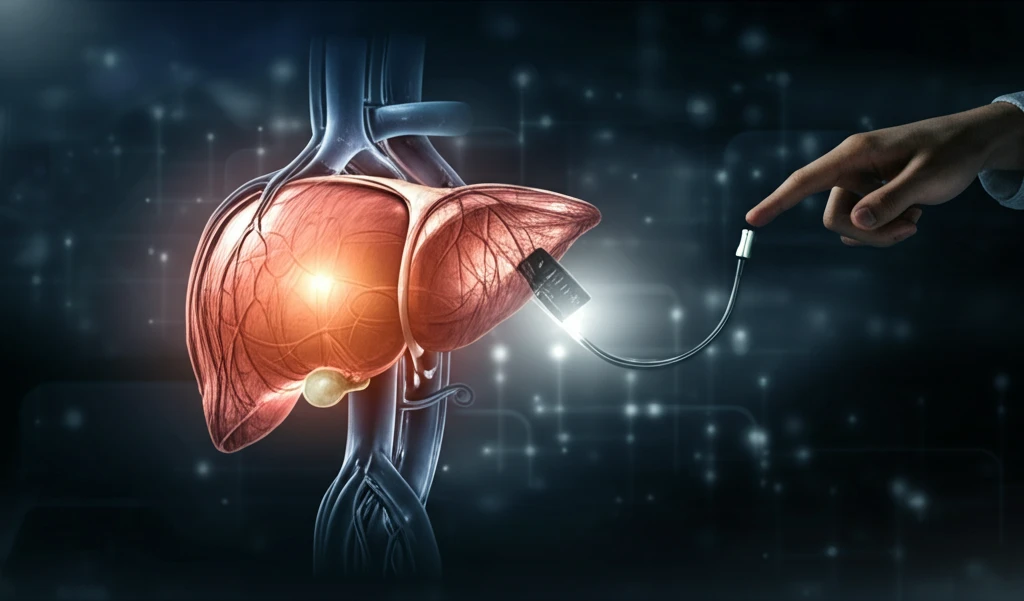
Unlocking Liver Health: A Simple Guide to Portal Pressure Measurement

"Navigate liver disease with our breakdown of indirect portal pressure measurement. Learn how this key diagnostic tool can help manage and monitor your health."
Chronic liver diseases, such as cirrhosis, can lead to portal hypertension, a condition that can cause a range of complications, including ascites, hepatic encephalopathy, and variceal hemorrhage. Fortunately, medical advancements allow for better assessment and management of these conditions.
While noninvasive imaging techniques like ultrasound, MRI, and CT scans are valuable for assessing the liver's structure and identifying abnormalities, measuring portal pressure remains essential. One common method is the hepatic venous pressure gradient (HVPG), often performed alongside a transjugular liver biopsy.
Although rarely used for direct visualization, wedged CO₂ portography plays a crucial role during TIPS (Transjugular Intrahepatic Portosystemic Shunt) procedures. Let's explore the ins and outs of indirect portal pressure measurement and wedged CO₂ portography, offering you a clearer understanding of these important techniques.
Portal Pressure: Why It Matters
Portal pressure measurement has important prognostic and clinical implications for patients with liver disease. A single portal pressure measurement can predict survival outcomes in cirrhotic patients who have experienced bleeding. The hepatic venous pressure gradient (HVPG) measurement is considered the gold-standard method for monitoring portal pressure, though its invasive nature limits availability to experienced centers.
Current Gold Standards and Their Constraints
Hepatic vein pressure gradient (HVPG) measurement is considered the gold standard for quantifying portal hypertension, defined as the difference between wedged and free hepatic venous pressure. However, there is still no unified method for the assessment of portal vein pressure across clinical practice. Alternative approaches including intrasplenic puncture, operative measurements, umbilical vein catheterization, and transhepatic portal catheterization have been historically recommended, though WHVP (wedged hepatic venous pressure) remains widely used despite limitations.
Evolution of Portal Pressure Measurement
Endoscopic ultrasound-guided portal pressure gradient (EUS-PPG) represents a novel technique to evaluate portal hypertension, marking a significant development in the field. Cook Medical recently received CE mark approval in the European Union for the EchoTip Insight Portosystemic Pressure Gradient device, an endoscopic ultrasound tool that allows endoscopists to measure portal pressure. This approval signifies growing recognition of EUS-based approaches as viable alternatives to traditional transjugular methods.
Understanding Indirect Portal Pressure Measurement
Historically, direct measurement of portal pressure involved invasive procedures like surgical, percutaneous transhepatic, or transjugular catheterization of the portal vein. However, due to the risks associated with these methods, they were rarely performed. A significant breakthrough came with the development of occlusive hepatic venous catheterization, pioneered by Myers and Taylor and Friedman and Weiner in 1951.
- WHVP: Sinusoidal pressure, reflecting portal venous pressure.
- FHVP: Measured in a nonocclusive position, accounting for intraabdominal pressure.
- HVPG: WHVP minus FHVP, providing a more accurate assessment.
Emerging Evidence for EUS-Guided Measurement
Systematic reviews and meta-analyses have demonstrated good correlation between clinical portal hypertension and portal pressure gradients measured via EUS-PPG. Published reviews have emphasized the feasibility and safety of endoscopic ultrasound-guided portal pressure gradient measurement compared to transjugular approaches. Technical considerations include performing measurements in the left lateral position under monitored anesthesia care with propofol, and proper zeroing at the phlebostatic axis to ensure accuracy.
Challenges in Pressure Measurement Applications
While portal pressure measurement techniques continue to evolve, various pressure measurement challenges exist across different applications. In some cases, increased pressure may be normal depending on the context, but sustained high pressure while at rest indicates pathology. Accurate measurement requires consideration of the specific application and proper measurement conditions to avoid misleading results.
Methodological Comparisons and Clinical Outcomes
Portal pressure measurement approaches vary in their invasiveness and clinical utility. Research examining terlipressin treatment has shown significantly higher 7-day survival rates in treated groups compared to controls when portal pressure is monitored. The choice of measurement method depends on available expertise, clinical requirements, and the specific information needed for patient management.
The Future of Liver Health Assessment
Indirect portal pressure measurement has revolutionized our understanding and management of portal hypertension. By providing a reliable and less invasive way to assess portal pressure, techniques like HVPG have become indispensable tools for guiding treatment decisions and improving outcomes for individuals with chronic liver diseases. As research continues, we can expect even more refined methods and a deeper understanding of liver health.
Understanding Portal Pressure Gradients
Portal pressure gradient calculation follows the formula PPG = FHVP – PP, where FHVP represents free hepatic venous pressure and PP represents portal pressure. Direct portal pressure measurement can be obtained and compared with wedged hepatic venous pressure (WHVP) to assess portal hypertension. The distinction between cirrhotic and non-cirrhotic causes of portal hypertension is important, as the underlying pathology affects measurement interpretation and clinical management.
Innovations in Portal Pressure Assessment
Novel techniques have been developed for rapid and direct portal pressure measurements using digital pressure wires delivered through EUS-guided 22-G FNA needles. Clinical implementation of EUS-guided portal pressure gradient measurement is expanding into advanced therapeutic practices, representing a significant frontier in endohepatology. The Baveno VII conference has highlighted portal hypertension assessment and EUS-guided portal pressure measurement as areas of active development and early clinical experience.
Pressure Measurement Across Applications
Pressure measurement principles extend beyond medical applications to industrial contexts, where pressure gauges and sensors are essential for monitoring fluids at various stages. The conversion between different pressure units such as bar and PSI is important for international standardization. These measurement challenges highlight the universal need for accurate, reliable pressure assessment across different fields and applications.
Clinical Outcomes and Resource Implications
Early hepatic venous pressure gradient (HVPG) measurements in cirrhotic patients with acute variceal bleeding have demonstrated significant prognostic value. Studies have shown that incorporating portal pressure studies into management algorithms for variceal bleeding can reduce the number of endoscopies required for intervention and follow-up. This approach leads to significant savings in terms of cost and demand on healthcare resources, improving both patient outcomes and system efficiency.