
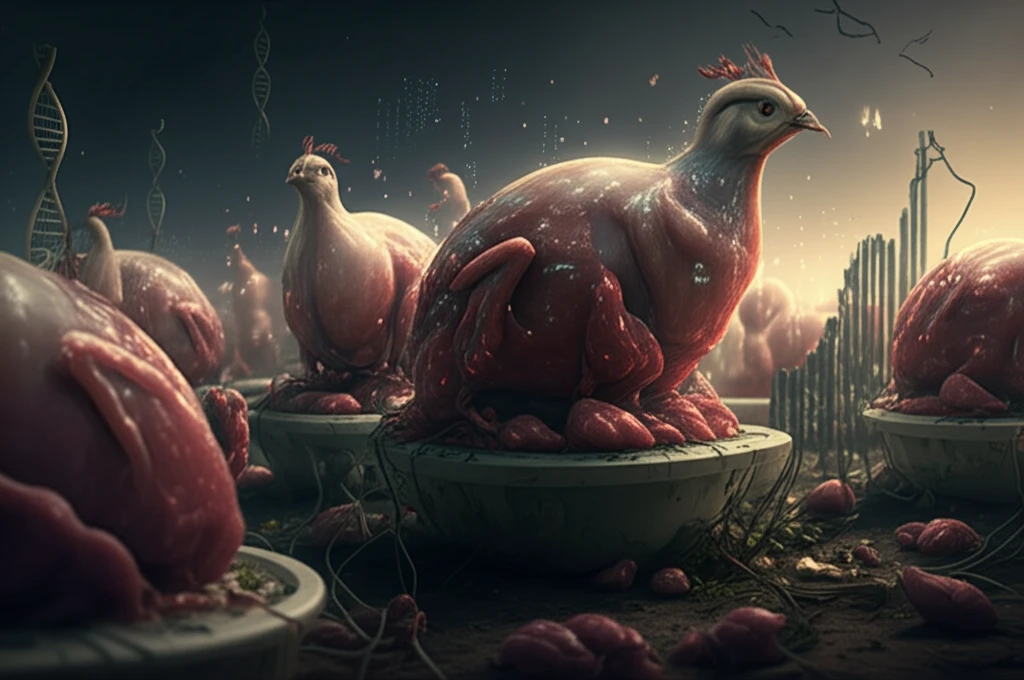
Unlocking Growth: How Quail Farming Can Optimize Meat Production

"A deep dive into using advanced modeling techniques to revolutionize quail meat yield and genetic selection"
For decades, farmers and agricultural scientists have sought innovative methods to enhance meat production efficiency. Accurately predicting and optimizing animal growth is pivotal in this endeavor. Growth curves, which graphically represent an animal's growth trajectory over time, serve as invaluable tools. These curves, defined by a few biologically interpretable parameters, facilitate the comparison of individuals or entire populations for critical traits such as growth rate, maturation rate, and mature size.
Traditionally, nonlinear models have been employed to correlate weight and age data, proving adept at describing growth patterns across various animal species. In poultry farming, the Gompertz, Logistic, and von Bertalanffy models are widely used due to their precision and relative simplicity. These models help farmers and scientists understand the interplay between various growth parameters, facilitating more informed breeding and management decisions.
However, the traditional methods for estimating genetic parameters of growth curves often involve a two-step process. This approach can lead to inaccuracies as it fails to account for the errors from the initial parameter estimation when assessing (co)variance components and predicting genetic values. Addressing these limitations requires more advanced analytical tools. This is where Bayesian hierarchical models come into play, offering a more integrated and precise method for optimizing meat production.
The Growing Role of Quail in Global Poultry
Quail farming has emerged as a solid foundation for many smallholder farms, with well-managed operations capable of yielding between ten to fifteen birds per month depending on care and conditions maintained. Quail eggs are highly nutritious and in high demand due to their numerous health benefits, while quail meat is recognized as a delicious and healthy alternative to other poultry meats. Research into quail production systems, such as characterization studies conducted in Benin using descriptive statistical analysis, underscores the growing academic and commercial interest in optimizing this sector.
Conventional Methods for Raising Quail
Standard quail farming practices emphasize clean, well-ventilated housing and proper waste management, including the use of septic tanks or dedicated disposal systems to control manure odor. Cages can range from simple homemade structures built from readily available materials to commercially purchased units, making the barrier to entry impressively low. Farmers typically monetize their operations by selling eggs, meat, and live birds, though success depends on maintaining consistent ventilation and hygiene standards throughout the grow-out period.
Origins and Evolution of Quail Farming
Quails are migratory game birds native to Europe, Asia, and Africa, with their recorded history dating back to the 11th century and references appearing in the Old Testament of the Bible. In the modern commercial era, most farmed quail has been destined for upscale restaurant markets, though in the last decade the two largest quail companies—Quail International and Manchester Quail—have worked their way into a modest retail market. Quail farming is broadly characterized as a simple, profitable, and enjoyable operation that has attracted entrepreneurs worldwide.
Bayesian Hierarchical Models: A New Approach to Quail Farming
A recent study investigated the use of Bayesian hierarchical models to compare different nonlinear functions for describing the growth curve of European quails. This innovative approach allowed for the estimation of growth curve parameters, (co)variance components, and the genetic and systematic factors influencing the curve, all within a unified framework. The key advantage of this model lies in its ability to perform joint estimation, enhancing accuracy and reliability.
- Deviance Information Criterion (DIC)
- Mean Square Error (MSE)
- Gelfand's check function (E(g|y-r))
Advances and Challenges in Quail Science
Research interest in the Japanese quail as a study animal increased significantly after 1957, driven by work at the University of California and Auburn University, and has continued to expand in scope. A review of quail farming in Bangladesh found that the sector's present status warrants further attention across areas including production, breeding, and marketing. In South Africa, the poultry industry has recently recognized commercial quail farming as a potential protein source capable of alleviating protein-energy malnutrition in rural communities. Quail farming generates two primary revenue streams—eggs and meat—though some breeds exhibit low productivity in both categories, making them unsuitable for commercial-scale agribusiness.
Skepticism Around Quail Farming Viability
Despite quail hens starting to lay eggs early in life and producing around 300 eggs during their first year—a figure that makes commercial quail farming appear attractive—questions remain about whether the small size of the birds offsets the per-unit returns compared to conventional poultry. The relatively low meat yield per bird can limit the economic appeal for farmers targeting higher-volume meat production. Nonetheless, commercial quail farming persists as one of the more popular small-scale farming ventures, suggesting that many operators find the trade-offs acceptable.
Cost-Effective Housing Solutions for Quail
New urban quail farmers have found that transforming standard dog cages into quail enclosures provides an inexpensive and practical housing solution, reducing upfront investment significantly. This approach demonstrates that quail farming infrastructure need not be specialized or costly to be functional. Compared to purpose-built commercial quail battery systems, repurposed enclosures trade some optimization for accessibility, making the practice more attainable for beginners.
Optimizing Quail Growth: Implications for Future Farming
This research underscores the potential of Bayesian hierarchical models to revolutionize quail farming. By providing a more accurate and nuanced understanding of growth dynamics and genetic parameters, farmers can make better-informed breeding and management decisions. This, in turn, leads to enhanced meat production efficiency and improved profitability. As the demand for sustainable and efficient farming practices grows, methodologies like these will play an increasingly crucial role in shaping the future of agriculture.
Consolidating the Evidence on Quail Farming
Across the available literature, quail farming consistently appears as an accessible entry point into poultry production, with low startup costs and relatively straightforward management requirements. However, the economic case depends heavily on scale, breed selection, and market access—factors that vary significantly by region. While the scientific foundation has deepened since the mid-twentieth century, translating research findings into widespread commercial adoption remains an ongoing process.
Emerging Interest and Digital Engagement
Social media platforms are increasingly serving as hubs for knowledge sharing among quail farming enthusiasts, with dedicated content discovery feeds on platforms like TikTok reflecting growing grassroots interest in the practice. This digital engagement suggests a widening audience of aspiring and current quail farmers seeking practical guidance and community connection. As online communities mature, they may play a meaningful role in disseminating best practices and accelerating adoption of optimized farming techniques.
Systemic Barriers to Quail Farming Scale
While quail farming holds promise as a decentralized protein source, its expansion faces systemic challenges including limited access to formal supply chains, inconsistent regulatory frameworks for small livestock, and gaps in breed improvement programs. These structural issues disproportionately affect smallholder farmers in developing regions who stand to benefit most from quail production. Addressing these barriers will likely require coordinated investment in extension services, market infrastructure, and research dissemination.
Profitability Tools for Working Farmers
Practical decision-support tools, such as feed formulation calculators tailored to specific regions like Eritrea, are emerging to help quail farmers assess whether their operations are generating real profit. These resources address a critical gap between the theoretical promise of quail farming and the on-the-ground financial realities that determine whether a farm sustains itself. By enabling farmers to optimize input costs against expected yields, such tools translate abstract agricultural potential into actionable economic outcomes.