
Unlocking Culture: How Darwin's Natural Selection Shapes Our Societies

"Explore the surprising parallels between biological evolution and cultural development, and discover how understanding this connection can revolutionize our approach to cultural studies."
The study of culture often begins with individual expression or creative activity, but culture's origins lie elsewhere. Charles Darwin connected culture and evolution, noting that community opinion shapes individual action. Our regard for approval and disapproval depends on sympathy, an essential part of our social instinct.
Darwin's causal sequence is sympathy leading to social instinct, then community, language, common opinion, and individual action. Evolved traits enable sympathy, followed by an instinct for sociality. Language and culture express this instinct, leading to individual action guided by group values. Individuality stems from sociality, and language precedes individual action.
Darwin noted the importance of praise and blame in shaping cultural evolution. He sketched a model where individual moral sense develops into a communal standard of morality, originating in social instincts and guided by reason, self-interest, religion, instruction, and habit. In short, culture sets the rules for individual action, a view modern evolutionary biology is returning to.
Natural Selection as the Most Accurate Theory of Origin
Evolution by natural selection is now widely agreed to be the most accurate theory to explain the origin and diversity of species. Sociocultural evolution builds on this foundation as a family of theories describing how societies and culture change over time. Together these ideas give modern audiences a framework for understanding both biological and social change.
Intentional versus Unintentional Selection
Darwin popularised the term "natural selection" by contrasting it with artificial selection, which is intentional, whereas natural selection is not. For Darwin, natural selection operated as a law or principle whose results emerged without deliberate human direction. This distinction remains a central limitation of simple analogies between farming, breeding, and the evolution of societies.
Darwin's 1859 Landmark Publication
Darwin published his theory in "On the Origin of Species" in 1859, presenting natural selection as the mechanism behind biological evolution. The term Darwinism came to describe this theory of biological evolution developed by Darwin and his contemporaries. His observations of biological diversity, such as those captured in studies of Darwin's finches, formed the empirical core of the theory.
The Parallels Between Nature and Culture
Darwin saw the relations between nature and culture as 'curiously parallel,' noting that languages (culture) and species (nature) both evolve through natural selection. The formation of languages and distinct species follows a gradual process. He claimed that the explanation for changes in languages mirrors that of changes in species.
- Culture and nature evolve similarly.
- Culture evolves through natural selection.
- Study culture as an evolutionary process.
- Darwin's ideas need a fresh examination.
Toward a Unified Science of Cultural Evolution
Recent scholarship argues for a unified science of cultural evolution that draws on cultural anthropology, cultural transmission, evolutionary archaeology, and evolutionary biology. Researchers integrate concepts such as gene-culture coevolution, memes, and social learning to explain how culture evolves. This work aims to connect parallel findings across disciplines into a single explanatory framework.
Misuse, Challenge, and the Social Darwinism Caution
Sociocultural evolution theory is consistently being challenged, in part because Darwin's theory was a scientific theory focused on explaining observations about biological diversity, not society. Herbert Spencer and others nevertheless applied evolutionary ideas to human societies, producing the distorted doctrine known as Social Darwinism. Critics note that applying biological selection to social order has historically justified harmful imperial and political projects.
Darwinism versus Neo-Darwinism
Classical Darwinism describes biological evolution developed by Darwin and his contemporaries, while Neo-Darwinism explains how these processes occur at the gene and DNA level. The modern view questions whether Neo-Darwinism is complete. This comparison highlights how evolutionary theory has deepened from observing organisms to understanding the molecular mechanisms of heredity and selection.
Linking Evolution and Culture
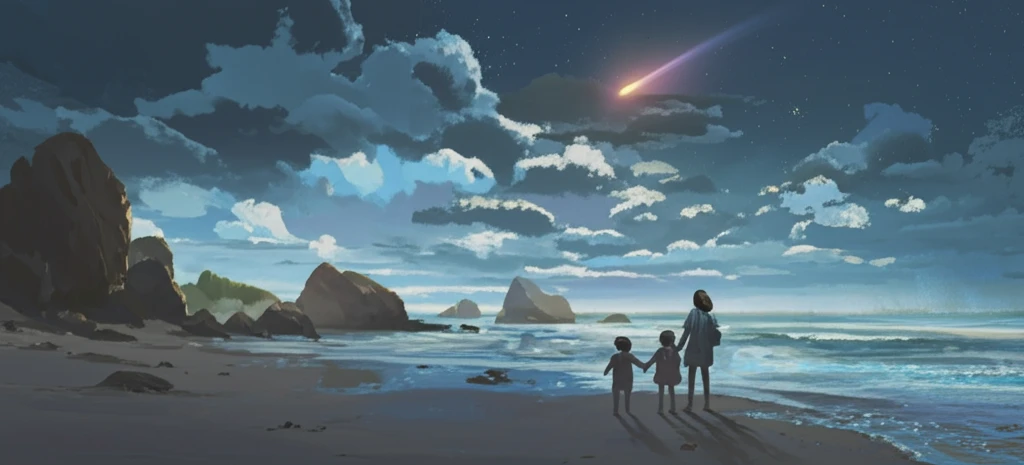
Dyce's painting captures the moment when evolution and culture linked in public thought. The cliffs, comet, and shells allude to ancient processes against daily experience. The painting ties lumbering processes of ancient earth to the here-and-now of daily experience. We can make the study of culture into an evolutionary science by following these links.
Cultural Evolution in the Social Sciences
Cultural evolution refers to the development of cultures from simple to complex forms. Studied in social science, it provides insights into modern societies by examining how cultures change over time. Sociocultural evolutionism describes how societies and culture change over time through the permanent interplay of social order and cultural forces.
Completeness and the Next Questions
A key open question is whether Neo-Darwinism is complete, since it explains processes at the gene and DNA level but may not fully capture cultural dynamics. Future work aims at a unified science of cultural evolution integrating fields such as social learning and memes. Such a synthesis could link biological and cultural change into a single evolutionary account.
The Interplay of Social Order and Cultural Evolution
Sociocultural evolution theory examines the permanent interplay between the evolution of the social order and cultural change over time. Despite being consistently challenged, it remains a framework for understanding how societies develop. The systemic challenge is separating scientific evolutionary reasoning from ideological claims about social progress.
Survival, Society, and Everyday Life
Natural selection shapes organism survival, and its key concepts are now part of core education, such as Grade 12 Life Sciences curricula. Unlike artificial selection, which is intentional, natural selection operates without deliberate direction, which affects how people understand human agency in society. Recognizing this helps societies use evolutionary thinking responsibly rather than as a justification for social engineering.