
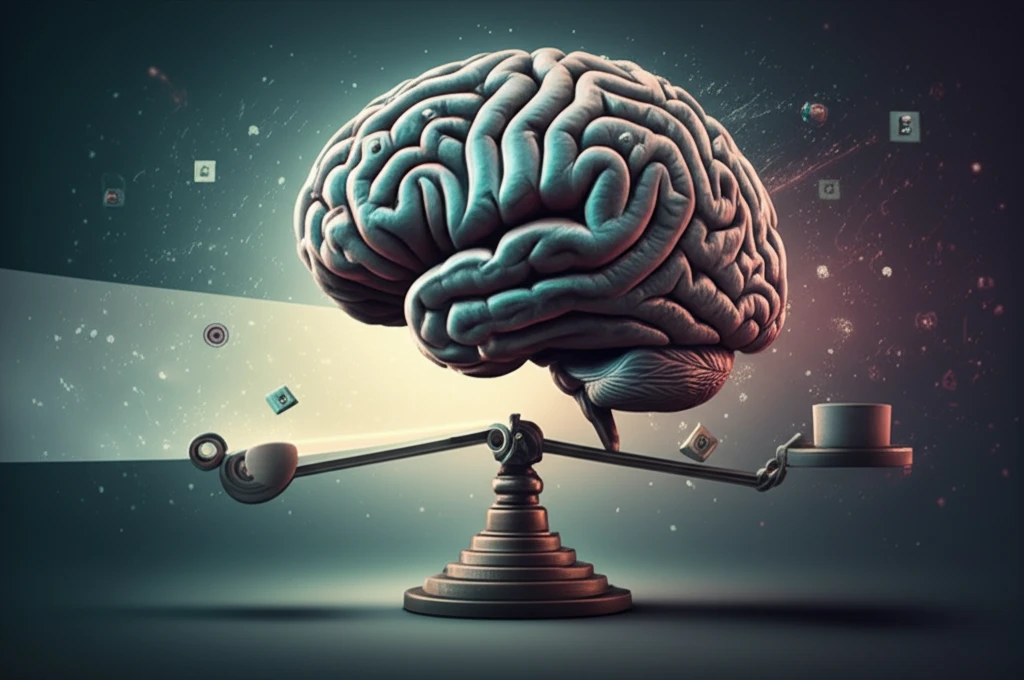
Unlocking Better Decisions: How 'Coherent Distortions' Can Help Us Understand Belief Biases

"A deep dive into how individuals process information and make choices, challenging traditional economic models and offering new insights into subjective Bayesianism."
Every decision we make hinges on our beliefs about the world, future events, and potential outcomes. Traditional economic models often assume that individuals process information and form beliefs in a perfectly rational manner. However, a growing body of evidence reveals that people frequently deviate from this ideal, exhibiting what are known as 'belief biases.' These biases can range from overconfidence and optimism to conservatism and base-rate neglect, significantly impacting our judgment and decision-making processes.
Recognizing the pervasive nature of these distortions, researchers have developed numerous models to explain and rationalize them. These models fall into several major branches, including those focused on biases in inference and information processing, probability weighting, and the maximization of anticipatory utility. Yet, despite the proliferation of these models, there remains a critical need for a framework that imposes natural and intuitive restrictions on how belief distortion functions operate.
Enter the concept of 'coherent distortions,' a novel approach that offers a more consistent and robust way to understand subjective beliefs. By introducing simple coherence conditions, this framework ensures that belief distortions commute with conditioning, aligning with a form of subjective Bayesianism. This means that the way we adjust our beliefs based on new information remains consistent, regardless of when the distortion is applied. This article will delve into the implications of coherent distortions, connecting them to existing models and exploring their potential to enhance our understanding of decision-making under uncertainty.
Belief as a Stance Toward Truth
Definitions of belief converge on the idea of a mental stance toward truth. Wikipedia characterizes belief as a subjective attitude that a state of affairs is the case, and notes that in epistemology the term refers to attitudes about the world that can be true or false. Cambridge Dictionary similarly defines belief as the feeling of being certain that something exists or is true, while Merriam-Webster describes it as a state or habit of mind in which trust or confidence is placed in some person or thing. Dictionary.com adds that a belief is an opinion or conviction. Taken together, these definitions point to acceptance and confidence as belief's core features, though the cited sources do not quantify how common or consequential belief-driven biases are.
Belief as Unverified Acceptance
Vocabulary.com defines a belief as an idea one accepts as being true or real. The source illustrates this with children's strong belief that the Tooth Fairy really does exist, showing that everyday belief often rests on acceptance rather than verification. Because this is the only source available for this subsection, it offers little detail on standard research methods or their limitations. More specific commentary on how beliefs are typically measured, or where such methods fall short, would require additional evidence.
A History Still to Be Documented
The available source material does not include specific historical milestones in the study of belief. In general, interest in belief reaches back to ancient philosophy, where thinkers treated beliefs as truth-evaluable claims about the world. Modern psychology later added questions about how beliefs form, endure, and shift. These statements are general context rather than documented findings.
What are Coherent Distortions and Why Do They Matter?
The concept of 'coherent distortions' introduces a set of intuitive restrictions on belief distortion functions, ensuring that these distortions are consistent with conditional probabilities. In simpler terms, it suggests that how we adjust our beliefs when we receive new information should not depend on whether we distort our beliefs before or after receiving that information. This aligns with the idea of 'subjective Bayesianism,' where individuals act rationally based on their own distorted beliefs.
- Commuting with Conditioning: Ensures that the order in which information is received and beliefs are distorted does not affect the final outcome.
- Subjective Bayesianism: Requires agents to act as subjective Bayesians with respect to their distorted beliefs, ensuring consistent belief updating.
- Robustness to Timing: Maintains that the structure of distortions remains the same, whether information is accessed before or after the distortion.
Beyond Current Sources
No recent research articles are included in the source material for this section. Current scholarship on belief generally spans fields such as cognitive science, psychology, and economics, examining how people update beliefs in light of new evidence. Any specific recent findings would need to be verified against primary literature before being reported.
Open Critiques
The available sources do not document specific counter-arguments or failures of coherent-distortion frameworks. In general, critiques of belief-bias models tend to question whether distortions are truly systematic or merely experimental artifacts. These caveats reflect common academic debate, but without source material they should be treated as general commentary rather than verified claims.
Comparisons Awaiting Evidence
No comparative sources are available for this section. Comparing belief frameworks across cultures or historical periods generally requires multiple empirical studies, none of which appear in the source list here. Accordingly, this subsection cannot offer a data-backed comparison at this time.
The Path Forward: Leveraging Coherent Distortions for Better Models
The framework of coherent distortions provides a powerful tool for refining our understanding of belief biases and improving the accuracy of economic models. By imposing intuitive and mathematically grounded restrictions on how individuals distort information, we can develop more robust and reliable representations of human decision-making. As research continues to explore the nuances of belief distortions, the principle of coherence will likely play an increasingly important role in shaping our understanding of how people make choices in a complex and uncertain world.
Preliminary Framing Only
The source list for this subsection contains no expert commentary to synthesize. A meaningful synthesis of coherent distortions and belief biases would generally draw on converging evidence from multiple fields, including decision science and psychology. In the absence of such sources, conclusions here should be regarded as preliminary framing rather than expert consensus.
Speculative Directions
No sources describe the next frontiers of research on coherent distortions. Plausible directions, if pursued, would include more naturalistic studies of how beliefs persist under uncertainty and how distortions respond to training. Such outlooks are speculative until supported by primary research.
Systemic Dimensions Unaddressed
The available material does not address the systemic or societal dimensions of belief biases. Generally, belief quality matters well beyond individual choice, shaping public debate, education, and policy environments. Discussing these systemic challenges responsibly would require evidence that the current source set does not provide.
Lived Effects Unknown
No source material addresses the lived, real-world impact of belief distortions. In general, beliefs that resist disconfirming evidence can affect personal decisions, relationships, and trust in institutions. These remarks are reasonable generalizations but are not grounded in the sources provided.