
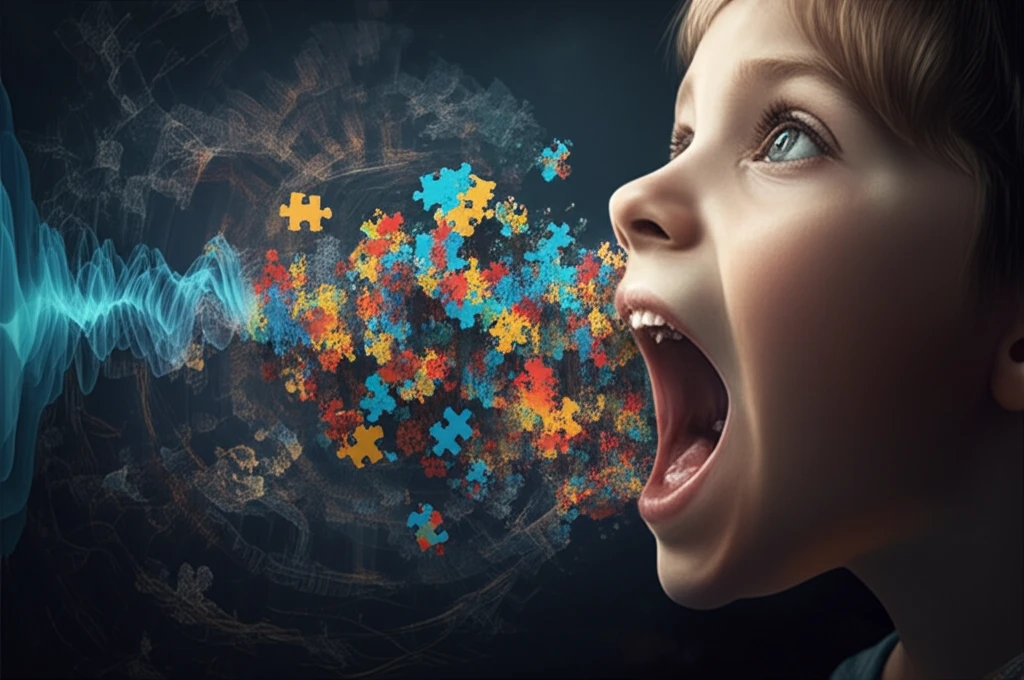
Unlocking Autism: How Voice Analysis Could Revolutionize Early Detection

"New research explores subtle vocal differences in autistic children, paving the way for innovative diagnostic tools"
Autism Spectrum Disorder (ASD) affects a significant portion of the population, impacting communication, social interaction, and behavior. Early diagnosis is crucial, enabling timely interventions that can dramatically improve outcomes for affected individuals and their families. Traditional diagnostic methods, however, are often lengthy, complex, and rely heavily on subjective observations.
Recognizing the need for more efficient and objective tools, researchers are increasingly turning to technology. One promising area of investigation involves the detailed analysis of vocal patterns. Recent studies suggest that subtle differences in the way individuals with ASD speak can be detected through careful examination of acoustic features, offering a potential pathway for automated screening and diagnostic frameworks.
This article delves into groundbreaking research focused on identifying unique acoustic 'fingerprints' in the speech of children with autism. By examining low-level descriptors (LLDs) in voice, scientists aim to uncover reliable markers that distinguish autistic speech patterns from those of typically developing individuals. The insights gleaned from this research could revolutionize early detection efforts, leading to earlier interventions and improved quality of life for those with ASD.
Voice analysis as a measurable marker of autism
Voice analysis research has emerged as a promising avenue for quantifying autism-related speech differences. A 2021 study published in Frontiers in Psychology, led by Asgari, Chen, and Fombonne, used speech samples and machine learning to quantify voice characteristics for detecting autism, incorporating harmonic modeling and prosody analysis. Public-facing tools now translate this research into practice: AnyToSpeech's "Do I Sound Autistic?" feature lets users record or upload their voice and see how closely it matches research-described atypical prosody patterns tied to autism, including pitch, rhythm, pauses, expressiveness, and voice quality. Families and clinicians likewise observe that high-functioning autism can noticeably affect tone, rhythm, and pacing in everyday speech.
From AAC and therapy to neurodiversity-informed support
Traditional support for autistic communication relies on a mix of evidence-based approaches, including presuming competence and augmentative and alternative communication (AAC) tools. Speech and language therapy is a mainstay, with practitioners citing research indicating that early behavioral therapy methods can produce significant improvements in language, social skills, and independence. Clinical descriptions often emphasize distinctive features such as echolalia, or repeating others' words, alongside atypical prosody and intonation. At the same time, neurodiversity-aligned perspectives caution that these differences are not deficits: autistic speech patterns can be effective communication in their own right, which shapes how support and therapy should be framed.
Speech signs at the foundation of autism recognition
Historically, autism has often been identified through speech and communication markers. At the time of diagnosis, autistic children are frequently nonverbal, and they may also avoid eye contact, show a blank expression, and fail to respond to their name. Clinicians have long described "cluttered speech" in autistic children, marked by difficulty with fluency—the flow, speed, and rhythm of language. Because speech delays are common among children generally, specialists have worked to distinguish a simple speech delay from autism, noting that speech delay may also be an indicator of autism and that the two can be differentiated through careful evaluation.
The Science of Sound: Unveiling Acoustic Biomarkers
The human voice is a complex tapestry of sounds, shaped by a multitude of factors including age, gender, genetics, and even cultural background. Untangling these interwoven influences to isolate the specific impact of autism on speech is a significant challenge. The study highlighted here addresses this challenge through an innovative approach: examining triplets, one of whom has ASD, minimizing genetic and environmental variables.
- Pitch Variability: Differences in the range and consistency of pitch during speech.
- Vocal Intensity: Variations in loudness and energy levels.
- Spectral Characteristics: Analysis of the distribution of energy across different frequencies.
Advances in acoustic analysis, tempered by review
Research on the acoustic characteristics of vowels in autism spectrum disorder has advanced significantly over the past two decades, yielding essential insights into the articulatory and prosodic attributes of speech in autistic individuals. Broad studies of language development indicate that more than half of children with autism are unable to communicate by speech, and those who do develop spoken language may experience delayed language proficiency, which can make everyday social functioning challenging. At the same time, scholarly reviews caution that no single speech or language phenomenon is unique to autism and that none should be treated as diagnostic on its own, calling into question unwarranted assumptions about autistic language development. This mix of accelerating acoustic research and critical review helps explain both the promise and the limits of voice-based analysis.
Communication is broader than any single voice marker
The National Institute on Deafness and Other Communication Disorders (NIDCD) outlines how autism spectrum disorder can affect communication in children, describing the speech and language problems that may accompany ASD. The agency also addresses how these problems are treated and what research is being conducted to improve communication in autistic children. Its overview serves as a reminder that voice-based markers are one piece of a larger communication picture that includes comprehension, nonverbal behavior, and social interaction. Because this source frames communication differences as treatable challenges with active research behind them, it provides a cautionary counterpoint to any claim that a single voice analysis could fully capture a child's communication profile.
Speech delay versus autism: why the distinction matters
A key practical question for families is telling a speech delay apart from autism. Sources emphasize that while speech delays are common among children, they may also be an early indicator of ASD, and that the two conditions can be distinguished through careful evaluation. Once a diagnosis is reached, families can work with their child's healthcare team to develop a treatment plan, which may include speech therapy, behavior therapy, and/or medication. This comparative framing underscores why accurate early assessment matters: the right plan depends on correctly identifying whether the underlying issue is a speech delay or autism.
A Future Shaped by Sound
This research marks a significant step towards developing objective, technology-driven methods for early autism detection. By identifying specific acoustic markers in speech, scientists are paving the way for innovative tools that can supplement traditional diagnostic approaches. These tools could potentially be integrated into telehealth platforms, allowing for remote screening and monitoring, ultimately leading to earlier interventions and improved outcomes for individuals with ASD and their families. Further research with larger, more diverse populations is needed to validate these findings and refine the models for broader application, but the potential impact on early intervention is immense.
Acoustic evidence meets clinical practice
Research on acoustic analysis of prosody in high-functioning autism shows that autistic speech has distinct acoustic patterns that differ from typical speech. Because these differences are measurable, analyzing acoustic features derived from the speech of autistic children can help support early detection of ASD. Expert clinical guidance emphasizes that autism affects speech and language in varied ways and that speech therapy remains a central resource, including for autistic teens and adults who seek support later in life. Taken together, the acoustic research and clinical expertise point to voice analysis as a complementary tool within a broader, human-centered approach to communication support.
Prosody across languages as the next frontier
Looking ahead, prosody—the rhythm and intonation that help us express emotions and convey meaning with our words—is a central frontier in voice research. Autistic people are often described as demonstrating differences in speech prosody, and emerging studies indicate that these speech rhythm differences are consistent across different languages. That cross-language consistency is notable because it suggests prosodic markers may reflect traits that persist regardless of linguistic background, making them potentially useful signals for research and, eventually, for screening tools. Researchers note that such findings are still emerging, but they help define the direction of future work in early detection.
Access to tools and trained support remains uneven
Speech therapy is a widely used intervention for autism, and organizations like Autism Speaks describe it as addressing language and communication challenges while helping improve verbal, nonverbal, and social communication. Therapists and families rely on a range of tools and approaches, including augmentative systems such as the Picture Exchange Communication System (PECS), tablet apps on devices like iPads, and speech output devices such as Dynavox. This reliance on varied, often specialized technology highlights a systemic challenge: access to speech therapy and communication devices is uneven, and not every family can easily obtain the tools or trained professionals needed. How voice-analysis innovations fit into this infrastructure—and whether they broaden or narrow access—remains an open question.
Being understood, not just measured
For the families and autistic individuals behind the statistics, voice analysis is more than a technical question—it is about being understood. Every child communicates in their own way, and tools that merely label speech as atypical risk oversimplifying a deeply personal experience. While the potential to detect differences earlier is genuinely hopeful, the real-world impact will ultimately depend on how such tools are used with warmth, respect, and a genuine commitment to supporting communication in whatever form it takes.