
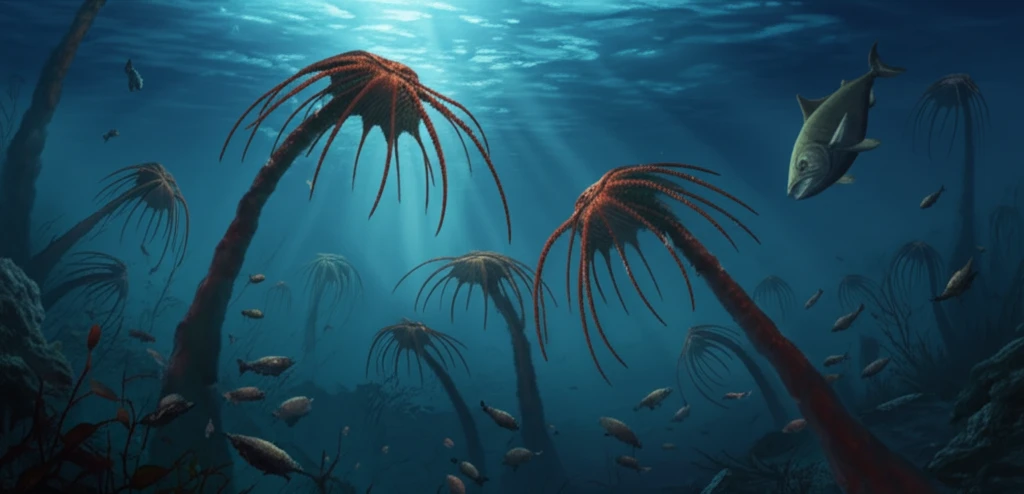
Unlocking Ancient Mysteries: How Crinoid Fossils Reveal Evolutionary Secrets

"Fossilized crinoid spines offer compelling evidence of predator-prey dynamics and adaptation over millions of years."
Imagine diving into an ancient ocean, teeming with life forms both familiar and strange. Among these, crinoids, often called 'sea lilies,' swayed gently in the currents. These marine animals, relatives of starfish and sea urchins, have a long and rich history, dating back hundreds of millions of years. While their soft bodies rarely fossilize, their skeletal remains, particularly their spines, offer a unique window into the past.
Fossilized crinoid spines are not just pretty rocks; they're time capsules containing valuable information about the ecosystems in which these creatures lived. In particular, the study of spine regeneration – the ability of a crinoid to regrow a damaged spine – provides direct evidence of predation attempts. The frequency and patterns of regeneration can tell us about the intensity of predation pressure and the evolutionary adaptations crinoids developed to survive in a dangerous world.
Recent research focusing on crinoid spines from the Upper Pennsylvanian period in eastern Ohio has uncovered some remarkable findings. These ancient spines exhibit evidence of repeated regeneration, suggesting that these crinoids were frequently targeted by predators. This discovery sheds new light on the predator-prey dynamics of the time and the evolutionary strategies crinoids employed to thrive amidst constant threats.
Ancient Origins of Crinoids
Crinoids are marine invertebrates belonging to the class Crinoidea, commonly known as sea lilies when stalked and feather stars when unstalked. This ancient group first appeared in the seas of the Middle Cambrian, approximately 300 million years before dinosaurs, establishing them as one of the oldest surviving echinoderm lineages. The order Comatulida, comprising unstalked forms, represents the largest modern crinoid group. Many extant crinoids are free-swimming and lack stems, while stalked varieties remain anchored to the seafloor in deep-water environments.
Fossil Preparation Challenges
Most crinoid fossils consist of individual button-like plates from the stem rather than complete specimens. Once dead, crinoid muscles decompose and cause disarticulation of the arms, calyx, stem, and columnals, meaning fossils are predominantly found as scattered parts. Even when well-preserved complete specimens are located, they require painstaking professional preparation using air abrasive technology to expose their delicate structures. Kentucky's rocks preserve crinoid fossils spanning the Ordovician through Pennsylvanian periods, documenting their long evolutionary persistence.
Crinoids in Cultural and Scientific History
Crinoids evolved approximately 480 million years ago and persist in modern oceans, making them a remarkable case of evolutionary longevity. The largest known sea lily specimens feature calyxes with arms spanning 1.5 metres in diameter, demonstrating their historical size diversity. Most remarkably, Ohio State University researchers extracted organic compounds from the pores of 350-million-year-old crinoid skeletons, representing the oldest biomolecules isolated directly from a fossil. The distinctive alien-like morphology of crinoids also inspired creature designs in the film 'Alien'.
Repeated Regeneration: A Sign of the Times
The study, conducted by James R. Thomka and Donald B. Eddy, examined brachial spines (small, rod-like structures extending from the arms) of pirasocrinid crinoids from the Ames Member of the Glenshaw Formation. What makes these spines so special is the evidence of multiple regeneration events. In some specimens, size discontinuities along the length of the spine indicate that they had been broken and regrown not once, but multiple times during the crinoid's lifespan.
- High Predation Intensity: The frequency of regeneration suggests a high level of predation in the Upper Pennsylvanian seas of eastern Ohio.
- Predator-Driven Evolution: The constant threat of predation may have been a driving force in the evolution of crinoid morphology, favoring traits that enhanced survival.
- Ecosystem Dynamics: Understanding predator-prey relationships helps us reconstruct the complex web of life in ancient ecosystems.
- Adaptation Strategies: Crinoids may have developed unique defense mechanisms, such as increased spinosity, to deter predators or minimize damage from attacks.
Post-Palaeozoic Diversity Decline
Research into crinoid diversity dynamics reveals that stalked crinoids became increasingly uncommon throughout the Cenozoic era. This pattern reflects a continuous decline beginning in the Late Cretaceous period, during which stalked varieties gradually restricted themselves to deep-sea habitats. This environmental shift introduces a significant fossil record bias, as deep-sea sediments are less accessible and less frequently sampled than shallow marine deposits. Understanding these macroevolutionary factors remains an active area of investigation within paleontology.
Market Abundance vs. Scientific Value
Crinoid fossil stem fragments are remarkably common and inexpensive, with smaller pieces often available for under one dollar and larger specimens priced below five dollars. This market abundance contrasts sharply with the scientific value of well-preserved articulated specimens, which command significantly higher prices. The Crawfordsville, Indiana locality represents world-renowned crinoid fossil deposits where expert preparation and preparation techniques yield museum-quality specimens. The disparity between fragment accessibility and complete specimen rarity highlights challenges in both collecting and scientific study.
Crinoids Among Extinct Marine Groups
Crinoids occupy a distinctive position among extinct and declining marine invertebrate groups due to their remarkable evolutionary persistence spanning hundreds of millions of years. While many ancient marine lineages disappeared entirely during mass extinction events, crinoids survived and diversified, albeit with significant shifts in dominant body forms. The transition from predominantly stalked to unstalked forms across geological time suggests adaptive responses to changing ocean conditions and ecological pressures.
More Than Just Fossils: A Glimpse into Evolutionary History
The study of crinoid spine regeneration provides a fascinating glimpse into the evolutionary history of these ancient creatures. By analyzing the patterns of breakage and regrowth, scientists can reconstruct the predator-prey dynamics of ancient ecosystems and gain a better understanding of the selective pressures that shaped the evolution of crinoid morphology. This research underscores the importance of studying fossils, not just as static objects, but as dynamic records of life's ongoing struggle for survival.
Hidden Complexity in Plain Sight
What appears to be an ordinary rock can reveal extraordinary biological structures under microscopic examination. Crinoid fossils exemplify how macroscopic simplicity often conceals intricate anatomical details invisible to the unaided eye. Microscope studies of fossil specimens continue to uncover previously unrecognised features, demonstrating the importance of modern analytical techniques in palaeontological research. This underscores how even well-known fossil groups retain undiscovered information requiring advanced imaging and preparation methods.
Dating Earth's Geological Record
Crinoid fossils serve as valuable tools for geologists seeking to relatively date sedimentary rock layers and reconstruct Earth's geological history. Different crinoid genera emerged at distinct intervals during the Paleozoic era, each thriving before eventually declining, creating a biostratigraphic framework for correlation. Missouri, where crinoids are the state fossil, preserves over 600 related living species in the warm, clear waters of the Pacific and Indian oceans and Caribbean Sea. This combination of fossil record depth and living diversity positions crinoids as ongoing subjects for studying evolutionary adaptation across vast timescales.
Conservation and Research Gaps
Despite their ancient heritage and current global distribution, crinoids face underappreciated conservation challenges that merit greater attention. Limited awareness among the general public about living crinoid populations may reduce support for marine habitat protection efforts. The intersection of paleontological study and modern biodiversity monitoring remains underdeveloped, creating gaps in understanding how deep-time evolutionary patterns inform contemporary conservation priorities.
Public Engagement and Discovery
Personal encounters with crinoid fossils, whether in museums or during amateur fossil hunting, spark curiosity and foster public interest in Earth's deep history. The accessibility of common crinoid stem fragments enables widespread participation in fossil collecting, creating grassroots engagement with palaeontology. Educational programs and popular media featuring crinoid discoveries help bridge the gap between specialist research and public understanding of evolutionary science.