
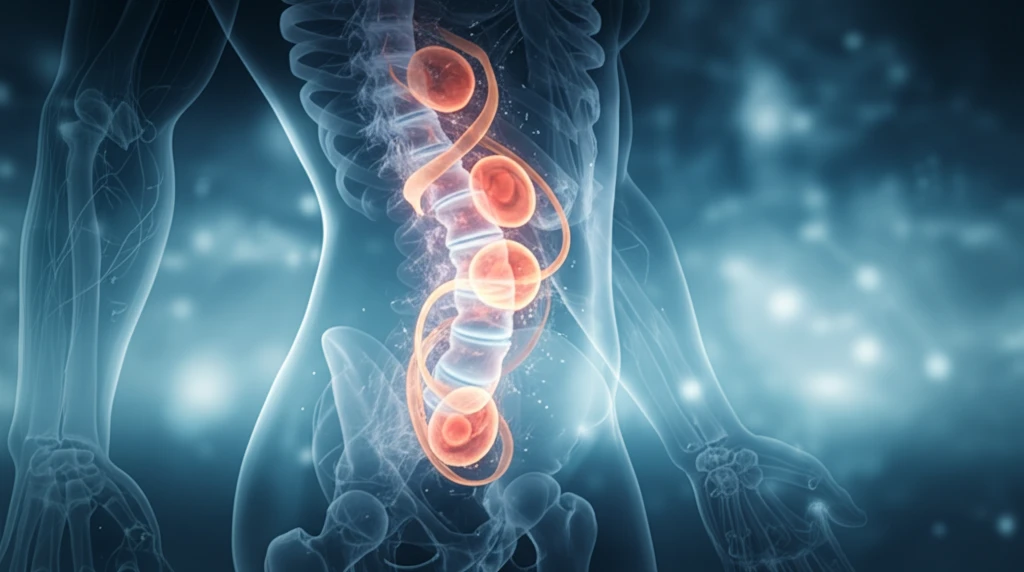
Unlock Your Spine's Secrets: How Embryonic Cells Could Revolutionize Back Pain Treatment

"Decoding the development of the spine's shock absorbers to pave the way for regenerative therapies."
Back pain, a relentless tormentor, plagues a staggering 85% of adults at some point in their lives. Beyond the personal suffering, the financial burden is immense, costing the United States over $100 billion annually. Current treatments, ranging from physical therapy and injections to spinal fusion and disc replacement, often provide temporary relief without addressing the root cause: intervertebral disc degeneration.
Intervertebral discs, the spine's unsung heroes, are complex structures comprised of the nucleus pulposus (NP), annulus fibrosus, and cartilage endplates. These components work in harmony to absorb shock and facilitate movement. Disc degeneration, frequently triggered by aging, initiates a cascade of cellular, structural, and biomechanical changes, ultimately compromising the disc's integrity and leading to pain.
Now, imagine a world where damaged discs could be regenerated, restoring their youthful resilience. This is the promise of regenerative medicine, and a new study published in Scientific Reports offers a significant leap forward. By delving into the embryonic origins of the nucleus pulposus, researchers are uncovering the secrets to disc formation and paving the way for innovative therapies.
Understanding Back Pain Classification
Back pain, also known as dorsalgia, can be classified by the spinal segment affected: neck pain (cervical), middle back pain (thoracic), lower back pain (lumbar), or coccydynia. The lumbar region is the most commonly affected area. Episodes may be categorized as acute, subacute, or chronic depending on duration.
Conventional Treatment Pathways
Back pain is one of the most common reasons people seek medical help or miss work, and is a leading cause of disability worldwide. For many patients, especially those younger than 60, simple home treatment and proper body mechanics can resolve episodes within weeks. Surgery is considered when simpler measures fail, though its role and effectiveness vary by condition.
Historical Foundations
The vertebral column runs the length of the back and creates a central structural framework, while the muscles of the back support the spine, maintain posture, and enable trunk movement. Research into spinal biology has historically focused on biomechanics and muscular support, with regenerative approaches representing a more recent frontier in back pain research.
Embryonic Notochord-Derived Cells (NDCs): Nature's Blueprint for Spinal Discs
The key to this research lies in understanding the role of notochord-derived cells (NDCs) during embryonic development. The notochord, a transient midline structure present in all chordates, serves as a primitive axial skeleton and a signaling center, orchestrating tissue patterning and development through the secretion of vital molecular factors. In essence, it's the architect of the developing spine.
- Researchers isolated NDCs from mice at embryonic day 12.5 (E12.5) and postnatal day 0 (P0), representing distinct stages in NP formation.
- Global gene expression profiles were analyzed using RNA-Seq, revealing significant differences in mRNA abundance between E12.5 and P0 NDCs.
- Principal component analysis (PCA) demonstrated distinct gene expression clustering at each developmental stage.
- Over 5000 genes were significantly differentially expressed between E12.5 and P0.
Advancing Regenerative Approaches
Research into embryonic cell therapies for spinal conditions represents an emerging area of investigation, though specific clinical findings were not available in the provided source material. Early-stage studies in regenerative medicine have explored how progenitor cells might contribute to disc repair or tissue regeneration. However, this field remains in development and further evidence is needed to establish efficacy and safety.
Challenges in Spinal Cell Therapy
Cell-based therapies for back pain face significant hurdles that have limited their translation to clinical practice. Challenges include delivering cells to the avascular intervertebral disc environment, ensuring cell survival and integration, and achieving meaningful functional restoration. The complexity of spinal anatomy and the heterogeneous nature of back pain conditions further complicate treatment approaches.
Comparing Treatment Modalities
Traditional back pain management encompasses a spectrum from conservative home care to invasive surgical intervention. The lumbar region's susceptibility to injury and degeneration makes it a primary target for emerging regenerative therapies. While standard approaches address symptoms, regenerative strategies aim to modify underlying tissue pathology, though head-to-head comparisons remain limited.
The Path Forward: Mimicking Nature's Design
This groundbreaking research provides a comprehensive roadmap for understanding the molecular mechanisms governing embryonic disc formation. By identifying key signaling pathways and ECM molecules involved in NP development, scientists can potentially harness this knowledge to develop novel regenerative therapies. One promising avenue involves reprogramming readily available therapeutic cell types, such as mesenchymal stem cells (MSCs) or induced pluripotent stem cells (iPSCs), to mimic the secretory profile of notochordal cells. Through sequential exposure to specific growth factors, these cells could be guided towards a mature, biosynthetic NP cell phenotype, ultimately leading to functional disc regeneration and lasting relief from back pain.
Integrating New Evidence
The intersection of embryonic cell biology and spinal medicine represents a promising but early-stage convergence. Established understanding of spinal anatomy and back pain classification provides a foundation for evaluating novel therapeutic approaches. Expert consensus suggests that regenerative therapies may complement rather than replace current treatment algorithms.
Pathways Forward
Future research will need to address fundamental questions about cell sourcing, delivery methods, and long-term outcomes for spinal regenerative therapies. Clinical trials will be essential to determine whether embryonic cell-based approaches can achieve the tissue repair outcomes that conventional treatments cannot. Translational challenges from bench to bedside remain substantial in this developing field.
Healthcare System Considerations
The high prevalence of back pain as a cause of disability worldwide underscores the need for improved treatment options. Any new therapy must be evaluated not only for efficacy but also for accessibility and cost-effectiveness within healthcare systems. The potential for regenerative approaches to reduce long-term disability burden remains speculative pending further evidence.
Patient Experience and Outcomes
Back pain's status as a leading cause of missed work and disability reflects its substantial impact on daily functioning and quality of life. Patients experiencing chronic back pain face ongoing challenges that current treatments address with variable success. The promise of regenerative medicine lies in potentially offering more durable solutions that restore function rather than merely managing symptoms.