
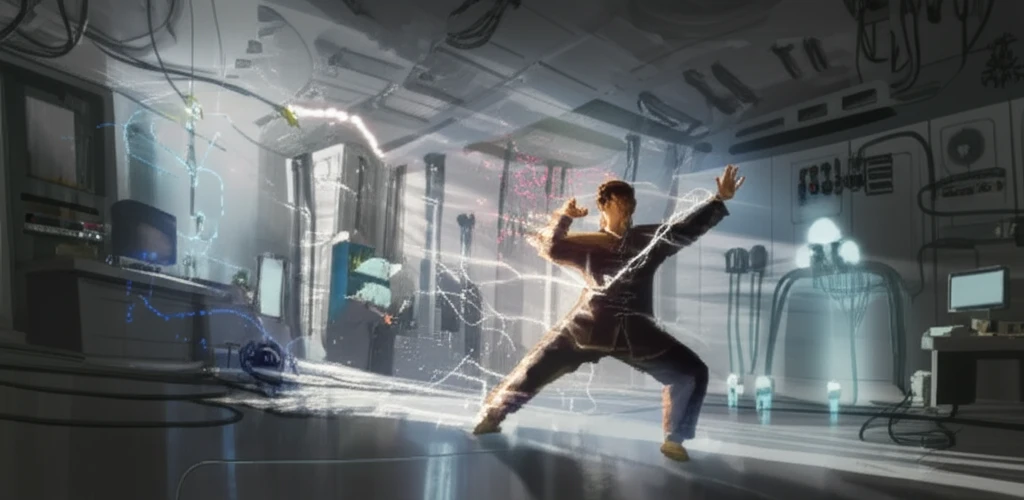
Unlock Your Potential: The Surprising Benefits of Tai Chi, Power Training, and VO2max Testing for a Healthier You

"Discover how Tai Chi enhances stability, power training boosts reaction time, and VO2max testing optimizes fitness for a vibrant life."
In today's fast-paced world, maintaining optimal health and fitness can feel like a constant uphill battle. With so much information available, it's hard to know where to focus your efforts. Fortunately, recent research provides valuable insights into effective strategies for improving your well-being. This article delves into three key areas: the benefits of Tai Chi for postural stability, the relationship between power and reaction time in older adults, and the importance of VO2max testing in achieving peak fitness.
We'll explore how Tai Chi, an ancient Chinese martial art, can significantly enhance postural stability, particularly in elderly women. We'll also uncover the critical connection between power and reaction time, revealing how targeted training can help older adults maintain their independence and prevent falls. Furthermore, we'll examine the role of VO2max testing in confirming the attainment of peak fitness levels, enabling individuals to optimize their training regimens and achieve their health goals.
Whether you're a seasoned athlete or just starting your fitness journey, understanding these concepts can empower you to make informed decisions about your health and fitness. By incorporating Tai Chi, power training, and VO2max testing into your routine, you can unlock your full potential and live a healthier, more fulfilling life.
Measuring Tai Chi and Postural Control
Research on Tai Chi commonly examines postural stability through center-of-pressure (COP) measures during standing. The PMC4262457 study describes multiscale entropy as a complementary method to traditional COP measures for characterizing sway during quiet standing. The PMC3640896 review notes that Tai Chi may improve physical function and reduce falls, while the magnitude or speed of COP excursions does not fully capture postural control.
Origins and Global Development
Accounts of Tai Chi history connect the practice with Chen Village origins, the Zhang Sanfeng legend, and five major family styles. Historical narratives differ on its early dating, citing 960, 1247, or 1279, and often combine documented history with Chinese legend. Other overviews describe Tai Chi as developing from ancient Chinese roots into modern global practice.
Tai Chi: Enhancing Postural Stability in Elderly Women
Tai Chi, a mind-body practice characterized by slow, deliberate movements, has long been recognized for its health benefits. A recent study investigated the impact of Tai Chi practice on postural stability in elderly women, an area of significant concern due to the increased risk of falls and related injuries. The research, conducted at Kanto Gakuen University in Ohta, Japan, sought to determine whether Tai Chi could improve postural control and balance in this vulnerable population.
- Study Design: Compared postural stability of Tai Chi practitioners and sedentary women.
- Participants: Included 56 female Tai Chi practitioners and 52 sedentary women.
- Measurement: Assessed COP fluctuations using a gravicorder.
- Key Finding: Expert Tai Chi practitioners showed significantly better postural stability.
Unresolved Evidence
The effect of Tai Chi practice on postural stability in elderly women is not clearly understood. This finding represents a limitation in interpreting Tai Chi as an established solution for postural stability. It also indicates that claims about its effects should be presented cautiously rather than as conclusive.
Comparing Stability and Complexity Measures
One Tai Chi comparison examined power spectral density of center-of-pressure fluctuations in the forward-and-backward direction under eyes-open and eyes-closed conditions. The reported power spectral density was larger with eyes closed than eyes open above 0.2 Hz. Separately, entropy studies have measured approximate entropy in EEG recordings from healthy adults during eyes-open and eyes-closed conditions, showing how postural and neural analyses use different complexity measures.
Empowering Your Health Journey
The insights from these studies underscore the importance of adopting a holistic approach to health and fitness. By incorporating Tai Chi for balance, power training for reaction time, and VO2max testing for fitness assessment, individuals can proactively enhance their well-being and achieve their personal health goals. Embrace these strategies to unlock your potential and live a healthier, more vibrant life.
What the Evidence Supports
A 2021 systematic review and meta-analysis investigated Tai Chi's effects on muscle strength, physical endurance, postural balance, and flexibility using tests applied in health-related fitness and competitive sports contexts. A separate meta-analysis reevaluated Tai Chi's effects on balance, falls, and health outcomes in older adults while examining subgroup differences that may influence effectiveness. Together, these reviews support evaluating Tai Chi across several functional outcomes rather than relying on a single balance measure.
Cautious New Directions
A 2026 narrative review links Tai Chi practice with molecular changes associated with neuroplasticity and improved functional outcomes. However, it states that direct causal links between Tai Chi, those molecular changes, neural plasticity, and clinical improvement still require further validation. The growing Tai Chi Walking trend likewise calls for a more nuanced assessment of how much science supports its popularity.