
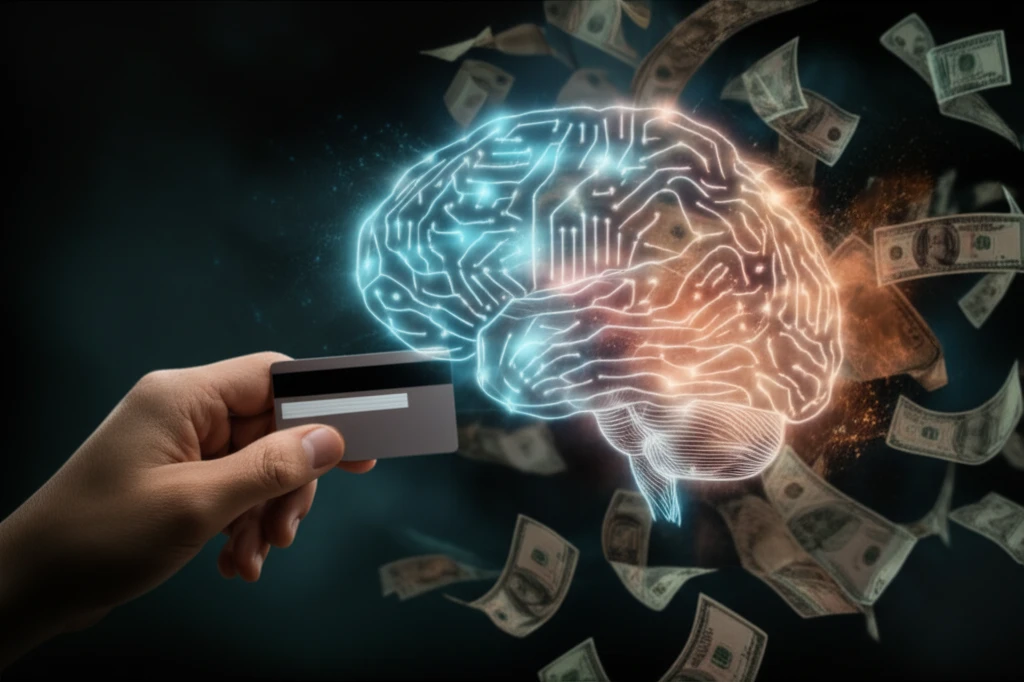
Unlock Your Patience: How Brain Stimulation Can Curb Impulsive Spending

"Can stimulating a specific brain region boost your financial self-control? New research reveals how targeting the prefrontal cortex can reduce impulsivity and improve decision-making."
We've all been there: the lure of instant gratification overshadowing long-term goals. Impulsivity, characterized by undervaluing future consequences, impacts our health, finances, and overall well-being. But what if we could tap into the brain's control center to curb these urges and promote more patient decision-making?
A fascinating area of research explores how contextual changes can significantly influence impulsivity. One of the most robust effects is the 'magnitude effect,' where individuals become more patient when the stakes are higher. Imagine choosing between receiving $20 today or $30 in a week, versus $2,000 today or $3,000 in a week. People tend to be more patient with the larger amounts, suggesting a shift in how our brains weigh immediate versus future rewards.
Now, scientists are digging deeper, examining the role of the dorsolateral prefrontal cortex (dlPFC)—a brain region associated with cognitive control—in this magnitude effect. By using targeted brain stimulation, they're uncovering how we can potentially enhance self-control and make better decisions.
Impulse Spending in 2026
A 2026 statistics page reports that Americans spend $3,381 per year on unplanned purchases. Other listed sources describe their coverage as including impulse-purchase totals and breakdowns by age, category, or platform, but the supplied snippets do not provide figures that can verify or corroborate the $3,381 estimate. A 2021 PLOS meta-analysis examined how financial self-control strategies affect saving and spending outcomes, but its snippet gives no effect size.
Strategies for Financial Self-Control
A 2021 study distinguishes empirically studied financial self-control strategies from lay strategies and strategies people devise for themselves, and examines their spontaneous use and effectiveness in aligning spending with goals. A related meta-analysis compares empirical findings with online-media and lay perspectives on ways to curb spending and save. The supplied sources do not identify which particular strategy works best. One source also cautions against conflating compulsive buying with impulsive buying: although both may involve self-regulatory failure, they differ in the cause and form of that failure.
Psychological Roots and Emerging Research
The listed material frames impulse buying as a behavior with psychological roots and points to self-control as a way to reduce wasteful spending. A 2026 paper describes research on Chinese college students examining self-control and impulsive consumption across family socioeconomic status and peer-feedback conditions. A separate article reports that a 2023 Financial Health Network survey found nearly 60% of U.S. adults admitted to impulsive spending and identifies emotional distress as the primary driver; it also reports an average of $314 in unplanned purchases per month. These sources provide context on possible explanations and research questions, rather than establishing a historical timeline of foundational discoveries.
The Brain's Impulsive Switch: How rTMS Works
Researchers at Stanford University used repetitive transcranial magnetic stimulation (rTMS) to temporarily disrupt activity in the dlPFC. rTMS involves using magnetic pulses to non-invasively stimulate specific brain regions, essentially 'dialing down' their activity for a short period. The study aimed to understand if the dIPFC plays a causal role in the magnitude effect.
- The Magnitude Effect Dissolves: Disrupting dIPFC activity with rTMS significantly reduced the magnitude effect. Participants became more impulsive overall, especially when dealing with high-magnitude choices.
- Control vs. Reward: The findings support the idea that the dlPFC-mediated control processes are key in modulating impulsivity, rather than simply altering how we value rewards. While areas like the striatum are involved in reward evaluation, the dIPFC appears to exert top-down control, influencing our ability to delay gratification.
- Challenging the 'Utility' Account: The study weakens the 'utility' model, which suggests that subjective valuation itself changes with magnitude. Because rTMS targeted the control center (dlPFC) and not reward centers, the results indicate that self-control, rather than altered valuation, underlies the magnitude effect.
Prefrontal Stimulation and Spending-Related Self-Control
A study titled “Brain Stimulation of Dorsolateral Prefrontal Cortices Influences Impulsivity in Delay Discounting Choices” investigates how stimulation of the dorsolateral prefrontal cortices relates to impulsivity in delay-discounting choices. Its supplied snippet describes a hypothesis about self-controlled tendencies under cost-needed conditions, comparing high- and low-magnitude reward options. A 2025 article reports that financial self-control predicts financial well-being and associates low self-control with impulsive spending, debt accumulation, and financial distress. The supplied excerpts do not establish that brain stimulation reduces real-world spending.
Evidence Is Not Uniform Across Sides
The cited report on causal evidence for the dependence of the magnitude effect on the dorsolateral prefrontal cortex notes a contrast with findings that repetitive transcranial magnetic stimulation (rTMS) and current stimulation of the left, but not the right, prefrontal cortex bias decision-making. This indicates that stimulation-related decision effects reported in the literature are not uniform across the brain side and methods described in the snippet. The supplied material does not specify the direction or size of the contrasting effects, so it cannot support a broader conclusion about whether stimulation reliably curbs impulsive spending.
Takeaways and Future Directions
This groundbreaking research provides compelling evidence that the dIPFC plays a causal role in the magnitude effect, influencing our ability to resist impulsive choices, especially when significant sums are involved. By temporarily disrupting this brain region, scientists demonstrated that cognitive control, rather than altered valuation, underlies the shift in patience we experience with larger rewards.
Impulsivity and Financial Strain
A 2024 overview describes impulsivity as a factor that can contribute to unplanned purchases and financial strain. It presents developing healthier financial behaviors as a response and points to strategies for doing so. The supplied source snippet does not name specific systemic causes or quantify the scale of these challenges.
Impulsivity in Everyday Decisions
The cited research describes impulsivity as a hallmark of human decision-making with documented health and financial ramifications. This places impulsive choices in a broader human context, beyond spending alone. The supplied snippet does not describe particular participants, personal experiences, or specific financial outcomes.
The findings challenge traditional economic models and open up exciting avenues for interventions aimed at enhancing self-control. Imagine a future where targeted brain stimulation or cognitive training programs could help individuals struggling with impulsive spending, addiction, or other decision-making challenges.
While further research is needed to fully understand the complexities of the dIPFC's role in intertemporal choice, this study offers a powerful glimpse into the brain mechanisms that govern our financial decisions—and how we might harness them to build a more patient and prosperous future.