
Unlock Your Fitness Potential: How Hands-On Learning Can Transform Your Biomechanics Course

"Struggling to grasp complex movement concepts? Discover how guided, hands-on activities can boost your biomechanics learning and enhance your understanding of the human body."
Kinesiology, the study of human movement, relies heavily on understanding human anatomy. Biomechanics, a core component of kinesiology, often challenges students due to its application of physics principles to the human body. Many find it difficult to translate theoretical knowledge into practical understanding.
Traditional biomechanics courses often rely on lectures, which can be abstract and difficult to relate to real-world movements. While laboratory experiences can enhance learning, they are often limited due to cost and time constraints. This creates a need for alternative teaching methods that can effectively engage students and improve their grasp of biomechanical principles.
This article delves into research exploring the effectiveness of integrating hands-on activities into a lecture-based qualitative biomechanics course. We'll examine how these activities, particularly when guided, can enhance student performance and provide a more embodied and lasting learning experience, potentially reshaping how biomechanics is taught.
A Long History of Studying Movement
Kinesiology is the study of human movement; the term comes from the Greek word *kinesis*, meaning motion or movement. Its development has been gradual over roughly the last 1,500 years, with physical education, military readiness, and health care among the historical contexts shaping the field. Records of movement study reach back to ancient Greece, where Aristotle observed and analyzed human and animal movement. Later insights into how the brain coordinates and regulates feedback between the body's systems added new dimensions to learning and kinesiology.
The Power of Doing: How Hands-On Activities Enhance Learning
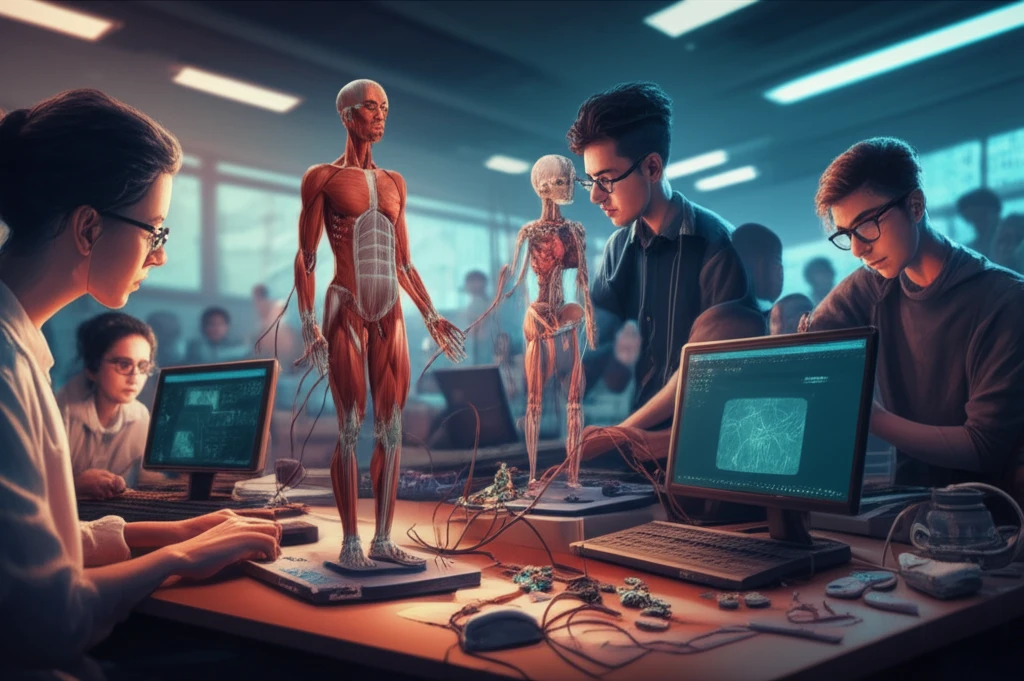
Research from Washington State University investigated the impact of incorporating hands-on activities into a biomechanics course. The study compared a traditional lecture format with one that included guided and unguided hands-on activities during lectures. Student performance on tests and course evaluations were compared between the two formats to determine if the hands-on approach improved learning.
- Skeletal Models: Students used skeletal models during lectures to interact with the bones of each joint as it was discussed. This provided a tangible way to visualize and understand the relationships between different anatomical structures.
- Electromyography (EMG): Following lower limb lectures, students used EMG units to measure the muscle activity of two muscles simultaneously. This allowed them to see in real-time how muscles activate during different movements.
- Isokinetic Dynamometer: Students used an isokinetic dynamometer to assess and practice various movements. This device allowed them to measure force and velocity, providing a quantitative understanding of muscle performance.
Practical Learning in Biomechanics
A report on experiential activities in neuroanatomy lectures cites findings by Catena and Carbonneau that hands-on activities, including electromyography in biomechanics, improved test scores. In a study of undergraduate perceptions of biomechanics curricula, students described practical sessions as a way to connect abstract theories or equations with observable movement. That study also reports that such sessions have been associated with greater motivation and personal responsibility for learning. Together, these sources point to practical work as a way to make movement concepts more tangible to students.
How Kinesiology and Biomechanics Differ
Kinesiology is generally described as the broader study of human movement, while biomechanics focuses on applying physics to biological movement, including forces and their effects on structures. Kinesiology can bring together physiological, psychological, and mechanical perspectives, as well as related areas such as exercise physiology, sports psychology, motor development, sports medicine, and physical education. One source notes that kinesiology grew out of physical education departments in the 1960s, as researchers questioned the value of simply counting exercises for understanding motor learning. These descriptions distinguish biomechanics as a focused analytical lens within the wider study of movement.
Reimagining Biomechanics Education: A Path Forward
The findings of this study highlight the potential of hands-on activities to transform biomechanics education. By incorporating these interactive methods, educators can create a more engaging and effective learning environment for students.
Technology and Changing Expectations Ahead
A kinesiology podcast panel featuring Dr. Gregory Wallace, Dr. Joshua Bullock, Dr. Michael Richards, and Dr. Karly Mendez considers how technology, data, and changing expectations may shape the field over the next 5–10 years. Other listed material points to current research topics spanning seven areas, with 105 frontier ideas in exercise science, sports medicine, biomechanics, and motor behavior. A separate Research.com outlook describes job-market trends, salary expectations, and career opportunities through 2030. These sources frame the future through emerging research themes, professional trends, and the influence of technology and data.
Furthermore, the research suggests that guided hands-on activities are more effective than unguided ones. This implies that structured activities with clear learning objectives are crucial for maximizing the benefits of this approach.
As biomechanics continues to evolve, embracing innovative teaching methods like hands-on activities will be essential for preparing the next generation of kinesiologists and fitness professionals. By shifting towards a more active and embodied learning paradigm, we can unlock the full potential of students and foster a deeper appreciation for the wonders of human movement.