
Unlock Your Financial Future: Mastering the Elasticity of Intertemporal Substitution

"Navigate economic shifts with confidence by understanding how your saving and spending choices impact your long-term financial health."
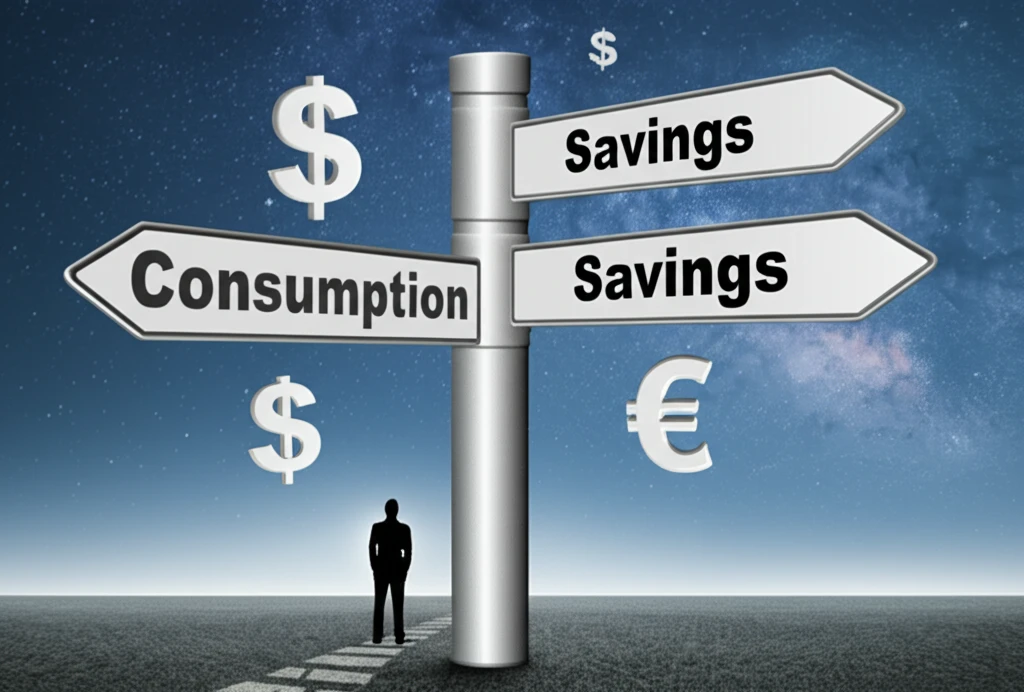
In an ever-changing economic landscape, making sound financial decisions can feel like navigating a complex maze. One concept that can provide clarity and empower individuals to take control of their financial futures is the Elasticity of Intertemporal Substitution (EIS). Simply put, the EIS helps us understand how willing we are to shift our spending and saving habits in response to changes in interest rates or expected returns.
Think of it this way: imagine interest rates suddenly jump. Will you be tempted to save more, taking advantage of the higher returns, or will you continue spending as usual? The EIS measures this very responsiveness. It's a powerful tool that can help you optimize your financial strategies, whether you're planning for retirement, managing debt, or simply trying to make the most of your income.
This article will explore the intricacies of EIS, breaking down complex economic theories into actionable insights. We'll delve into how understanding your own EIS can lead to better financial planning, improved investment decisions, and greater resilience in the face of economic uncertainty. Get ready to unlock a new level of financial understanding and take charge of your future.
A Contested Measure With High Stakes
Intertemporal substitution is central to how individuals weigh current versus future consumption, yet no single authoritative statistic pins down its magnitude. Published estimates can vary widely depending on the data, estimation method, and model assumptions used, so precise figures should be treated as study-specific rather than universal. What is clear is that the concept shapes assessments of saving behavior, interest-rate sensitivity, and overall economic welfare.
Measuring Responsiveness as a Ratio
In economics, elasticity measures the responsiveness of one variable to a change in another, commonly capturing how demand changes in response to price, and it is expressed as a unitless ratio that allows comparisons across different goods. For example, a price elasticity of demand of -2 means that a 10% increase in price will cause the quantity demanded to fall by 20%. The idea parallels its origins in physics, where elasticity describes a body's ability to resist a distorting force and return to its original size and shape once the force is removed. The key limitation of the standard approach is that elasticity quantifies responsiveness rather than explaining its cause: it records how much quantities move but does not reveal why that response occurs.
Responsiveness as a Lens on Markets
Britannica Money describes elasticity, in economics, as a measure of the responsiveness of one economic variable to another, capturing how strongly one quantity shifts when a related variable changes. This framing indicates that responsiveness has long served as a core conceptual lens for analyzing market behavior rather than a secondary detail. The historical record offered by this source is limited, so the specific origins and milestones of the concept should not be overstated here.
What is the Elasticity of Intertemporal Substitution (EIS)?
At its core, the EIS measures the percentage change in consumption growth resulting from a one percent change in the rate of return on investment. In simpler terms, it tells us how sensitive our current consumption is to potential future rewards. A high EIS indicates a strong willingness to adjust spending based on interest rates or returns, while a low EIS suggests a preference for maintaining current consumption patterns regardless of potential future gains.
- Savings Allocation: Deciding how much to save versus spend based on prevailing interest rates and investment opportunities.
- Investment Choices: Selecting investments that align with your risk tolerance and EIS, maximizing potential returns while staying comfortable with market fluctuations.
- Debt Management: Strategically managing debt by considering how changes in interest rates might impact your repayment plans.
- Retirement Planning: Projecting future income and adjusting savings rates based on expected returns and your EIS.
An Evolving but Unsettled Literature
Ongoing research continues to probe how strongly people shift consumption across time in response to changes in interest rates and expected returns. Estimates of the elasticity of intertemporal substitution vary considerably across studies, depending on the data, model assumptions, and measurement techniques employed. As a result, claims about a single authoritative value are not currently supported by the literature, and any specific figures should be treated as provisional outcomes of particular methods.
Critiques of a Strong Concept
The elasticity of intertemporal substitution has drawn criticism, with some researchers arguing that standard models overstate how readily households adjust consumption over time. Evidence on whether observed savings behavior matches theoretical predictions is mixed, and poorly estimated values can lead to misleading conclusions about policy and welfare. Disagreement remains about whether the parameter reflects genuine behavioral flexibility or is partly an artifact of model assumptions.
Distinct but Frequently Confused Concepts
The concept is often compared with closely related measures such as risk aversion, with which it is sometimes conflated even though the two capture different aspects of preferences. Comparisons across countries and demographic groups also reveal wide variation in how much households smooth consumption over time. Such contrasts are suggestive rather than definitive, given differences in data quality and methodology across settings.
Seize Control of Your Financial Destiny
The Elasticity of Intertemporal Substitution offers a powerful lens through which to view your financial decisions. By understanding your own EIS and how it interacts with economic conditions, you can craft personalized strategies that optimize your savings, investments, and overall financial well-being. Embrace this knowledge, and empower yourself to navigate the complexities of the economy with confidence and achieve your long-term financial goals.
A Useful Tool, Not a Fixed Number
Taken together, current knowledge suggests the elasticity of intertemporal substitution is a valuable conceptual tool rather than a precisely fixed number. It helps organize thinking about how households trade off present and future consumption, yet its estimated magnitude remains sensitive to context and method. The most defensible synthesis is that the concept illuminates behavior even while precise quantification stays contested.
Toward Sharper Estimates
Future work is likely to combine richer household-level data with more flexible modeling approaches, potentially narrowing the range of plausible estimates. Advances in empirical methods and new data sources could clarify how the parameter varies across income, age, and economic conditions. Any such progress, however, remains prospective, and near-term conclusions should be treated cautiously.
At the Center of Big Policy Questions
The parameter sits at the heart of debates over saving, investment, and monetary policy transmission. How strongly individuals respond to interest rates affects everything from retirement planning to how central bank actions ripple through the wider economy. Because these questions have practical stakes, uncertainty about the parameter matters well beyond academic economics.
Ordinary Choices Behind an Abstraction
Behind the parameter are everyday decisions about saving, borrowing, and spending over a lifetime. A high elasticity implies households eagerly shift consumption to match changing opportunities, while a low one suggests habits, constraints, and uncertainty dominate. These real-world realities-including retirement security and living standards-are what make the abstraction meaningful in personal terms.