
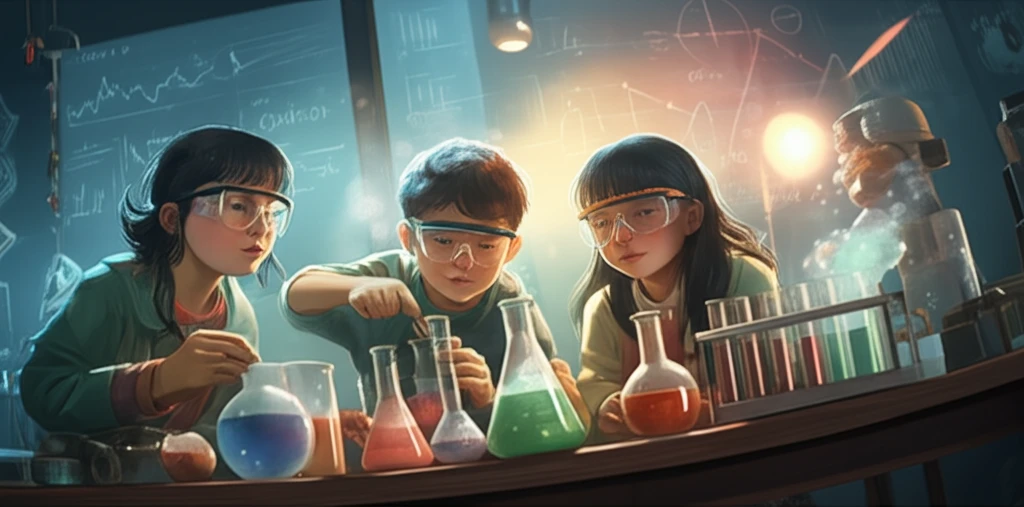
Unlock Your Child's Potential: How Multi-Cycle DEAL Transforms Science Learning

"Discover the innovative teaching model that's boosting science mastery in elementary schools and how you can use it."
In today's rapidly evolving world, a strong foundation in science is more critical than ever. From understanding the technology that shapes our lives to making informed decisions about our health and environment, scientific literacy is essential for success. However, many elementary school students struggle with science, finding it difficult to grasp complex concepts and apply them to real-world situations. Traditional teaching methods often fall short, leaving children feeling disengaged and unmotivated.
But what if there was a way to make science learning more effective, engaging, and enjoyable for young learners? Enter the Multi-Cycle DEAL teaching model, an innovative approach that's transforming science education in elementary schools. This model, which stands for Discussion, Exploration, Analysis, and Look-back, is designed to actively involve students in the learning process, fostering a deeper understanding of scientific concepts and improving their ability to solve problems and make informed decisions.
This article explores the Multi-Cycle DEAL teaching model, examining its key components, its effectiveness in improving science mastery, and how educators and parents can implement it to unlock their child's full potential. Get ready to discover a new approach to science education that empowers young learners and prepares them for a future driven by innovation and discovery.
Education Data and Its Uses
Education statistics cover school enrollment, educational attainment, student achievement, and aspects of school finance, curriculum, teaching, and instruction across elementary, secondary, higher, and adult education. UNESCO DataHub provides global statistics, datasets, visualizations, and indicators intended to support evidence-based policymaking and sustainable development goals. A 2018 study describes using educational data science dashboards to show patterns and trends in teaching performance and to support data-informed decision-making in higher education.
Reviewing Science Teaching Methods
A 2024 analysis report examines teaching methodologies used in science education, including their advantages, disadvantages, and relevance to instruction and assessment. A 2025 mixed-methods study investigates current challenges and gaps in science-education pedagogy. Separately, a systematic review of 31 research articles published between 2010 and 2022 examines modeling in science education, using a PRISMA-guided selection process. Together, these sources frame teaching methods and modeling as areas being evaluated, while the available summaries do not identify a single approach as universally effective.
Changing Foundations in Science Education
A 2024 chapter on the history of science in science teacher education reports that a significant percentage of pre-service and in-service teachers develop or approach their teaching based on outdated foundations. The supplied history of science education summary describes K–12 standards grounded in research on how students learn science, emphasizing scientific practices and core ideas, and notes that the standards went through multiple rounds of review before release for state adoption and implementation. These accounts point to both the persistence of older teaching ideas and efforts to ground standards in research about student learning.
What is the Multi-Cycle DEAL Teaching Model and Why Does It Work?
The Multi-Cycle DEAL teaching model is a structured approach to science education that emphasizes active learning and critical thinking. Unlike traditional methods that often rely on passive listening and rote memorization, DEAL encourages students to take an active role in their learning journey. Each stage of the model is carefully designed to build upon the previous one, creating a cohesive and engaging learning experience.
- Discussion: The learning process begins with a discussion of the problem or concept at hand. This allows students to share their existing knowledge, ask questions, and identify areas where they need more information.
- Exploration: Students then engage in hands-on activities, experiments, or research to gather information and explore the topic in more detail. This stage encourages curiosity and allows students to learn through direct experience.
- Analysis: Once students have gathered sufficient information, they analyze their findings, identify patterns, and draw conclusions. This stage develops critical thinking skills and helps students make sense of the information they have gathered.
- Look-back: In the final stage, students reflect on what they have learned, evaluate their understanding, and identify areas where they still need clarification. This stage reinforces learning and helps students develop metacognitive skills.
Limits and Barriers to Effective Teaching
The study of the Multi-Cycle DEAL Teaching Model concludes that further research is needed across a wider range of material and with a broader research population. A 2025 source identifies systemic education-policy issues, inadequate resources, insufficient teacher professional training, and limited student-centered engagement as barriers to effective science teaching. A separate 2023 source describes problem-based learning as using complex, open-ended real-world problems to encourage student learning. These sources indicate that an instructional model’s findings may need broader testing and that classroom and system conditions can constrain science education.
Empowering Future Scientists: The Lasting Impact of DEAL
The Multi-Cycle DEAL teaching model offers a promising approach to transforming science education in elementary schools. By actively engaging students, fostering critical thinking, and promoting collaboration, it empowers young learners to develop a deep understanding of science and a lifelong love of learning. As educators and parents, we have a responsibility to provide children with the best possible learning experiences. By embracing innovative approaches like Multi-Cycle DEAL, we can unlock their full potential and prepare them to become the scientists, innovators, and problem-solvers of tomorrow.
What Expert Science Teaching Means
The Expert Science Teaching Evaluation Model (ESTEEM) was developed under the Center for Research on Educational Accountability and Teacher Evaluation, with goals that included defining expert science teaching and developing instruments to assess it. The model’s theoretical premises and research from 1990 through 1993 are discussed in an ERIC-indexed paper. A 2023 metasummary offers a broader evidence base on teacher expertise in K–12 education, analyzing 106 empirical studies from 16 countries involving 1,124 teachers identified as experts. Together, these sources show that expert teaching has been examined both through a dedicated evaluation model and through a cross-study synthesis.
Emerging Directions in Science Education
A systematic review of current science-education trends identifies inquiry-based and project-based approaches, STEM integration, technology-integrated learning, and gamification among the pedagogical approaches examined in empirical research. Its stated aim is to consolidate evidence about teaching strategies and learning outcomes. Other supplied sources describe future science education as shaped by technological advances, innovative teaching methods, interdisciplinary approaches, inclusive practices, and attention to global challenges such as sustainability. These are presented as developing directions rather than established predictions about outcomes.
Scaling STEM Education Innovations
The National Academies’ November 2024 consensus study, *Scaling and Sustaining Pre-K-12 STEM Education Innovations*, describes a rich variety of U.S. STEM education innovations, including programs, practices, models, and technologies. It notes that although some innovations have the potential to affect learners on a broad scale, that potential often remains unrealized. The report frames these issues as systemic challenges requiring systemic responses, placing the spread and durability of innovations within a broader education-system context.