
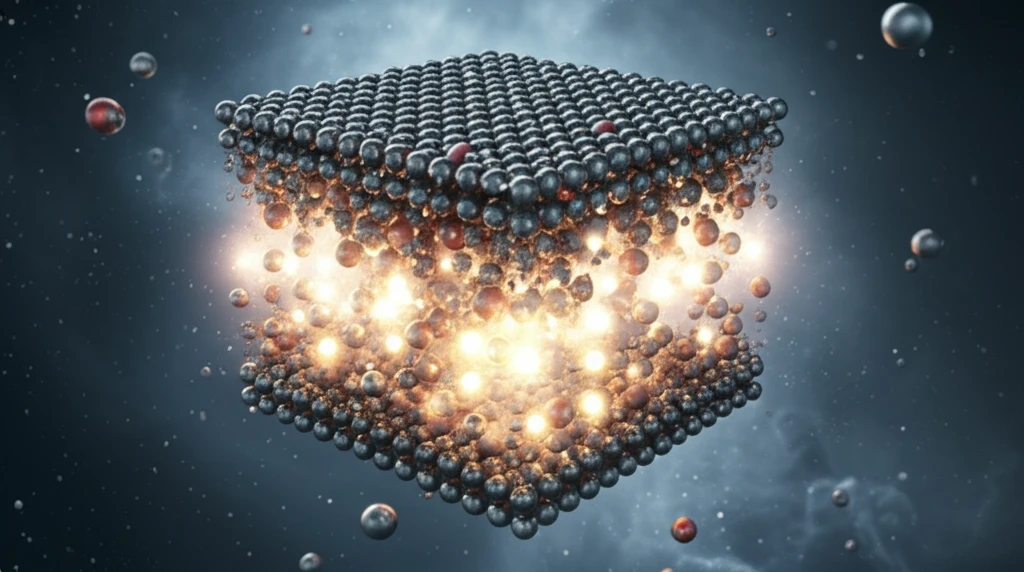
Unlock the Power: How Dual Substitution Can Revolutionize Battery Performance

"Could a simple tweak to battery chemistry solve the energy crisis? Discover the groundbreaking potential of dual-substituted LiFePO4 in creating high-performance, long-lasting batteries."
In a world increasingly powered by portable electronics and electric vehicles, the quest for more efficient and reliable batteries is paramount. Lithium-ion batteries have become the cornerstone of modern energy storage, but their limitations in terms of rate capability and lifespan are driving researchers to explore innovative solutions. One promising avenue is the modification of existing battery materials through a process known as 'dual substitution.'
The pursuit of better batteries has led scientists to focus on Lithium Iron Phosphate (LiFePO4), a material celebrated for its inherent stability and suitability for energy storage. A breakthrough in battery technology comes from the manipulation of LiFePO4, known for its robustness. But, LiFePO4 has its drawbacks, including relatively slow lithium-ion diffusion, which limits its performance under high charge or discharge rates. That’s where dual substitution comes in, offering a pathway to enhance these critical aspects.
Recently published in 'ACS Applied Energy Materials,' a team of researchers has demonstrated a method to significantly boost the rate performance of LiFePO4 batteries by employing dual substitution. This method involves replacing a small percentage of iron and phosphorus ions with zirconium and silicon, respectively, to manipulate the material's structure at the atomic level. Let’s dive into how this process works and what it could mean for the future of energy storage.
Dual Substitution: A Promising Strategy for Next-Gen Batteries
Dual substitution—a technique where two different elements are simultaneously replaced within a crystal structure—has emerged as a powerful approach to improving battery cathode and electrolyte materials. A dual substitution strategy applied to Co-free layered material LiNi0.5Mn0.5O2, partially replacing Li and Ni with Na and Al respectively, has been shown to produce a superior cathode material for lithium-ion batteries. This approach addresses long-standing challenges in battery material design by enabling synergistic improvements that single-element substitution cannot achieve alone.
Beyond Mono-Substitution: The Dual Approach Advantage
Conventional single-element (mono) substitution methods have limitations in engineering structural defects and improving material performance. Research demonstrates that dual substitution can be more effective than mono substitution when foreign ions are suitably selected, as it enables synergistic enhancement of properties. For Na-ion battery cathodes, a dual substitution of Cu2+ and Zn2+ for Ni2+ in layered oxide materials achieves a complete solid solution reaction and better cycling stability—a result unattainable through conventional single-substitution approaches. This highlights how the strategic selection of two dopant ions can unlock performance gains that elude standard methods.
From Simple Substitutions to Dual Strategies
Battery substitution has long been a practical concern, from consumer-facing battery replacements in devices like Kodak Instamatic cameras—where a K Battery could be replaced with a substitute pack using AA batteries—to modern efforts at the materials science level. The concept of replacing one battery chemistry or format with another has evolved significantly, moving from simple form-factor swaps at the device level to sophisticated atomic-scale dual substitution strategies within crystal lattices. This progression reflects the broader maturation of battery technology, where researchers now manipulate materials at the elemental level to unlock performance improvements that were once inconceivable.
The Science Behind Dual Substitution
At its core, the dual substitution strategy aims to address a fundamental bottleneck in LiFePO4 batteries: the lattice volume change that occurs as lithium ions are inserted or extracted during charge and discharge cycles. This volume change creates strain within the material, hindering the rapid movement of lithium ions and ultimately limiting the battery's rate capability. By introducing zirconium and silicon, the researchers were able to reduce this lattice volume change, creating a more stable and efficient pathway for lithium-ion transport.
- Increased Rate Capability: By reducing the lattice volume change during charging and discharging.
- Stable Intermediate Phase: Ensuring smoother transitions and faster lithium-ion movement.
- Enhanced Performance: Dual-substituted LiFePO4 can charge and discharge significantly faster than the undoped material.
- Longer Lifespan: Reduced strain within the battery material enhances durability.
Dual Substitution Breakthroughs in Solid Electrolytes and Cathodes
Recent studies have demonstrated the significant potential of dual substitution in improving both cathode and solid electrolyte materials for lithium-ion batteries. In garnet-structured solid electrolytes, dual substitution of Ta5+ for Zr4+ and Mg2+ for Li+ in Li6.5Mg0.05La3Zr1.6Ta0.4O12 achieved an enhanced total ionic conductivity of 6.1 × 10⁻⁴ S cm−1 at room temperature. Researchers at Imperial College London have also developed an innovative dual substitution strategy for garnet electrolytes, introducing Ga3+ on Li sites to stabilize the fast-conducting cubic phase. These findings collectively show that carefully designed dual substitution can address multiple material limitations simultaneously.
Compatibility and Practical Challenges
Despite its promise, dual substitution faces real-world implementation challenges. Battery compatibility remains a critical issue even in conventional substitution scenarios—terminology like 'Group H5' versus 'Size 35' illustrates how confusing battery specifications can lead to improper substitutions that compromise performance. For consumer devices like iPhones, even straightforward battery replacements require careful attention to service options and costs, underscoring that material-level innovations must eventually navigate the practical constraints of manufacturing, certification, and end-user accessibility. These challenges suggest that while dual substitution shows laboratory promise, translating it into widely adopted commercial products requires overcoming significant practical hurdles.
Pulse vs. Continuous Current: Substitution Performance Nuances
When substituting battery types, real-world performance differences often emerge beyond nominal capacity figures. As noted in electronics engineering discussions, substituting one lithium cell for another—such as a CR2450 for a CR2340—may not yield the expected duration differences when comparing typical capacity figures, because pulse current and continuous current ratings behave differently in practice. Similarly, in the consumer battery space, viable substitutes like the 377 battery for the LR41 must match not only physical dimensions but also discharge characteristics. These comparisons reveal that dual substitution strategies in battery materials must similarly account for multiple performance parameters simultaneously, not just a single metric like capacity or conductivity.
The Future of Battery Technology
The development of dual-substituted LiFePO4 represents a significant step forward in battery technology. By manipulating the material's structure at the atomic level, researchers have unlocked a pathway to enhance rate capability, improve stability, and extend lifespan. This innovative approach has the potential to revolutionize energy storage, paving the way for more efficient electric vehicles, longer-lasting portable electronics, and more reliable grid-scale energy storage systems. As the world transitions towards sustainable energy solutions, advancements like dual substitution will play a crucial role in shaping a cleaner, more efficient future.
Dual-Substitution Research Converges on Structural Stability
Expert analysis and recent dataset publications underscore the importance of dual substitution for structural stability in advanced battery materials. Research on Ti and Zn dual-substitution in P2-type Na2/3[Ni1/4Mn1/2Ti1/6Zn1/12]O2 demonstrates almost non-step voltage curves with a reversible capacity of 114 mAh g−1, with less structural changes and maintained high crystalline structure during charging and discharging. Meanwhile, broader industry commentary from the mining and investment sector warns that lithium-ion battery substitution carries material supply chain risks, suggesting that dual substitution strategies may also serve as a hedge against single-element resource dependencies. These perspectives converge on a key insight: dual substitution is not merely a performance optimization but a strategic approach to building more resilient battery technologies.
Sodium-Ion Batteries and the Substitution Wave
The rise in lithium carbonate prices has catalyzed substitution demand, directly fueling expectations that sodium-ion batteries could emerge as a viable alternative technology. According to SMM analysis, this price pressure triggered a seasonal peak demand period across the sodium-ion battery industry chain, with various segments showing differentiated responses. However, studies caution that regulatory decisions to phase out established battery technologies prematurely would negatively impact overall vehicle performance and cost. The path forward appears to involve parallel development of advanced substitution strategies—both at the materials level through dual substitution in crystal structures and at the system level through alternative battery chemistries—rather than wholesale technology replacement.
Industry-Wide Implications of Battery Technology Substitution
The European Automobile Manufacturers' Association (ACEA) has warned that substitution of battery technologies would have a significant impact on the overall performance and cost of vehicles, as well as on targets for fuel efficiency and reduced CO2 emissions. Research on P2-type sodium manganese oxides demonstrates how dual substitution impacts both anionic and cationic activity simultaneously, revealing the complex interplay of factors that must be balanced when modifying battery materials at the atomic level. These systemic challenges highlight that dual substitution strategies, while scientifically promising, operate within a broader ecosystem of regulatory requirements, supply chain constraints, and performance targets that collectively determine whether innovations can achieve commercial viability.
Bridging Lab Innovations to Practical Battery Applications
The ultimate measure of dual substitution's impact lies in its translation from laboratory research to real-world battery applications. Researchers at National Cheng Kung University have demonstrated Ga/Nb dual substitution in Li7La3Zr2O12 garnets, achieving high Li+ conductivity and dense microstructures specifically for solid-state battery applications. Further, studies on Ti–Zn dual-substituted layered oxides show that this approach retains original wide interslab space during charging, contributing to suppression of structural stress between P2 and O2 phases and stabilization of crystal structures in both bulk and surface. These advances move dual substitution from theoretical material science toward tangible improvements in battery safety, longevity, and performance that directly benefit end users.