
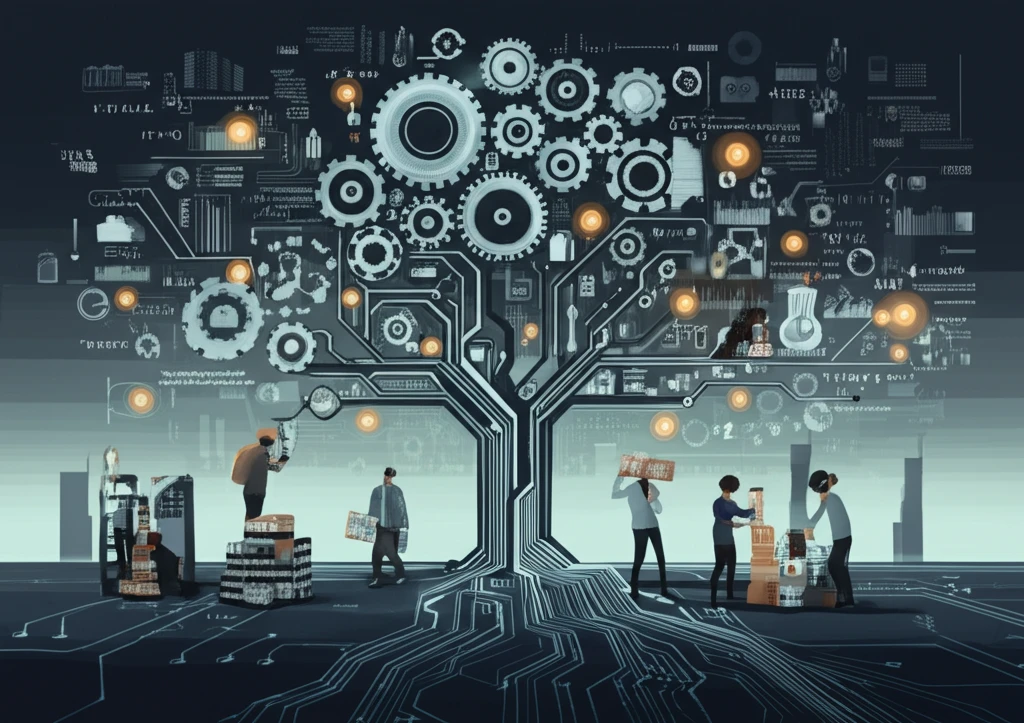
Unlock the Future: How STEM Education is Reshaping Learning for a New Generation

"Dive into the world of STEM education, exploring its core principles, practical frameworks, and why it's essential for K-12 success."
The dawn of the new millennium has ushered in unprecedented scientific advancements, profoundly impacting every facet of our social and economic structures. At the heart of this transformation lies Engineering in STEM, a discipline now recognized as a critical priority, reflecting the accelerating pace of scientific progress. STEM education distinguishes itself by weaving together concepts traditionally taught in isolation, emphasizing the application of knowledge to solve real-world problems and foster innovation.
In STEM learning environments, educators consciously strive to synchronize learning objectives and activities across two or more STEM disciplines, whether in classrooms or schools. This approach aims to provide a holistic and integrated educational experience, breaking down traditional silos between subjects. This article delves into a critical analysis of the contexts and frameworks that support engineering in STEM education, offering research-backed insights and practical recommendations to enhance STEM teaching and learning.
Engineering education plays a pivotal role in cultivating essential 'habits of mind,' including systems thinking, creativity, optimism, collaboration, effective communication, and ethical considerations. Integrated into the Next Generation Science Standards (NGSS), engineering design education equips students with the skills to transfer knowledge across various science disciplines. Through activities such as modeling, planning, conducting investigations, analyzing data, and constructing explanations, students demonstrate a comprehensive understanding of core scientific concepts, bridging the gap between theory and application.
Growing Pay, Growing Gaps
Statistics aggregations report that STEM professionals earn a median salary of $100,000 compared to $65,000 for non-STEM workers, with STEM careers projected to grow faster and deliver higher long-term returns than non-STEM paths. These figures are drawn from peer-reviewed studies, official statistics, industry databases, and recognized institutions. Yet the same data show that major gaps by race, gender, and income still limit who can enter STEM fields even as opportunity grows. On the policy side, coalitions such as Turkey's STEM Education Task Force (FeTeMM) bring together academicians and teachers working to raise the quality of education in STEM fields.
From Isolated Subjects to Integrated Learning
STEM differs from traditional learning by integrating science, technology, engineering, and math into a hands-on, connected experience that fosters creativity and real-world problem solving, in contrast to topics taught individually. Government programs have tried to scale this approach, with the Obama administration's Educate to Innovate initiative directing billions in additional federal funding to STEM education programs. National outcomes still vary considerably, however: in Ireland, the variety of STEM graduates reached 40.1 per 1,000 individuals aged 20 to 29 in 2022, the best figure within the EU.
From Acronym to Movement
STEM began as an education curriculum focused heavily on the subjects of science, technology, engineering, and mathematics. Over time it evolved into an interdisciplinary approach that couples academic concepts with real-world lessons and is considered important because it aims to expand the workforce of scientists and engineers while improving literacy in science, mathematics, and technology. A key milestone was the emergence of STEAM, a progression of the original acronym that adds art; educators report that integrating the arts expanded the benefits of hands-on education and collaboration.
The Evolution of STEM Frameworks
While various approaches exist for integrating STEM into educational systems, influenced by unique political, social, and cultural contexts, the objective remains consistent: to equip students with interdisciplinary skills and knowledge. Despite the absence of a universally accepted method for subject integration and STEM implementation, theoretical frameworks and models offer valuable guidance for curricular and program inclusion. Theories such as Capraro's Project-based Learning, Roni's Problem-based Learning, T-STEM, and Dugger's STEM Implementation Theory provide diverse strategies for enhancing STEM education.
- Project-Based Learning (PBL): Enables students to acquire a deeper knowledge through active exploration of real-world challenges and problems.
- Problem-Based Learning (PBL): Students learn about a subject through the experience of solving an open-ended problem found in trigger material.
- T-STEM Model: Focuses on creating rigorous and relevant educational experiences that prepare students for STEM careers and higher education.
- Dugger's STEM Implementation Theory: Provides a structured approach for integrating STEM disciplines into the curriculum, emphasizing collaboration and innovation.
What New Evidence Shows
Recent reviews highlight how STEM education has moved beyond the mere combination of four subjects into an integrated, interdisciplinary approach essential for developing skills like critical thinking and problem-solving. Evidence-based research is increasingly being placed within the specific context of STEM teacher education, where it can shape how educators are prepared. National efforts such as "STEM Education in Canada: A Knowledge Synthesis" serve as a backdrop for the papers that follow in that field. One study reported that parents talking to children about STEM fields boosts test scores and career interest, an approach researchers described as cost-effective.
When Reform Falls Short
STEM reforms are not guaranteed to succeed, and the Turkish experience illustrates the obstacles. Reforms in STEM education are considered particularly critical for Turkey's economic competitiveness because the innovation productivity of the country's human capital lags behind other developed countries. Introducing STEM there required a critical investigation of global and local educational policies, previous research on curriculum integration and integrated teaching knowledge (ITK), and the existing Turkish educational reforms.
How Nations Measure Up
International comparisons show how differently STEM is implemented around the world. Reports such as "Status and Trends of STEM Education in Highly Competitive Countries" provide country reports and international comparisons, including attention to Canadian culture and education and to BIPOC students in engineering and technology. Meanwhile, country rankings compile international data on education systems, literacy, and performance indicators to produce comparative scores. At the individual level, some programs show that families do not have to choose between STEM and screen limits, using PDFs and kitchen-science guides to keep young learners moving without a tablet.
Conclusion: Charting the Future of STEM Education
STEM-focused career and technical education (CTE) programs offer invaluable opportunities in high schools and regional centers, preparing students for diverse STEM careers while engaging those at risk of dropping out. This research provides a clear definition and purpose of STEM for K-12 students, aligned with extensive research literature. Pre-service, in-service, and administrative leaders can leverage this information to articulate the meaning, goal, and purpose of STEM within their curricula, fostering collaboration and clarity among educators.
Voices Across the Field
Expert commentary increasingly focuses on early STEM education and the importance of evaluating its benefits and forming a clear position, a topic prominent even in education-writing contexts. Teachers' own perspectives matter too: a study analyzing prospective teachers' metaphorical perceptions of STEM education used content analysis to understand how future educators conceive of the approach. Professional gatherings reinforce the exchange of ideas, such as a two-day STEM conference in Hawaiʻi where an AI and education expert delivered the opening keynote to teachers and students from across the state.
The 2026 Shift
Many observers expect the coming period to clearly separate institutions that are truly future-ready from those simply keeping pace with curriculum requirements. Emerging technologies and trends are giving educators new tools and methodologies for active, hands-on learning, with STEM education seen as critical for preparing students for the future of work. The landscape is evolving rapidly, driven by technological advancements and changing workforce demands, making it essential for educational leaders to stay ahead of the curve.
Barriers Beyond the Classroom
Systemic challenges still shape who can enter and advance in STEM. One study examined the systemic challenges and support that 82 participants who identified as women and/or LGBT+ academics and PhD students experienced in their STEM environments and throughout their careers. India leads in female STEM enrollment, yet women still face leadership underrepresentation after education, attributed to systemic barriers and unconscious biases, with proposed remedies involving workplace reforms and empowering women's voices in STEM. Advocates argue the impact of educating girls extends far beyond individual careers, creating a multiplier effect that drives broader social and economic transformation.
Learning That Reaches the Real World
At its core, STEM education connects abstract knowledge to people and real problems. Interactive tools let students immerse themselves in real-life STEM cases, learning about real-world challenges and solving them like actual scientists. STEM learning starts with the basics, such as addition and subtraction, and as students get older it can bring in project-based learning, one way to allow students to tackle real-world problems using all the blended knowledge they need.