
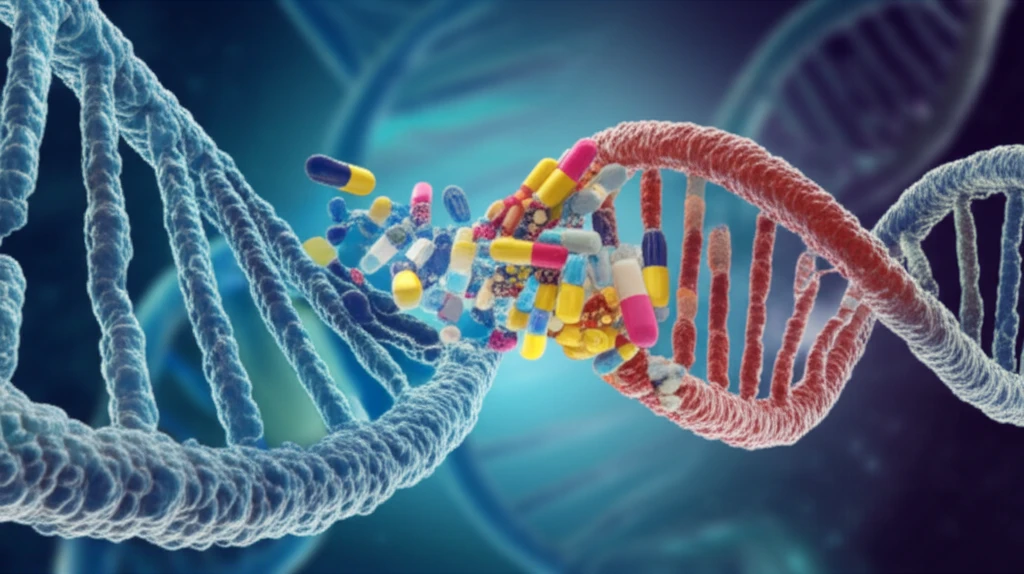
Unlock Synergistic Drug Combinations: A Guide to Better Treatments

"Navigate the complexities of drug synergy with a comprehensive guide, designed to explain statistical analysis and enhance treatment effectiveness."
In the relentless pursuit of more effective treatments, combining drugs to leverage their synergistic effects has emerged as a promising frontier. This approach, however, introduces significant complexity in data analysis. It's no longer sufficient to understand how each drug performs in isolation; the critical question becomes how they interact when administered together.
Imagine trying to bake a cake, but instead of just focusing on whether your oven heats up correctly, you also have to worry about how the flour reacts with the sugar at different temperatures. That's the challenge scientists face when studying drug combinations: understanding not just the individual effects, but their combined impact.
This guide aims to demystify the process by exploring statistical methodologies designed to analyze drug combination studies. We'll break down complex concepts into digestible insights, empowering researchers, healthcare professionals, and anyone interested in optimizing treatment strategies to make sense of the science.
Drug Use and Interaction Awareness
Drug use can involve legal, controlled, or illegal substances taken to alter consciousness and create positive emotions or feelings. Substance misuse refers to using a drug in amounts or ways that harm the individual or others. Drugs.com reports that its database covers more than 24,000 prescription drugs, over-the-counter medicines, and natural products. Its interaction checker also cautions that not all drugs interact and that an interaction does not necessarily mean a medication must be stopped.
What Counts as a Drug
Britannica defines a drug as any chemical substance that affects the functioning of living things. This definition includes substances that act on organisms such as bacteria, fungi, and viruses. It provides a broad foundation for discussing medicines and drug combinations, but it does not by itself establish that combining particular drugs is effective or safe. Evaluating a combination therefore requires attention to its specific effects and risks.
A Developing Field
The study of drug combinations has developed through changing ideas about how substances affect living systems. Earlier approaches may provide useful context, but historical conclusions should be tied to documented evidence for particular discoveries and milestones. Without source-specific evidence here, the history is best treated as a broad progression rather than a list of definitive turning points.
Decoding Drug Synergy: What Methods Work Best?
When analyzing how drugs interact, we're essentially trying to determine if their combined effect is simply additive (1+1=2), synergistic (1+1>2, a multiplied effect), or antagonistic (1+1<2, a lessened effect). The goal is to move beyond simple observation and quantify the extent of these interactions in a statistically meaningful way.
- Individual Drug Analysis: First, you assess each drug's effect separately. This baseline helps in understanding the combined impact.
- Combination Studies: Next, conduct experiments with varying drug ratios. Collect data on how these combinations affect the targeted condition or disease.
- Statistical Modeling: Apply statistical models to the data to determine whether the drug interaction is additive, synergistic, or antagonistic. Models like the Loewe additivity model or variations of the Bliss independence model are often used.
- SAS Package: One of the methods uses the SAS statistical package. While the results from different methods don't vary widely, the method allows for estimating simultaneously all required parameters is preferable because it allows for a statistical test for the significance of the joint action of the drug combinations to be carried out.
- Combination Index (CI): Loewe's additivity is typically used, using the combination index to assess the joint action of two compounds.
Evidence Continues to Evolve
Research on synergistic drug combinations is likely to remain an evolving area rather than a settled method. New studies may clarify when combined treatments provide benefits beyond individual drugs, while reviews can expose uncertainty or inconsistent results. Claims about the newest findings should therefore be checked against the methods, populations, and outcomes reported in each study.
Synergy Is Not Guaranteed
Combining drugs does not automatically produce better treatment. A combination may offer limited benefit, introduce additional risks, or fail to work consistently across patients. Careful testing is therefore needed before a proposed synergy is treated as a reliable clinical advantage.
Comparing Treatment Strategies
Comparing single-drug and combination approaches requires more than observing whether one option appears more effective. Relevant comparisons may include benefits, adverse effects, dosing complexity, and how consistently outcomes are achieved. Because no subsection-specific comparative sources were provided, conclusions should remain cautious and avoid ranking one strategy universally.
The Future of Combination Therapy: Precision and Personalization
As statistical methods evolve and computing power increases, the ability to analyze complex drug interactions will continue to improve. Future research will likely focus on developing more sophisticated models that account for individual patient variability, genetic factors, and other variables that influence treatment response. This will pave the way for precision medicine approaches where drug combinations are tailored to each patient's unique needs, maximizing therapeutic benefit and minimizing adverse effects.
Balancing Benefit and Risk
A practical synthesis of synergistic treatment requires balancing potential therapeutic gains against interaction risks and uncertainty. Expert interpretation is most useful when it distinguishes established evidence from early or incomplete findings. In the absence of subsection-specific sources, the central lesson is to evaluate each combination on its own evidence rather than assume that more drugs produce better care.
The Next Questions
Future work may focus on identifying which drug combinations benefit which patients and under what conditions. Progress will depend on reliable evidence showing both meaningful outcomes and acceptable safety. These possibilities remain forward-looking because no source-specific projections or research findings were provided for this subsection.
Challenges Beyond the Prescription
The impact of combination treatments can depend on factors beyond pharmacology, including monitoring, communication, access, and the ability to follow a treatment plan. System-level weaknesses may make a theoretically useful combination harder to use safely in practice. These challenges should be considered cautiously here because no subsection-specific evidence was supplied.
Treatment in Real Life
Patients experience drug combinations through practical concerns such as daily routines, side effects, confidence in treatment, and communication with clinicians. A regimen that appears promising in theory may be difficult to sustain for an individual patient. Real-world impact should therefore be assessed alongside clinical effectiveness, while recognizing that this subsection has no source-specific evidence.