
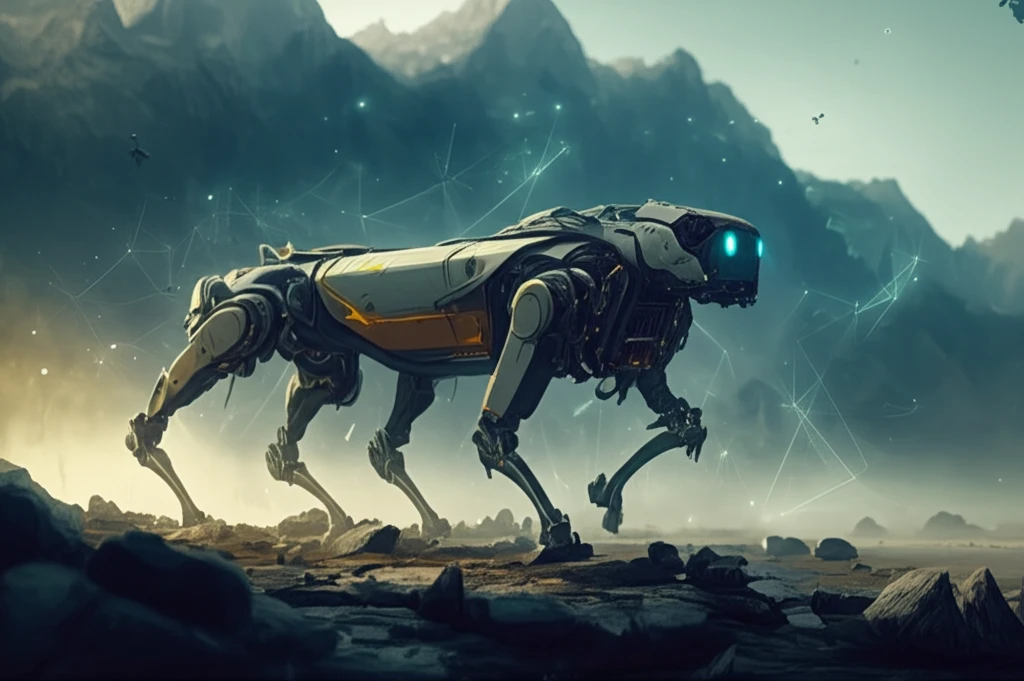
Unlock Stability: How Mutual Information Can Revolutionize Quadruped Robot Locomotion

"Explore how leveraging mutual information in Central Pattern Generators (CPGs) can lead to more coordinated and stable movements in quadruped robots."
Quadruped robots, inspired by four-legged animals, have long fascinated researchers and engineers alike. These robots hold immense potential in various applications, from search and rescue missions to exploring terrains inaccessible to humans. A key challenge, however, lies in designing control systems that enable these robots to move with stability, coordination, and efficiency. Traditional methods often rely on hand-crafted utility measures that can be limiting.
Central Pattern Generators (CPGs) offer a promising avenue for controlling legged robots. CPGs are neural networks that produce rhythmic patterns, ideal for generating the coordinated movements required for walking, running, and other forms of locomotion. Imagine a simplified 'brain' for each leg, working in harmony to create a fluid gait. However, configuring these networks for optimal performance on a specific robot platform remains a complex task.
Now, researchers are exploring a novel approach: using mutual information to guide the optimization of CPGs. Mutual information, a concept from information theory, quantifies the statistical dependence between different components of a system. By maximizing mutual information within the robot's control system, engineers aim to create robots that are not only faster but also more coordinated and stable. This approach moves beyond purely task-dependent metrics, focusing on the inherent properties of the robot itself.
Why Quadruped Stability Demands New Approaches
Quadruped robots, designed to mimic the locomotion of four-legged animals, have attracted significant attention in robotics because of their versatility, stability, and ability to navigate complex terrains. Yet their locomotion remains genuinely hard: partial observations, noisy sensors combined with latency, and rich contacts all raise the difficulty of the task. Recent work attacks these challenges from several angles, including learning quadrupedal locomotion on deformable terrain and building single-leg test rigs that accelerate data collection for real-to-sim surface recognition. Collectively, this research underscores why stable locomotion on varied surfaces remains a central, unresolved problem.
Learning-Based Methods and Their Known Limits
Robotic locomotion generally combines concepts from mechanics, control systems, and artificial intelligence to enable efficient, adaptive motion, and quadruped research increasingly leans on learning-based methods. A recurring limitation is the diversity of reference motion data, which constrains how versatile a robot's learned gaits can become. Learning-based systems also face catastrophic forgetting, where a robot may lose previously acquired locomotion skills when learning new tasks. These constraints push the field toward continual-learning formulations and richer data-generation strategies to make learned locomotion more robust.
From Dynamic Balance to Torque-Controlled Platforms
Quadrupedal robots draw inspiration from the locomotion of four-legged animals, using articulated joints, and their development spans decades of work spanning mechanical design, control, and perception. A foundational milestone came from Marc Raibert, who founded the MIT Leg Lab in 1980 and later founded Boston Dynamics in 1992 on the basis of years of research into dynamically balanced robots. Hardware itself has evolved considerably over the past few decades in both capability and cost, with torque-controlled quadruped robots traditionally relying on actuation mechanisms such as hydraulics or electric motors with torque sensors. Modern quadruped research continues this trajectory by folding environmental sensing and mobility planning into locomotion control.
Mutual Information: A New Path to Robot Control
The heart of this innovative method lies in using mutual information (MI) as a selection pressure during the evolutionary process of a Genetic Algorithm (GA). Think of a GA as a method of 'survival of the fittest' for robot controllers. The GA explores different configurations of the CPG, and MI acts as a guide, favoring those configurations that lead to more coordinated movements. In essence, it encourages the robot's joints and sensors to work together harmoniously, maximizing both diversity and coordination within the system.
- Controller 1: Used only mutual information as the fitness function.
- Controller 2: Focused solely on maximizing the robot's forward displacement (a task-based approach).
- Controller 3: Combined both mutual information and forward displacement in the fitness function.
Where Quadruped Research Is Concentrating Effort
Recent reviews report that quadruped robots are highly favoured among legged robots for their robust stability, efficient locomotion, and streamlined structures, with research teams concentrating on dynamic gaits, motion stability, balance ability, and high-load carrying. Learning-based control is central to this momentum, as shown by dual-layer reinforcement learning approaches that use terrain information and robot states to dynamically adjust walking speed while maintaining high stability. Notably, work at ETH Zurich on the ANYmal platform illustrates how reinforcement learning can build on a previously perfected model predictive control (MPC) controller, training learned policies from that earlier MPC reference. Such hybrids show the field combining classical control foundations with learned policies rather than replacing one with the other.
The Real-World Complexity Behind the Promise
Quadruped locomotion carries substantial engineering complexity, since robotic dogs rely on synchronized sensing, control, and actuation to achieve stable locomotion across complex terrains. Coordinating those subsystems is a demanding problem, and quadrupedal structures carry high expectations precisely because they can accomplish tasks that traditional vehicles are unable to perform. Robust autonomous navigation of small-scale quadrupeds in real-world environments exposes the gap between lab demonstrations and field reliability. These practical hurdles make continued stability research essential rather than optional.
Learned Policies Versus Conventional Control
Comparisons between learning-based and conventional control show meaningful differences in outcomes. One 2021 study reported that reinforcement-learning-trained quadruped robots exhibited superior locomotion performance on challenging terrains compared with conventionally programmed robots. Industry observers, meanwhile, state that robot locomotion technology is expected to create significant new opportunities for companies, pointing to platforms ranging from quadruped to bipedal walking robots. The overall picture suggests the strongest gains emerge where learned policies are combined with robust mechanical platforms and simulation-driven development.
The Future of Robot Locomotion
This research marks a significant step forward in the quest to create more versatile and robust quadruped robots. By leveraging the principles of information theory, engineers can develop control systems that are not only efficient but also inherently adaptable to changing environments and task demands. Future research will explore the use of different information-theoretic measures, such as transfer entropy, and apply these concepts to more complex robotic platforms, including bipedal robots. Imagine a future where robots seamlessly navigate challenging terrains, assist in disaster relief efforts, and even become our companions, all thanks to the power of mutual information.
Energy Efficiency as the Stability Bottleneck
Energy efficiency remains a critical challenge in quadruped robot locomotion, particularly at low to moderate walking speeds, where rigid foot-ground interactions lead to excessive energy dissipation. Work reported in this line of research explores TPMS-based structural designs as one avenue for reducing that dissipation. The stakes are practical: efficiency directly shapes how long a robot can operate and how viable it is outside the laboratory. Expert commentary therefore positions energy-aware mechanical design alongside control and learning as a defining frontier for quadruped stability.
Actuators, Structures, and the Next Generation of Quadrupeds
Future research in quadrupedal robotics is likely to focus on improving structural design and motion, according to recent reviews. On the hardware side, quadruped robot motors are becoming integrated actuator packages that combine several technologies into a single unit, and industry observers point to future trends in quadruped robot motion systems driven by these components. Progress is therefore expected to come from the convergence of smarter actuators, lighter structures, and more capable control. As these strands mature, the next generation of quadrupeds is expected to handle rough terrain with greater confidence.
Systemic Constraints on Progress
Beyond any single algorithm or actuator, quadruped robotics operates within a broader system of trade-offs involving cost, power, reliability, and deployment conditions. Generalization across unseen terrains and environments remains an acknowledged challenge across the field, and individual technical advances rarely translate into practical impact on their own. These systemic constraints are worth keeping in mind when assessing the significance of any single research contribution.
Opening Locomotion Research to More Builders
Beyond laboratory demonstrations, accessible tools are broadening who can participate in quadruped locomotion research. The LocoKit robot construction kit, for example, was designed to support the systematic study and development of functional robot morphologies, and its creators demonstrate the methodology in a case study on quadruped locomotion. They conclude that the approach represents a systematic and efficient method for studying and developing functional robot morphologies. By lowering the barrier to hands-on experimentation, such kits extend the real-world impact of locomotion research beyond specialized laboratories.