
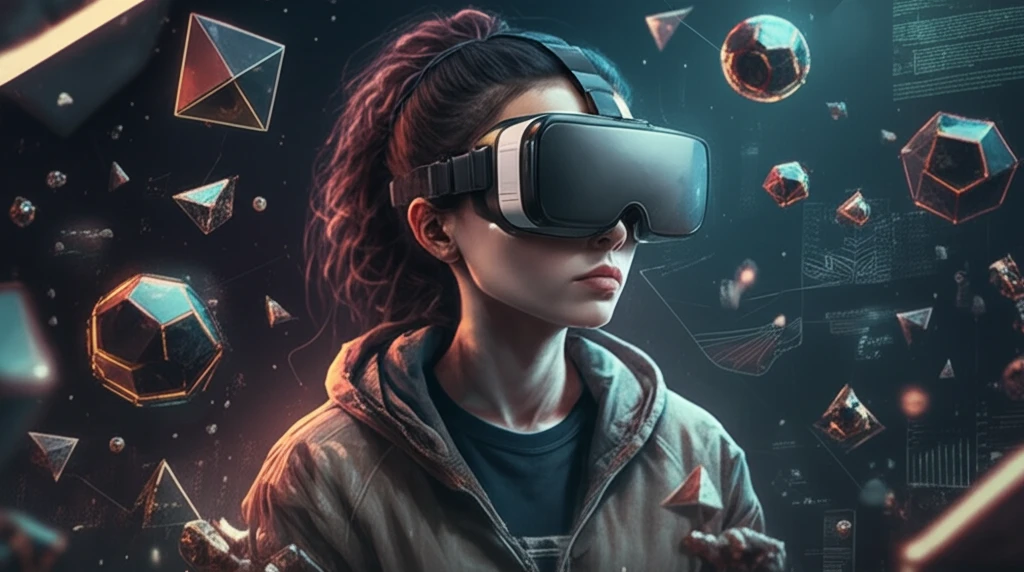
Unlock Geometry: How AR & VR are Revolutionizing Math Education

"Dive into the world of augmented and virtual reality as transformative tools that make complex math concepts, like Platonic solids, accessible and engaging for all learners."
In today's rapidly evolving educational landscape, educators face the ongoing challenge of making complex subjects engaging and accessible to students. Mathematics, with its abstract concepts, often presents a significant hurdle, requiring innovative teaching methods to bridge the gap between theory and understanding. Traditional approaches sometimes fall short, leaving students struggling to grasp fundamental principles.
Enter augmented reality (AR) and virtual reality (VR), two groundbreaking technologies poised to revolutionize the way mathematics is taught and learned. By creating immersive, interactive experiences, AR and VR transform abstract concepts into tangible, visual representations that students can explore and manipulate. This hands-on approach not only enhances understanding but also sparks curiosity and enthusiasm for learning.
This article delves into the transformative potential of AR and VR in mathematics education, focusing on the teaching of Platonic solids. We will explore how these technologies are being used to bring geometry to life, making it more accessible, engaging, and ultimately, more effective for students of all backgrounds.
Immersive Math Tools Gain Traction
Virtual reality applications now enable students to plot and manipulate data in full 3D axes, transforming abstract numbers into interactive visualizations. Platforms like ClassVR offer dedicated mathematics resources covering 3D shapes, fractals, and other concepts through immersive and interactive experiences. EnmaTech provides VR/AR/XR solutions for virtual reality mathematics education across Saudi Arabia, while DeltaMath focuses on delivering depth, clarity, and rigor in math instruction built by teachers.
Game-Based and After-School Models
Prodigy Math employs curriculum-aligned, game-based learning to help students build skills and confidence while making math engaging and free for school or home use. RSM (Russian School of Mathematics) provides after-school math programs for grades K-12 with learning centers, emphasizing new methods and foundational skills. Looking ahead, equations.live predicts that AR/VR math labs will emerge in late 2026 and beyond, with edge AI tutors offering immediate hints and feedback to reduce server costs and improve privacy.
Early Immersive Learning Explorations
Augmented reality has been explored as a tool to make educational subjects more engaging and relatable, with educators using it to immerse students in learning experiences. Virtual reality in education more broadly offers benefits such as enhanced learning and student engagement through immersive 3D experiences. While math formulas and tables have long served as foundational reference materials, the integration of immersive technologies represents a newer approach to mathematics education.
Platonic Solids: From Textbook to Tangible
Platonic solids—those perfectly symmetrical, three-dimensional shapes with identical faces—have fascinated mathematicians and thinkers for centuries. However, visualizing and understanding their properties can be challenging for students using traditional methods. AR and VR offer a dynamic solution by allowing students to interact with these shapes in a virtual environment.
- Visualizing Characteristics: AR and VR software allows students to visualize key characteristics of Platonic solids, including their faces, vertices, and edges, in an interactive 3D environment.
- Interactive Manipulation: Students can manipulate and explore the solids from any angle, gaining a deeper understanding of their spatial properties.
- Unfolding the Mystery: Software features like face planning and separation enable students to see how the solids are constructed, enhancing their comprehension of geometric principles.
- Engaging Learning: By making learning fun and interactive, AR and VR capture students' attention and motivate them to learn.
VR Platforms for Math Education
Surveys of virtual reality applications in education examine its use across various learning contexts, including critical reviews of VR and AR applications. Prisms Math positions itself as an ambitious VR mathematics education platform where students become urban planners, environmental scientists, and engineers solving real-world problems requiring algebra, geometry, and statistics. VR Math Bridge is a virtual reality application designed to enhance calculus education by combining immersive virtual environments with artificial intelligence-driven teaching assistance.
Note on Available Sources
The source material provided for this subsection does not contain content relevant to counter arguments or failures in AR/VR math education. The referenced website appears to address an unrelated topic. Without substantiated source material on this specific angle, no factual claims about counter arguments or failures in this domain can be responsibly included.
Comparison Frameworks and Implementation Guidance
Comparison platforms like Versus provide side-by-side evaluations with detailed specifications and filters across numerous categories, establishing frameworks for evaluating different approaches. Implementing virtual reality in mathematics education requires careful planning and resources, with guidance suggesting educators start small and gradually expand their VR math programs as they gain experience. These implementation guides emphasize that integrating VR into math curricula is a process that develops over time with measurable results.
The Future of Math Education is Here
The integration of AR and VR into mathematics education holds immense promise for the future. By transforming abstract concepts into tangible, interactive experiences, these technologies have the power to unlock a deeper understanding and appreciation of mathematics for students of all backgrounds. As AR and VR technologies continue to evolve and become more accessible, we can expect to see even more innovative applications emerge, further revolutionizing the way we teach and learn mathematics.
Affordances and Constraints of VR Tutoring
Meta-analyses of virtual reality in education demonstrate positive effects, with immersive forms of VR being particularly effective for learning outcomes. However, the use of VR in mathematics tutoring involves significant constraints including the expense of hardware, setup requirements, and the expertise needed to implement these systems effectively. The research highlights a balance between the educational benefits of immersive VR and the practical barriers to adoption in real-world tutoring contexts.
VR's Transformative Potential in Education
Virtual reality is expected to play a transformative role in 21st-century education, with potential benefits including increased student engagement and improved access to educational content. The technology promises to make learning more accessible and engaging, potentially breaking down barriers to education that exist in traditional classroom settings. As VR technology continues to develop, its applications in education are expected to expand and evolve.
Funding, Resources, and Equity Considerations
Prisms VR raised $12.5 million in Series A funding to expand its immersive VR math literacy platform to more schools across the United States, indicating significant investment in this space. Various VR apps designed specifically for teaching math, such as Shapes 3D and GeoGebra 3D, offer interactive experiences often including curriculum-aligned lesson plans and activities. While VR math education tools advance, broader systemic challenges in education include barriers to educational equity that affect teachers and students across different communities.
Experiencing Math Concepts in Virtual Space
Educators are creating VR math lessons that allow students to visualize and interact with mathematical concepts in virtual space. Using applications like Gravity Sketch on Oculus Quest 2, instructors can demonstrate equations such as x² + y² = z², which represents a cone, in an immersive three-dimensional environment. These lessons represent a hands-on approach to teaching abstract mathematical concepts through direct manipulation and visualization in virtual reality.