
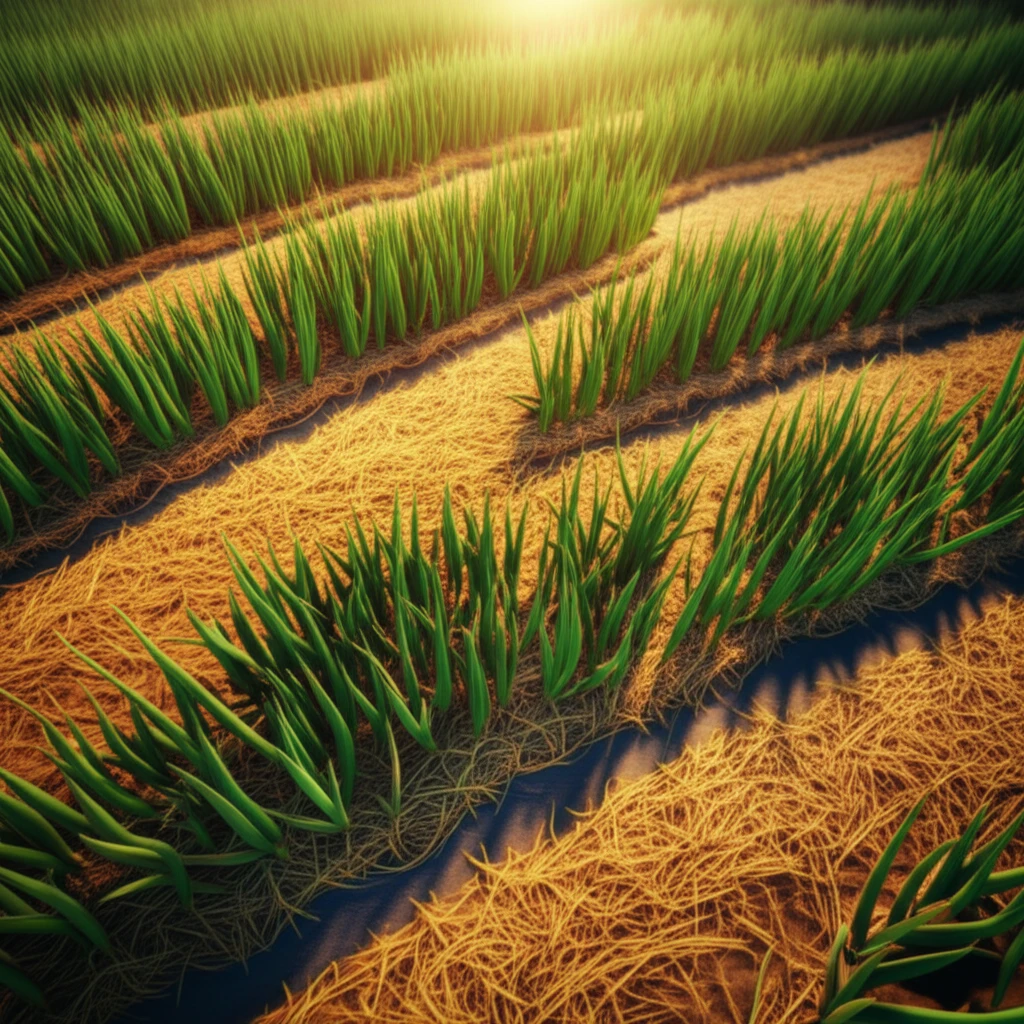
Unlock Bountiful Onions: The Secrets of Mulch, Nitrogen, and Potassium

"Maximize your onion harvest with proven techniques. Learn how mulch and essential nutrients like nitrogen and potassium can dramatically increase your yield."
Onions are a staple in cuisines worldwide, and Bangladesh is no exception. They're a key ingredient in countless dishes, making them a vital crop. However, achieving high onion yields can be challenging. Many farmers face hurdles in optimizing their harvests, leading to shortages and price fluctuations.
Traditional methods often fall short due to factors like inconsistent soil moisture and nutrient deficiencies. While irrigation can help, it also raises production costs. This is where innovative approaches like mulching and careful nutrient management come into play.
This article explores the groundbreaking research on how mulching, nitrogen, and potassium impact onion growth and yield. We'll break down the science, offering practical insights you can use to cultivate bigger, healthier, and more abundant onions.
Onion Production: A Global Staple
Onions are among the most widely cultivated vegetable crops worldwide, forming a critical component of global food systems and agricultural economies. While precise year-over-year impact statistics vary by region and are difficult to pin down without a single authoritative global dataset, the crop's significance is reflected in ongoing intensive research into optimizing its production. Studies consistently focus on yield improvement through soil management, irrigation strategies, and nutrient optimization, underscoring the economic and food-security stakes involved in onion cultivation.
Mulch and Irrigation Strategies for Onion Cultivation
Polyethylene mulching combined with herbicide programs is increasingly adopted as a sustainable alternative to herbicide-only weed control in rainy-season onion cultivation, though further research on mulch-specific agronomic practices and long-term ecological impacts remains essential. Research from the Onion Research Institute in Hyderabad has examined the integrated use of potassium and mulching to evaluate effects on onion growth and yield. Additionally, studies on modern bulb crop production methods emphasize the use of proper soil cover for weed control alongside sufficient irrigation to increase productivity under drip systems. However, a key limitation across these approaches is the need for multi-location validation and long-term ecological assessment before plasticulture-based systems can be fully realized.
The Evolution of Onion Growing Practices
Onion cultivation has a long history spanning thousands of years, with growing practices evolving from simple open-field methods to increasingly sophisticated systems involving irrigation management, mulching, and nutrient optimization. The integration of mulch materials into onion production represents a relatively recent agronomic development, driven by the need for improved weed control, moisture conservation, and yield stability. Foundational research establishing the relationship between soil cover, water management, and bulb development has progressively shaped modern approaches to onion cultivation across diverse climatic zones.
How Mulch, Nitrogen, and Potassium Supercharge Onion Growth
A study investigated the effects of straw mulch and different levels of nitrogen and potassium on onion growth and yield. The researchers compared onion plants grown with and without straw mulch, using varying amounts of nitrogen (0, 40, 80, and 120 kg per hectare) and potassium (0, 37.5, 75, and 112.5 kg per hectare).
- Mulch Matters: Straw mulch leads to significantly higher bulb yields.
- Nitrogen is Key: Increasing nitrogen levels boosts yield, with the highest level producing the best results.
- Potassium's Subtle Influence: Potassium contributes to yield, but different levels show similar results.
- The Power of Combination: Nitrogen and mulch together create significant yield variations. The best results come from combining straw mulch with the highest nitrogen level (120 kg per hectare).
Emerging Findings in Onion Agronomy
Recent research in onion cultivation continues to refine best practices around mulching, irrigation timing, and nutrient management. Studies published in 2025 and 2026 highlight the interplay between mulch type, water conservation, and bulb yield, with particular attention to semiarid growing conditions. The body of literature increasingly emphasizes the need for site-specific recommendations rather than one-size-fits-all approaches, recognizing that onion responses to mulch and irrigation vary by cultivar, soil type, and climate. These findings collectively point toward more precision-oriented strategies for optimizing onion production in diverse agricultural systems.
Risks and Drawbacks of Mulching Onions
While mulching offers potential benefits, research and practical experience reveal notable risks that can undermine onion yields if not carefully managed. A 2026 study from Biology Insights warns that pests such as onion maggots and thrips thrive under damp mulch and can damage tender onion tissue, while excessive moisture retained by thick mulch layers increases susceptibility to bacterial and fungal diseases, particularly neck rot as the plant approaches maturity. GardenerBible similarly cautions that improper mulch selection or application can create unfavorable growing conditions rather than beneficial ones. Research conducted at the Horticulture Farm in Bangladesh on organic mulches and winter onion cultivars also demonstrates that outcomes are highly dependent on cultivar choice and mulch management, reinforcing that mulching is not universally advantageous for all onion production scenarios.
Evaluating Mulch Approaches for Onions
The decision to mulch onions involves weighing multiple interacting factors, and available guidance reflects considerable variation depending on growing context. SmallSpaceGardenPros identifies timing, mulch quantity, and material selection as critical variables, noting that optimal approaches differ based on specific growing conditions and climate. GardenerBible concurs that the decision ultimately depends on the particular growing conditions, climate, and desired outcomes, urging gardeners to weigh pros and cons carefully. Among mulch materials, straw-based options have been highlighted as particularly effective for supporting onion growth, providing nutrients and structural support that other materials may not match as effectively.
Maximize Your Onion Harvest: Practical Takeaways
The research highlights the importance of balanced nutrient management and soil conservation techniques for successful onion cultivation. By incorporating straw mulch, optimizing nitrogen levels, and ensuring adequate potassium, farmers can significantly increase their yields and profitability.
Integrating Mulch Research into Practice
Research into biodegradable mulch effects on Vidalia onion yield across multiple sweet onion cultivars represents an effort to bridge laboratory findings with practical cultivation needs. A study cited in research on onion genotypes and mulching, attributed to Smith et al. (2017), found that organic mulches led to an increase in the number of scales per bulb, attributing this effect to improved moisture retention and soil temperature moderation provided by the mulch. Together, these findings suggest that mulch type and cultivar selection are interconnected decisions that growers must optimize in combination rather than in isolation. The expert consensus emerging from this body of work emphasizes that successful mulching requires alignment between material choice, cultivar characteristics, and local environmental conditions.
The Onion Market's Evolving Landscape
The global onion market is experiencing notable shifts in demand and production dynamics heading into 2026 and beyond. According to the Food and Agriculture Organization (FAO), global onion production reached 106 million metric tons in 2022, with Asia contributing 67 percent of total output. Market analysis from accio.com highlights rising demand for red onion varieties and growth in the dehydrated onion segment, alongside ongoing price volatility that affects both producers and consumers. The fresh onions market is also being shaped by health-conscious consumers seeking low-calorie, nutrient-rich produce, alongside expanding organic and specialty onion segments that are driving innovation and market growth through 2034.
Soil Health, Sustainability, and Mulch Innovation
Onion cultivation faces broader systemic challenges related to soil health, water conservation, and the environmental footprint of agricultural inputs. Oregon State University research notes that straw mulch has been proven to increase the yield of furrow and drip irrigated onions while helping retain soil moisture, improve nutrient and water retention, and encourage favorable soil microbial activity. A 2024 study published in Springer examined PBAT-PLA based biodegradable film mulch and found that biodegradable film with an appropriate degradation rate did not negatively impact the productivity of onions or subsequent corn crops, nor did it adversely affect soil physicochemical properties. Meanwhile, a 2025 study from DergiPark evaluated wheat straw, wood shavings, mulch film, beet pulp, and pine needles for weed control and yield in onion cultivation, comparing weedy and weed-free control plots to assess material-specific efficacy.
Translating Research into Grower Decision-Making
For onion growers, the practical implications of mulch and nutrient research come down to decisions made at the field level, where theory meets the constraints of budget, labor, climate, and local conditions. The diversity of findings across studies—from beneficial organic mulches in Bangladesh to biodegradable films in controlled trials—reflects the reality that no single recommendation fits every operation. Growers must balance the promise of improved yields and soil health against the risks of disease, pest pressure, and material costs, often drawing on both research insights and accumulated local experience. Ultimately, the value of this research lies in expanding the toolkit available to farmers, giving them more informed options for managing the complex interplay of factors that determine onion crop success.
For home gardeners and small-scale farmers, these findings translate into actionable steps: prioritize mulching to retain soil moisture, conduct soil tests to determine appropriate nitrogen and potassium levels, and consider a combination of both for maximum impact.
By implementing these strategies, you can look forward to a more bountiful onion harvest, contributing to both your table and potentially, the market.