
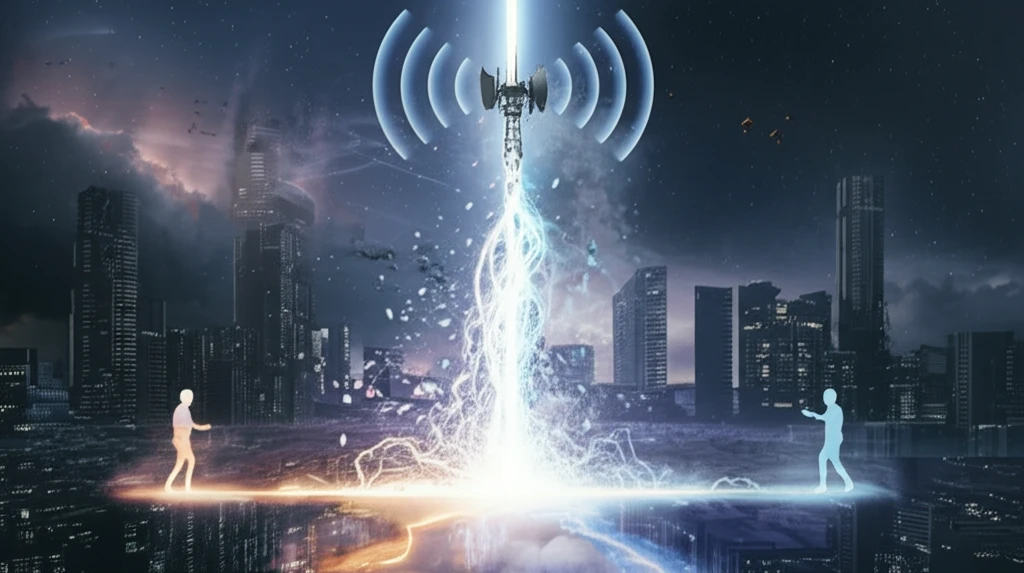
Unlock 5G Potential: The Future of Wireless Communication Without the Bottleneck

"Dive into the innovative NOMA scheme that's set to revolutionize MISO downlink channels, breaking free from traditional CSIT constraints for a faster, more reliable 5G experience."
In the rapidly evolving landscape of wireless communication, the demand for higher speeds, greater reliability, and massive connectivity is constantly escalating. Fifth-generation (5G) networks promise to deliver on these expectations, but they also face significant challenges. One of the most critical hurdles is efficiently managing multiple access techniques—the methods by which numerous devices can simultaneously use the same communication channel. Traditionally, techniques like Non-Orthogonal Multiple Access (NOMA) have relied heavily on Channel State Information at the Transmitter (CSIT).
CSIT allows base stations to intelligently allocate power among users, ensuring that their signals are separable at the receivers. However, acquiring and feeding back this CSI data consumes valuable bandwidth, creating a significant bottleneck. Moreover, existing NOMA techniques become impractical when CSIT is unavailable, leaving base stations with limited options and often resulting in poor performance in terms of outage and error probability. Addressing these limitations is crucial for unlocking the full potential of 5G and future wireless networks. This has lead to the development of a new type of NOMA scheme.
This limitation motivates the exploration of NOMA schemes that don't need CSI knowledge at the BS. By using new techniques, it allows the BS to communicate with two users at the same time while keeping signals separated at their respective receivers. This development aims at multiple-input single-output and single-input single-output downlink channels. By analyzing the technique in terms of achievable degrees-of-freedom and achievable rate per user, the proposed NOMA scheme has been shown to outperform existing NOMA techniques in terms of outage probability and error probability.
Statistics Across a Confusing Namespace
Searching for current 'NOMA' statistics surfaces a jumble of unrelated entities rather than one set of figures. For investors, Nomadar Corp. (trading under the ticker NOMA) has its own suite of valuation metrics and financial numbers tracked by stock-analysis platforms. In demographic data, the town of Noma, Florida reports an average per capita income of $29,219. Meanwhile, digital-nomad statistics are compiled live from tens of thousands of members, with analysts describing remote workers as reshaping global work trends. The lesson for a 5G article is that 'NOMA' must be disambiguated from a stock, a small town, and a workforce movement before any reliable statistic can be quoted.
A Spectral-Efficiency Boost With Known Trade-offs
The accepted method in this space is Non-Orthogonal Multiple Access (NOMA), an information-theoretic approach used in 5G networks to improve spectral efficiency. The technique has drawn enormous attention in the literature precisely because of that spectral-efficiency potential. Its known limitation, however, is interference, which researchers say is especially prone to occurring during handovers. To address this, proposed remedies include a hybrid method combining Gold-Walsh modulated sequences with deep learning, as well as an error-limited NOMA-HARQ scheme that is reportedly slightly less sensitive to codeword-length and error constraints than the standard NOMA-HARQ approach. In short, NOMA's efficiency gains come with interference and error-rate challenges that active research is still trying to close.
A Historical Name With Many Prior Lives
Before NOMA meant anything to wireless engineers, the name carried several other histories. NOMA was once the largest manufacturer of Christmas lighting in the world, and since 2021 the brand rights in Canada and the U.S. have been owned by Canadian Tire. The same letters name Washington, D.C.'s NoMa neighborhood, which has been the city's fastest-growing area since its Metro station opened in 2004. There is also the National Organization of Minority Architects, founded in 1971 when a group of African-American architects met during the AIA National Convention in Detroit. Those milestones belong to lighting retail, urban development, and architecture, a reminder that the acronym long predates any 5G-era usage.
Breaking the CSIT Dependency: How the New NOMA Scheme Works
The core innovation lies in a technique called 'interference dissolution,' which enables the base station to maintain perfectly separable signals at the receivers without needing CSIT. Signals are pre-coded in a nonlinear way to get the desired outcome. This approach significantly reduces the overhead associated with CSI feedback, making the system more efficient and robust.
- Interference Dissolution (ID): Uses nonlinear techniques to manage and dissolve interference, ensuring cleaner signal separation.
- CSIT-Free Operation: Eliminates the need for channel state information at the transmitter, reducing bandwidth consumption and improving practicality.
- Enhanced Separability: Maintains distinct signals at the receivers, even without explicit CSI, boosting reliability.
- Improved Performance: Outperforms existing NOMA techniques in outage and error probability, ensuring better overall communication quality.
Deep Learning and Error-Rate Frontiers
The latest wireless research on NOMA centers on signal processing and reliability. One recent review surveys deep-learning-based signal detection in NOMA systems and frames the NOMA principle as a general framework of which several recently proposed 5G multiple-access schemes can be viewed as special cases. Complementary work on bit error rate analysis examines NOMA's performance and challenges across various power allocation ratios and different numbers of users, positioning the technique for 5G and beyond. Notably, searching 'NOMA' for the latest research also surfaces a steady stream of unrelated daily stock headlines for Nomadar Corp. (ticker NOMA), which must be filtered out. Within the wireless literature itself, the recurring theme is how to make NOMA's capacity gains reliable under real power-allocation conditions.
When 'Noma' Means Something Else Entirely
A search for counter-arguments and failures of 'NOMA' returns results dominated by a disease and a restaurant rather than wireless technology. Medically, noma is an orofacial gangrene affecting malnourished children, mainly in tropical countries such as those of sub-Saharan Africa, with a current global incidence estimate of roughly 30,000-40,000 cases a year. Separately, the Copenhagen restaurant Noma announced it would close at the end of next year, with one prominent outlet reporting a very long waiting list, while social-media commentary has criticized failures of leadership at the establishment. Ironically, not all news is negative, since critics have also called the restaurant's relaunch at least as good as the original. These sources illustrate how much of the 'NOMA' discourse, including its failures, is crowded out by unrelated meanings of the name.
A Comparison Space Filled by Software, Not Airwaves
Meaningful comparative analysis of wireless NOMA against competing schemes is not what surfaces; instead, the comparison space is filled with software products sharing the Noma/Nomad name. Noma Security has a documented list of alternatives and competitors with user reviews, ratings, and pricing on SourceForge, and a 2026 comparison rounds up eight top security-tool alternatives. In the orchestration space, the Nomad Project is compared through community votes, with the most recent known review article positioning it among Kubernetes alternatives from 2023. E-commerce comparisons pit Nomad eCommerce against Handshake on scored features, pricing, and integrations, and even list it as a Magento alternative. None of these sources benchmark NOMA the 5G radio technique, underscoring how sparse direct head-to-head evidence is under this search term.
The Road Ahead: Implications and Future Research
This research paves the way for more efficient and robust wireless communication systems, particularly in 5G and beyond. By removing the dependency on CSIT, networks can operate more flexibly and reliably, supporting a larger number of users and a wider range of applications. The real-world improvements will provide faster access and reliable connectivity for mobile, virtual reality, and augmented reality. Further research could explore extending this NOMA scheme to more complex scenarios, such as those involving a larger number of users or more diverse channel conditions. The success of this research hinges on finding ways to translate cutting-edge insights into practical applications so the next generation will flourish.
Where the 'Experts' Actually Gather
Expert commentary around 'NOMA' today is scattered across entirely different industries. One consultancy, Noma (noma.pro), provides tokenomics design, auditing, and economic simulation for over 100 innovators, recently performing a 360-degree analysis of a client's Web2-to-Web3 transition. The Nomad Capitalist Live event assembles experts, CEOs, and heads of state on one stage for learning, mingling, and inspiration. In global health, the International Noma Network connects researchers, while Hilfsaktion Noma e.V. treats noma patients free of charge at hospitals in Guinea Bissau, Niger, and Nigeria. Notably absent from these expert channels is any commentary on Non-Orthogonal Multiple Access in 5G, a reminder that 'expert' content must be vetted for which NOMA it addresses.
One Term, Several Futures
The forward-looking literature for wireless NOMA points toward 6G, where Rate-Splitting Multiple Access (RSMA) is emerging as a more powerful successor that can act as a bridge between OMA and NOMA to manage interference even better in the 6G era. Meanwhile, the same name hosts other futures entirely. Chef Rene Redzepi has said his restaurant Noma, which opened in 2004 and popularized the New Nordic culinary style across Michelin-starred gastronomy, would close for good in 2025, with a Kyoto residency hinting at what he envisions next. And the National Organization of Minority Architects convened a 2025 conference themed 'Future Unfolding' in Kansas City, which its leadership called historic. Only the first of these futures concerns wireless communications.
Systemic Challenges in Many Domains
The systemic challenge for wireless NOMA is reliability: researchers report growing interest in error-rate analysis across broad NOMA configurations and designs, driven by the community's dedication to improving the reliability of NOMA systems and supported by comprehensive survey articles. The same name carries systemic challenges in other domains. In public health, noma is a gangrene that destroys mucous membranes of the mouth and other tissues, occurring in malnourished children in areas where sanitation and cleanliness are lacking. In fine dining, abuse allegations tied to Noma's kitchen culture have renewed debate about toxic kitchens and pushed restaurants to reconsider how they manage teams. Even an OECD economic strategy report covers the D.C. NoMa area, bounded roughly from Mount Vernon Square to Bladensburg Road and Massachusetts Avenue to Rhode Island Avenue.
The People Behind the Name
The human realities behind these search results are vivid and varied. Reporting on California restaurants describes real-world burnout: 12-, 14-, and 16-hour days were common and still are, even as an inside view of the Noma restaurant shows its high wooden-beamed ceiling and natural light. Elsewhere, a video documents the true nomadic life of an Iranian family beginning mountain migration, carrying all their belongings on a Nissan. The same search surfaces tools built for human connection, such as Magma, a platform where artists draw and collaborate on a shared canvas in real time. Whatever 'NOMA' the reader is researching, the underlying stories are about people, their labor, their movement, and their collaboration.