
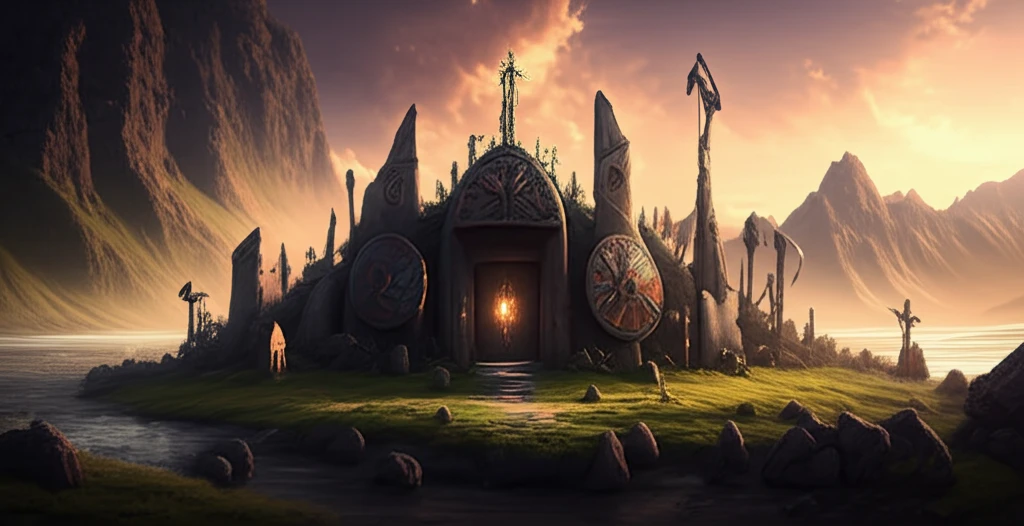
Unearthing Viking Age Burials: How Cultural Shifts Rewrite History

"Explore Viking Age burial customs in Iceland and discover what these fascinating rituals tell us about cultural transitions, religious conversions, and societal values."
The study of cultural and religious shifts offers a captivating glimpse into how societies evolve. Understanding transformations in religious beliefs, particularly, reveals much about a society's values, norms, and overall identity. In Europe, the understanding of past conversions to Christianity, is very important to understand current norms.
Archaeological evidence linked to conversion highlights equally illuminating insights. By observing changes, such as the disappearance of cremation with the introduction of Christian burial customs, one gets a deeper understanding of the society experiencing the transformation, not just the transformation itself. Culture trumps theology in terms of trends and views, ultimately showing which cultural norms take precedence.
This article explores how conversion reshapes societal practices, emphasizing how these shifts aren't solely dictated by religious doctrine, but shaped by culture. Cultural adaptations can illuminate aspects of society, which are essential for grasping the dynamics of religious and cultural change. Viking-age Iceland offers a captivating case study.
New Discoveries Reshape Viking Burial Knowledge
Recent excavations have dramatically expanded the archaeological record of Viking Age burials. In Denmark, researchers unearthed approximately 50 remarkably preserved skeletons along with rare artifacts including knives, glass pearls, and a silver ornament knife, offering an unprecedented window into Viking life and death. National Geographic has reported that ship burials in Scandinavia have been dated to before A.D. 780, pushing back the known timeline for these elaborate ceremonies. Meanwhile, the largest burial mound ever confirmed in Western Norway — potentially Viking Age in origin — has been identified as one of the biggest in all of Scandinavia.
Diverse Grave Types and Evolving Practices
Viking burial customs encompassed a wide variety of grave types, including burial mounds, boat burials, chamber tombs, stone settings, and ship settings, each revealing distinct cultural significance about the deceased. Simple burials typically involved placing the body in a pit or wooden chamber accompanied by personal belongings, reflecting a straightforward approach to honoring the dead. These practices remained largely consistent throughout the Viking Age until the spread of Christianity, which brought a fundamental shift: inhumation began to replace cremation as the primary means of delivering the dead to the afterlife. This religious transformation fundamentally restructured how Vikings treated their dead, marking one of the most significant cultural transitions of the era.
Burial Rites as a Primary Historical Source
Vikings originated from modern-day Scandinavia — present-day Denmark, Sweden, and Norway — and their burial rites remain one of the most important sources of information about their civilization. The Vikings are primarily known to have cremated their dead, a practice that shaped much of the early archaeological understanding of their culture. Their beliefs about the afterlife held that the deceased would join their gods in a realm similar to the living world, a conviction that drove the richness and variety of their burial customs. Early scholarly and educational efforts to catalog these practices laid the groundwork for the more sophisticated analytical methods used in modern Viking archaeology.
Reinterpreting Viking Burial Practices
Examining the burial customs of Viking-age Iceland reveals a complex interplay between conversion and cultural change. Iceland offers a fascinating case study because of its clear and relatively rapid transition in burial customs and church construction following the public decision to convert around 999 or 1000 AD.
- Location of Cemeteries: Pre-Christian cemeteries existed outside home fields, while Christian cemeteries were integrated into farmsteads, signifying a shift from marking territorial boundaries to a focus on community and consecrated spaces.
- Inclusion: Pagan cemeteries included a selected few, a select amount of men, women, children, and in some cases animals, highlighting a hierarchical structure of Viking society, while Christian cemeteries welcomed all members of the community, representing equality in death.
- Grave Goods: The transition from furnished to unfurnished graves demonstrates a change in the use of wealth and resources. As resources shifted towards supporting churches and the community rather than equipping the dead for the afterlife.
Unusual Double Boat Burial Stuns Archaeologists
In 2018, a farmer's field in southeastern Norway yielded a major Viking burial ship discovery that drew worldwide attention. Separately, archaeologists in central Norway uncovered a highly unusual double boat burial in which one vessel grave was placed directly on top of another. What makes this find particularly extraordinary is that the two burials are separated by roughly 100 years, suggesting the site held enduring significance across generations. These discoveries challenge previously held assumptions about Viking burial site reuse and the logistical complexity of their funerary practices.
DNA Evidence Undermines Long-Held Assumptions
A DNA study has directly challenged a longstanding archaeological assumption about Viking Age joint burials containing an adult and a child. For generations, archaeologists interpreted such side-by-side burials as evidence of a parent and child laid to rest together. However, genetic analysis of remains from 142 individuals — including roughly 60 children and adolescents found in shared graves at sites in Jämtland, Sigtuna near Stockholm, and Fjälkinge in Skåne — revealed that close relatives rarely shared the same grave. This finding forces a fundamental reconsideration of what drove the practice of co-burial in the late Viking and Middle Ages.
Burial Preparation and Cross-Cultural Comparisons
Before a Viking funeral, the body of the deceased was typically washed, dressed in their finest garments, and adorned with jewelry or other personal belongings, reflecting a belief in the importance of presenting the dead properly for the afterlife. Archaeological evidence also shows that Viking burial practices extended well beyond Scandinavia, with notable differences in how burials were conducted abroad, sometimes serving dual purposes as intimidation tactics toward local populations. The practice of boat burials remains one of the most iconic and widely recognized features of Viking funerary culture, capturing public imagination across centuries. Together, these comparative findings highlight that Viking burial customs were neither monolithic nor static, but adapted to local cultural contexts and political objectives.
A New View of Conversion
The changes in Viking-age Iceland reveal a shift in views, social structures, and economic relationships. These changes reveal as much about the norms, values, and socio-economic underpinnings of Viking society as they do about religious ideas. By examining the archaeological record, and understanding cultural changes, we gain an important understanding of this historical period, how conversion changes society's norms.
Rethinking What Joint Burials Really Mean
The growing body of genetic evidence has led researchers to conclude that Viking joint burials were likely driven by factors other than kinship, such as religious customs, social connections, community membership, or shared circumstances surrounding death. This represents a significant paradigm shift in how archaeologists interpret the social fabric of Viking communities. Some commentators have even raised the provocative suggestion that Viking Age burial customs may have been influenced by contact with Islamic cultures, particularly regarding ideas of an eternal afterlife. Isotope analysis of bone remains, as noted by researchers studying the Norwegian double boat burial, may further illuminate where the deceased lived and how they ate, adding dietary and geographic data to our evolving understanding.
The Road Ahead for Viking Archaeology
The intersection of biomolecular techniques — including stable isotope analysis and ancient DNA recovery — with traditional archaeological methods promises to yield increasingly granular insights into Viking Age populations. As excavation sites grow in number and analytical tools become more sensitive, researchers will likely resolve longstanding debates about kinship, migration, and social organization that have long defined the field. The integration of genetic data with material culture analysis is poised to rewrite not only burial interpretations but broader narratives about Viking trade networks, cultural exchanges, and identity. While challenges remain around sample preservation, ethical treatment of human remains, and cross-border collaboration, the trajectory points toward a far more nuanced and evidence-based understanding of the Viking world in the coming decades.
Challenging Generations of Interpretation
For generations, archaeologists across Scandinavia reasoned that graves containing an adult and child laid side by side represented family units — a parent and child buried together. This interpretation, while intuitive, has been undermined by DNA evidence and has broader implications for how the entire field interprets joint burials. The discovery that such co-burials were likely driven by religious customs, social connections, or community membership rather than biological kinship reveals how cultural assumptions can become entrenched in archaeological practice. The broader lesson is that even well-established interpretations must remain open to revision as new analytical tools, particularly genetic testing, become available and applied systematically across the region.
What These Burials Mean for Living Communities
Viking burial discoveries continue to carry real cultural and emotional weight for communities across Scandinavia, where ancestral heritage is deeply woven into local identity. The revelation that long-held assumptions about family bonds in shared graves may be incorrect challenges not just academic frameworks but also the personal narratives that communities have constructed around their past. As new evidence emerges — from DNA studies to previously unknown burial sites — these findings invite a collective reckoning with how much remains uncertain about the people who shaped Northern Europe. Ultimately, the evolving story of Viking burials underscores a universal truth: that history is not fixed, and each generation must be prepared to revisit and revise its understanding of the past.