
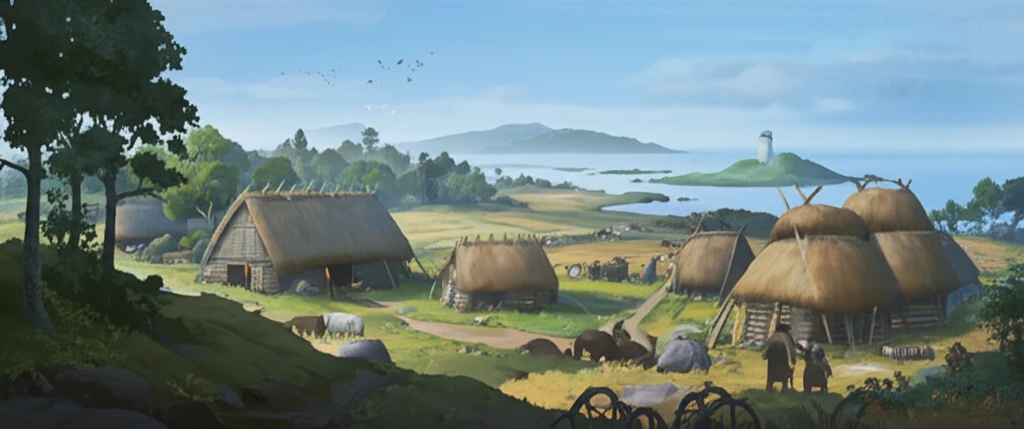
Unearthing the Secrets of Asva: How Ancient Islanders Thrived

"Dive into the economic strategies and agricultural practices that fueled the Asva settlements of Estonia, revealing surprising insights into their resilience and resourcefulness."
Imagine a world where survival depends on your ability to master the elements and harness the land's resources. The people of the Asva group, who inhabited the islands of Estonia during the Bronze Age, faced this challenge head-on. Archaeological research has been piecing together the story of how they thrived, revealing a complex interplay of agriculture, animal husbandry, and strategic resource management.
For years, the prevailing view was that the Asva relied primarily on livestock farming. However, recent discoveries suggest a more nuanced picture, one where crop cultivation and specialized crafts played significant roles. Understanding their economic foundations offers insights into their societal structure, technological advancements, and their relationship with the environment.
This article explores the latest findings on the economic underpinnings of the Asva settlements. By examining their agricultural practices, resource utilization, and trade networks, we can gain a deeper appreciation for the ingenuity and resilience of these ancient islanders.
A Compact Site, Rich in Finds
The Asva settlement covers a total area of roughly 3,500 square meters on the eastern side of Saaremaa Island in western Estonia, and approximately one sixth of that area has been excavated. Excavations have produced around 5,800 finds, giving researchers a surprisingly dense record from a comparatively small fortified site.
Excavation-Driven Archaeology
Understanding of Asva relies on standard archaeological excavation, with only about one sixth of the settlement's 3,500 square meter area explored so far. Because the bulk of the site remains unexcavated, current interpretations rest on a limited sample and are likely to be revised as more ground is opened up.
A Late Bronze Age Fortress
Asva is a fortified settlement dating primarily to the Late Bronze Age, approximately 900 to 500 BC, situated on the eastern side of Saaremaa Island. It represents the westernmost reach of the Finno-Ugrian Late Bronze Age culture, marking an important milestone in understanding how far this cultural tradition extended.
The Pillars of Asva Economy
The Asva people strategically combined several key elements to ensure their economic stability:
- Animal Husbandry: Cattle, sheep, goats, pigs, horses and dogs were essential for meat, milk, and transportation.
- Crop Cultivation: Growing grains provided a stable source of carbohydrates.
- Specialized Crafts: Metalworking and tool production contributed to trade and local needs.
- Resource Management: Hunting, fishing, and seal hunting supplemented their diet and provided valuable materials.
Barley: Estonia's Oldest Grain
One of the site's most significant discoveries is the oldest grain found in Estonia, barley, which was uncovered at Asva. Since barley was also a staple food for the Viking-era population, the find ties Bronze Age subsistence practices at Asva to the later culinary traditions celebrated at the modern Asva Tavern.
What Remains Unresolved
With only about one sixth of the 3,500 square meter settlement excavated, the evidence base for many claims about Asva remains partial. Researchers must be cautious about generalizing the site's social organization and economy from the 5,800 finds recovered so far, since unexcavated areas may hold evidence that changes current conclusions.
Bronze Age Site, Viking-Age Showcase
The archaeological settlement of the Late Bronze Age can be contrasted with the Asva Viking Village, a modern tourist attraction designed to replicate a Viking-age settlement on the same island. While the original site speaks to fortified Bronze Age life around 900 to 500 BC, the village offers a living reconstruction that lets visitors engage with the island's later Viking heritage.
A Legacy of Resilience
The economic story of the Asva group is one of adaptation, innovation, and resilience. By combining agriculture, animal husbandry, specialized crafts, and strategic resource management, they created a sustainable and thriving society on the islands of Estonia. Their legacy reminds us of the importance of resourcefulness and adaptability in the face of environmental challenges.
The Western Edge of a Cultural Tradition
Asva is understood as the westernmost reach of the Finno-Ugrian Late Bronze Age culture, a fortified settlement that anchored that tradition on the eastern side of Saaremaa. The site's combination of fortification, dense finds, and the earliest known barley in Estonia makes it a key reference point for Late Bronze Age life in the western Baltic region.
The Unexcavated Majority
Because roughly five sixths of the Asva settlement remains unexcavated, the most important discoveries may still lie underground. Future campaigns within the 3,500 square meter site could substantially expand the current inventory of 5,800 finds and refine the dating and interpretation of the settlement's occupation between approximately 900 and 500 BC.
Peoples of the Baltic Sea Region
Asva sits within the wider world of the Baltic Finnic peoples, the Finnic-language speakers of Northern and Eastern Europe such as the Finns and Estonians who inhabit the Baltic Sea region. Understanding the site therefore depends on broader research into how these communities developed across the Bronze Age and into later periods.
Living Heritage on Saaremaa
Today the island's past is made tangible through the Asva Viking Village, a tourist attraction in Asva designed to replicate a Viking-age settlement. Visitors can also dine at Asva Tavern, where food and drinks are inspired by ancient recipes and local flavors, directly connecting modern audiences with the culinary heritage rooted in the island's archaeological record.