
Unearthing the Past: How Early Media Technologies Shaped Our Understanding of Culture and Race

"Explore the surprising origins of modern media in ethnographic research and its lasting impact on how we perceive different cultures."
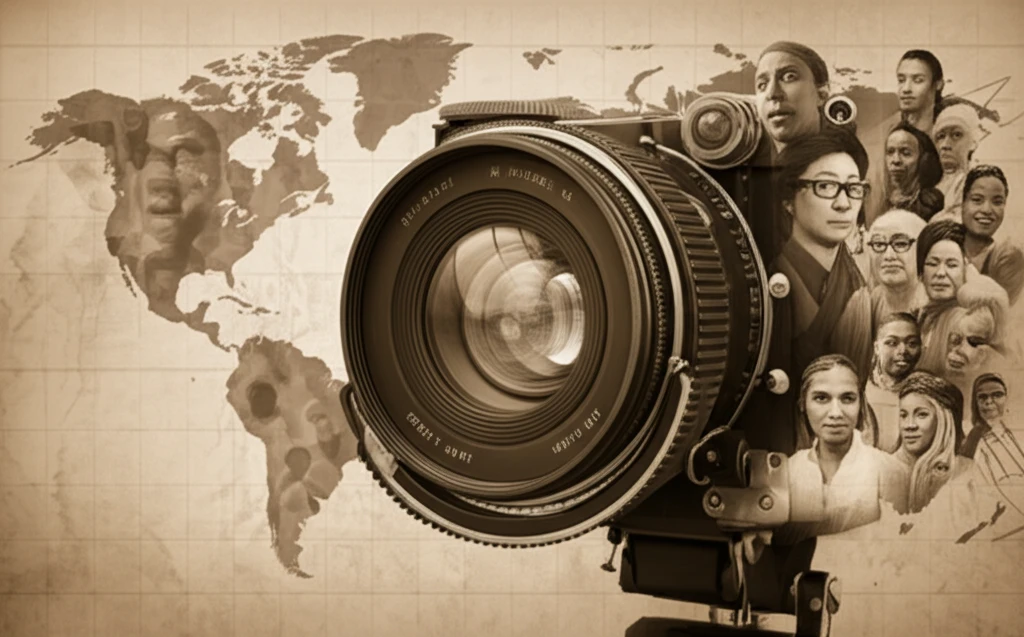
In an era dominated by digital media, it's easy to forget that our technologies have deep roots in the past. What if the tools we use to connect and understand each other were initially developed with a very different purpose in mind? This article delves into the fascinating and often unsettling history of early media technologies, tracing their origins to the world of 19th-century ethnographic research.
Imagine a time when the world felt vast and unknown, and anthropologists ventured into remote corners to document cultures believed to be on the brink of extinction. Driven by a sense of urgency and a desire to preserve what they saw as 'primitive' ways of life, these researchers turned to emerging technologies like photography, audio recording, and film. But what were the unintended consequences of these efforts?
This is the story of how the tools meant to preserve cultural heritage inadvertently played a role in reinforcing racial biases and shaping our understanding of different societies. As we unravel this history, we'll examine how these early media technologies continue to influence our perceptions today.
Mixing Field Notes, Demographics, and Data Science
Much of the raw material of ethnography comes from the ethnographer's field notes - daily logs, almost like journals, that describe the daily life and events the ethnographer witnessed and took part in. Yet ethnography is not purely qualitative: an ethnography of Muslims in Tibet, for example, needs quantitative data such as population, age, income, and other demographic characteristics. Once the data are collected, researchers use statistics to compare the groups, typically by comparing means and standard deviations. This blending is formalized in "quantitative ethnography," which integrates data-mining, discourse analysis, psychology, statistics, and ethnography into a new science for understanding what people do and why they do it.
From Fieldwork Classics to Digital Adaptation
Ethnography has evolved since the classic period exemplified by Margaret Mead's study of adolescents in Samoa, remaining a long and storied method of conducting social science research. The approach is employed by many fields, including anthropology, sociology, political science, and criminology. In recent decades, online ethnography (also known as virtual or digital ethnography) has adapted ethnographic methods to the study of communities and cultures created through computer-mediated social interaction. Researchers still confront practical constraints, as scholars note temporal and financial limitations that shape how ethnographic projects are designed and carried out.
Parallel Paths of History and Ethnography
History and ethnography have largely evolved in parallel, despite significant research contributions from historical ethnography and ethnographic history. Individual scholars helped shape the discipline - Natalya Romanovna Guseva, a Russian ethnographer, historian, and Indologist, is known for research on the ethnography and religions of the peoples of India. Ethnographers have also long shared turf with historians and archaeologists, as seen in the debated question of the precise proto-Slavic location, which has been argued over with theories pointing to territories in the Near East or in Russia. Such historical-ethnographic work is not without critique: one historian's review of a classic work was rated "boldly original" but "not entirely persuasive," illustrating negative assessments of ethnographic history and cultural hermeneutics.
Salvage Ethnography: A Race Against Time
In the late 19th and early 20th centuries, a concept known as 'salvage ethnography' took hold. The idea was that many 'primitive' cultures were rapidly disappearing due to Western expansion and modernization. Anthropologists felt a responsibility to document these cultures before they vanished, preserving their languages, customs, and traditions for future generations.
- Phonetic Alphabet: Creating phonetic alphabets to document and standardize indigenous languages.
- Photography: Using photography to document physical appearance and cultural practices.
- Audio Recordings: Recording speech and songs to preserve languages and traditions.
- Film: Capturing movement, rituals, and daily life.
Reckoning With Colonial Roots
Ethnographic research first became popular among anthropologists in the 1800s, who used it to classify specific cultures and ethnic groups based on their behaviors, interactions, perceptions, and shared values. Contemporary scholarship, however, stresses that ethnography's colonial roots complicate its current practice and ethical considerations, with distinguishing between method and methodology seen as crucial for understanding its theoretical underpinnings. Reviews also track ethnography's history as a methodological process in which the researcher immerses themselves in the subjects' social world. Encyclopedic treatments still frame ethnography as the basic field research method in anthropology, treating it primarily as a corpus of ethnographic data.
The Critique From Critical Ethnography
Ethnography explores cultural phenomena from the point of view of the subject of the study, but critical ethnographers argue that conventional ethnography has ignored questions relating to political economy under capitalism. In recent years, critical ethnography has attempted to go beyond the limitations set by conventional practice. Yet critics respond that the choice of an orthodox Marxist political economy places severe limitations on the possibilities for ethnographic enquiry. Such debates are visible in concrete studies, including critical ethnographies of classrooms that examine student opposition to reproduction.
Comparing Communities, Connecting the Pattern
Ethnographic comparison involves examining the cultural practices, social interactions, and lifestyles of different communities to identify similarities and differences. Underlying this is the classic method of ethnography itself - studying people and cultures through observation and firsthand experience, including immersing oneself in a culture to understand its social norms and beliefs. Comparative ethnography in practice, such as work on alternative spaces, examines how social groups position themselves between cultures, states, moralities, and local or state authorities. Ethnographers aim to show not only how parts of a social pattern are differentiated but also how they are interconnected.
The Enduring Legacy: Reflecting on Our Media Landscape
As we navigate the complexities of our modern media landscape, it's essential to remember the historical context in which these technologies emerged. The biases and assumptions of the past continue to shape our perceptions today. By understanding the origins of media technology in ethnographic research, we can critically evaluate the images, sounds, and stories that surround us. We can work to create a more equitable and inclusive media landscape that respects the diversity of human experience.
Expertise That Fieldwork Demands
Experts caution that misconceptions about ethnography, such as its supposed simplicity, can lead to unreliable results, since untrained individuals often overlook critical aspects of ethnographic expertise and produce superficial analyses. At the craft level, ethnographic interviews serve as a cornerstone of qualitative research, offering deep insights into human behavior and cultural contexts. The same rigor extends to commercial settings, where retail customer ethnography is a qualitative research method involving the systematic observation, description, and analysis of shoppers' behavior and experiences in commercial environments. Given the specialized skills involved, researchers can also hire freelance ethnology and ethnography experts through dedicated platforms.
Studying Cultures Not Yet Here
Ethnography has been used extensively in the study of past cultures, but its value in studying future cultures has only recently been recognized, with the method now used to understand how future cultures will develop and change over time. Ethnographic Futures Research (EFR) is a methodology that blends traditional ethnographic techniques with forward-thinking analysis, enabling researchers to explore potential future scenarios by examining current cultural trends and societal patterns. In parallel, digital ethnography is rapidly evolving with advancements in AI-driven analytics and immersive virtual environments, enabling deeper insights into online communities and consumer behaviors. Researchers are also pairing ethnography with scenario-building - for example, using ethnographic futures as windows into infrastructural change in the Arctic.
Standards, Scrutiny, and Systemic Pressure
Digital ethnography is increasingly institutionalized, as seen in dedicated communities of practice such as the Oxford Digital Ethnography Group, which hosts invited speakers and seminars on the latest questions and research methods in digital ethnography. The field also faces systemic challenges, as when a clash between journalism and ethnography over checking the facts drew a largely defensive reaction from the broader ethnography and sociology community. In response to such problems, Florian Naudet and colleagues presented six principles for assessing scientists for hiring, promotion, and tenure. Where context matters most, ethnography is seen as especially helpful - for instance, in policing, where it allows a more fundamental social analysis of the determinants, nature, and consequences of policing.
Deep Dives With Real-World Reach
A case study investigates a few cases, or often just one case, in considerable depth, and in ethnography case studies are used in various ways to illuminate themes or draw inferences. Field-based anthropology can bridge the gap between academic theory and real-world applications, as demonstrated in case studies that foster a deeper understanding of diverse cultural practices, including urban ethnography in city life. Virtual worlds ethnography, in contrast to "real-world" ethnography, opens the door to other data-collection methods, such as screenshots, chatlogs, and online interviews. Mobile ethnography extends the approach further, providing real-world insights that can fuel innovation.