
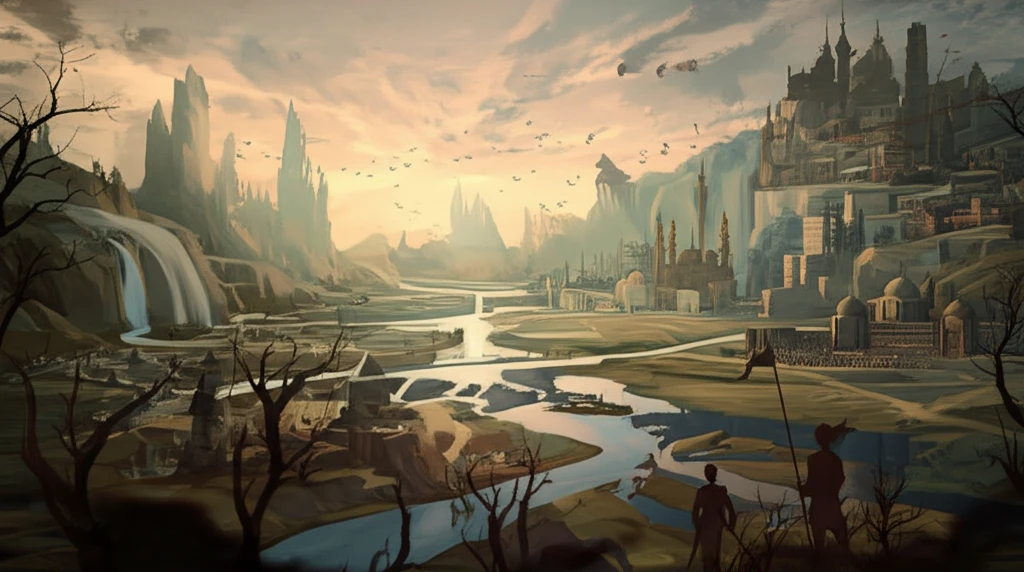
Unearthing India's Ancient Tapestry: A Journey Through Dynasties, Invasions, and Empires

"From the Egyptians to the Mughals, discover the historical currents that shaped the Indian subcontinent and its enduring legacy."
India, a land of vibrant cultures and ancient mysteries, holds a history as deep and layered as the earth itself. Civilizations have risen and fallen on this subcontinent, each leaving an indelible mark on its people, traditions, and landscape. From the earliest maritime explorers to the powerful Mughal emperors, India's story is one of constant change, resilience, and remarkable achievements.
This exploration of India’s past seeks to unravel the complex threads of its historical narrative, highlighting the key dynasties, significant invasions, and transformative empires that have shaped its identity. We'll journey through time, examining the forces that propelled India to both great heights and devastating lows, all while considering the enduring legacy of these events.
Understanding India's past is crucial to appreciating its present. By examining the intricate web of historical interactions, we can gain insight into the cultural, social, and political dynamics that continue to influence this dynamic nation.
India at 1.4 Billion: A Civilization-Scale Demographic
India is the most populous country in the world, comprising approximately one-sixth of the global population. According to the United Nations' World Population Dashboard, India's population reached slightly over 1.428 billion on 1 July 2023, surpassing that of China. This staggering demographic weight means that any study of India's ancient tapestry is simultaneously a study of the lived heritage of one in every seven humans alive today. Historical economic data compiled by the Maddison Project Database, which draws together the work of hundreds of economic historians, provides crucial long-run perspective on how this vast population has shaped and been shaped by the subcontinent's economic trajectory over centuries.
The Challenge of Method in Studying India's Past
Studying India's ancient tapestry requires disciplined methodological frameworks, yet not all so-called 'methods' are created equal. Popular step-by-step techniques — such as the Loomis method for drawing faces or the 'O' method for manifestation — illustrate how the word 'method' is applied across wildly different domains, sometimes with rigour and sometimes with wishful thinking. Similarly, commercial tools like Buyhatke's price tracker apply algorithmic methods to narrow retail comparisons, while Dr. Tan's Balance Method in acupuncture demonstrates a systematic clinical approach built on reproducible distal-needling results. The lesson for historians of India is that a method's value lies not in its label but in its evidentiary grounding — a principle that scholars must uphold when navigating fragmentary archaeological records and contested textual traditions.
From the Indus to the Mahabharata: India's Civilizational Bedrock
India, a country in South Asia, derives its very name from the Indus River, anchoring its identity in one of the world's earliest cradles of urban civilisation. The name 'Bharata' used in the Indian constitution references the ancient mythological emperor Bharata, whose story is told in part in the Indian epic Mahabharata. Hinduism, one of the oldest living religious traditions, has its origins intertwined with the broader ancient Indian landscape; the caste system, a social hierarchy dividing Hindus based on karma and dharma, reflects the interplay of the related concepts of varna (colour or race) and jati (birth). Together, these foundational pillars — riverine geography, epic literature, and social-religious organisation — form the starting point for any serious journey through India's dynastic, imperial, and cultural history.
Early Navigators and the Dawn of Indian History
The story of India's interaction with the world begins with the Egyptians and Phoenicians, who were among the first to establish maritime trade routes. Herodotus, often hailed as the father of history, provides some of the earliest accounts of India, though his knowledge appears limited to the regions bordering Persia. The aversion of ancient Indians to disclosing their history, often intertwined with religious beliefs, shrouds much of their past in mystery.
- The Egyptians and Phoenicians established early sea routes to India.
- Herodotus provided early historical accounts.
- The Persian Empire conquered parts of western India.
- Alexander the Great's expedition expanded European knowledge of India.
Uncovering India's Hidden Chapters: New Research and Narratives
Contemporary scholarship and journalism continue to peel back layers of India's complex history. A Telugu-language podcast featuring historian Madan Gupta has attracted over two million views for its exploration of lesser-known facts and hidden stories of India's past, signalling strong public appetite for narratives beyond textbook accounts. Major Indian news outlets such as India Today and The Hindu regularly feature reporting and analysis that connect historical themes to present-day politics, society, and culture, ensuring that the study of India's dynasties and empires remains a living conversation rather than a static archive. ScienceDaily's coverage of breaking research across disciplines also provides an avenue for cross-pollination between, for example, archaeological science and mainstream historical interpretation.
Criticising the Canon: When Historical Frameworks Fall Short
One of the most consequential methodological failures in Indian historiography was the periodisation imposed by James Mill, who divided Indian history into Hindu, Muslim, and British phases. Historians have criticised this categorisation extensively, arguing it was based on a flawed and biased understanding of Indian society and religion, and that it promoted a divisive and inaccurate view of the past by reducing a continuous civilisational stream to neat religious compartments. Outside historiography, India's experiment with cooperative farming offers a parallel cautionary tale: research published in Agri Articles documents how cooperative farming, despite its theoretical benefits of collective ownership and resource sharing, has faced significant limitations and criticism in practice, including issues of unequal power distribution and bureaucratic inefficiency. Both cases illustrate how grand frameworks — whether periodisations of history or models of agricultural organisation — can obscure more than they reveal when applied without critical scrutiny.
Comparing Civilisations: Cultural Dimensions and Their Limits
When analysing India's place among world civilisations, comparative cultural frameworks offer valuable but imperfect tools. Geert Hofstede's well-known six-dimensional model of national culture, which scores countries on axes such as power distance, individualism, and long-term orientation, provides a structured way to compare Indian cultural tendencies with those of other societies. However, such models risk flattening the enormous internal diversity of a subcontinent that encompasses multiple languages, religions, and social structures into a single data point. The utility of any comparison platform — whether Hofstede's cultural indices or a modern product-comparison tool like Versus — ultimately depends on the granularity and fairness of the categories chosen, a challenge that is acutely felt when one attempts to compare India's civilisational complexity with that of any other single nation.
Pulling the Threads Together: Expert Guidance on India's History
Expert institutions continue to shape how India's history is studied and understood. Vision IAS, a prominent Indian civil-services preparation institute, publishes guidance on studying medieval and modern Indian history, emphasising selective study, topic identification based on trend analysis, and the recognition that exam questions range from difficult to easy — a pragmatic reminder that mastery of India's past requires both breadth and strategic depth. The Indian Express, one of the country's leading newspapers, provides ongoing editorial commentary that frequently synthesises historical context with contemporary affairs, reinforcing the idea that India's ancient tapestry is not a relic but a living framework through which present-day events are interpreted. These expert voices collectively underscore that synthesising India's history demands not just knowledge of facts but the ability to weave them into coherent, critically evaluated narratives.
India's Trajectory: Economic Forecasts and Emerging Trends
The IMF's World Economic Outlook, published twice yearly with interim updates, provides authoritative projections and policy analyses of the global economy in the near and medium term — analyses in which India features prominently as one of the fastest-growing major economies. As AI and digital technologies reshape economic landscapes worldwide, forward-looking platforms like AiUntethered highlight key insights and future outlooks on pressing issues including technological disruption, a trend that will inevitably intersect with how India manages its demographic dividend and cultural heritage in the decades ahead. The intersection of economic projection and technological transformation sets the stage for a future in which India's ancient civilisational strengths — adaptability, pluralism, and scale — may prove as relevant as ever.
Systemic Barriers: From Public Health to Climate Adaptation
India's progress in the 21st century is constrained by deep-rooted systemic challenges that echo historical inequities. Research published in Frontline (The Hindu) on public health reveals that systemic factors — including unavailability of transport, poor quality of care characterised by alienation and disrespect in medical facilities, and high out-of-pocket expenditure in both public and private settings — continue to undermine healthcare access for marginalised populations. On the environmental front, the Global Soil Week initiative documents how systemic challenges in climate change adaptation demand innovative, agroecological responses that address root causes rather than symptoms. These overlapping crises in health and environment illustrate that the legacy of India's past — including historical patterns of inequality and resource distribution — remains embedded in the structural fabric of the present.
Lives Shaped by History: From Business Empires to Behavioural Nudges
India's history is not only written in stone inscriptions and court chronicles; it plays out in the dramatic arcs of individual lives. The downfall of Anil Ambani — from controlling massive assets in telecom, power, and entertainment to filing for bankruptcy — stands as one of the most dramatic modern business stories in Indian history, echoing the cyclical rise and fall of dynastic fortunes that characterises the subcontinent's longer past. At a more grassroots level, nudge theory is being applied across various sectors in India to help people make more sustainable choices and improve financial decisions, demonstrating how behavioural science rooted in an understanding of human psychology can shape outcomes at scale. Meanwhile, the classical age of Gupta and Harsha, highlighted in historical overviews of India, reminds us that the human element — the decisions of rulers, the faith of communities, the ingenuity of artisans — has always been the engine of civilisational change.
Echoes of the Past
India's history is a testament to the enduring power of cultural exchange, adaptation, and resilience. The rise and fall of empires, the impact of foreign influences, and the constant interplay of diverse traditions have shaped the unique character of this nation. By understanding its past, we can better appreciate the complexities and richness of its present, and gain valuable insights into its future trajectory.