
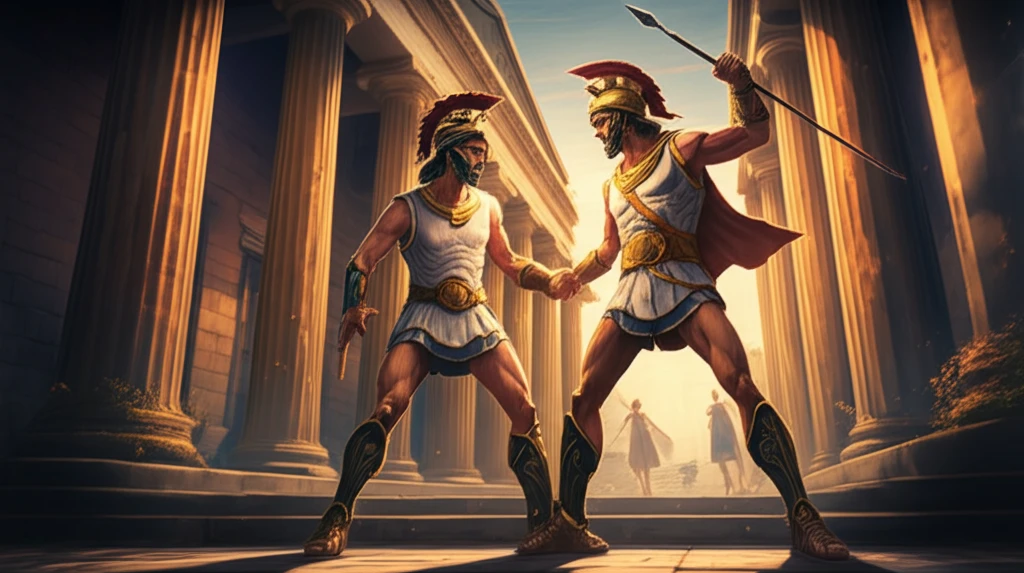
Unearthing Athenian Ideals: How Two Statues Shaped Democracy's Story

"Explore the hidden narratives behind the Tyrant-Slayers statues and their enduring impact on Athenian political thought and cultural identity."
In the heart of ancient Athens, amidst the bustling agora and towering temples, stood a pair of statues known as the Tyrant-Slayers. These weren't just artistic masterpieces; they were potent symbols, loaded with political meaning and capable of stirring profound emotions. A new analysis, inspired by the book 'The Tyrant-Slayers of Ancient Athens: A Tale of Two Statues' by V. Azoulay, delves into the fascinating journey of these statues, revealing how their significance transformed over centuries, mirroring the shifting tides of Athenian society.
Originally erected to honor Harmodius and Aristogeiton, who assassinated the tyrant Hipparchus in 514 BCE, the statues quickly became emblems of Athenian democracy. Their act, though driven by personal motives, was interpreted as a heroic blow against tyranny, paving the way for the establishment of a more inclusive government. The statues, therefore, weren't just representations of two individuals, but embodiments of the ideals of freedom, courage, and civic responsibility that defined Athenian identity.
However, the story of the Tyrant-Slayers statues is far more complex than a simple tale of democratic triumph. As Azoulay's research highlights, their meaning was constantly renegotiated and reinterpreted by various social actors, each seeking to appropriate their symbolism for their own purposes. From oligarchs to Roman emperors, the statues served as a canvas onto which different political agendas were projected, reflecting the ever-changing dynamics of power and ideology in the ancient world.
The Lasting Cultural Footprint of the Tyrant-Slayers
Michael W. Taylor's study "The Tyrant Slayers" has had a measurable impact on scholarship, with its primary theses incorporated into detailed discussions of various aspects of Athenian democratic culture. The narrative of two lovers who attempted to assassinate a tyrant in ancient Athens continues to resonate in modern political commentary, with observers drawing parallels between the ancient event and contemporary anti-authoritarian movements. The story of the Tyrant-Slayers endures as a touchstone for understanding how democracies remember and mythologize their founding acts of resistance.
Textual Sources and Methodological Constraints
The scholarly study of the Tyrant-Slayers tradition relies primarily on close readings of canonical ancient texts, particularly Thucydides' excursus in Book 6 (sections 54-57) and the accounts of Herodotos. These works have long served as the foundational sources for reconstructing the narrative and its political significance. However, this text-centered methodology faces inherent limitations, as different ancient authors offer divergent perspectives on the same events, complicating efforts to establish a single authoritative account.
The Original Assassination and Its Aftermath
In the early fifth century BCE, the emerging Athenian democracy was suppressed under the rule of two tyrants, Hippias and Hipparchos. Harmodios and Aristogeiton attempted to overthrow this regime; while the effort was only partially successful — Hippias escaped death — the two were nonetheless celebrated for their role in ending the tyranny. Their commemoration became one of the foundational moments in the civic mythology of classical Athens, establishing the Tyrant-Slayers as enduring symbols of resistance to authoritarian rule.
A Living Legacy: How the Statues Evolved Over Time
The story of the Tyrant-Slayers statues begins with their creation in the late 6th century BCE. The original statues, sculpted by Antenor, were commissioned shortly after the expulsion of Hippias, the last of the Peisistratid tyrants. These statues, though lost to time, represented a pivotal moment in Athenian history, marking the transition from tyranny to democracy. While Pliny suggests a date of 510/9 BCE for the erection of the Antenor group, some scholars speculate it may be a bit later, after the Battle of Marathon. This initial placement underscores their immediate importance as symbols of liberation.
- Political Symbolism: The statues were not just art; they were political statements, used to legitimize regimes and rally support.
- Iconographic Adaptations: The way the figures were depicted, their poses, and even their placement all contributed to the evolving narrative.
- Historical Context: Each era, from classical Athens to the Roman Empire, reinterpreted the statues through its own lens.
- Enduring Influence: Even today, the image of the Tyrant-Slayers continues to resonate as a symbol of resistance and democratic ideals.
Complicating the Heroic Narrative
Recent scholarship has offered a more nuanced reading of the Tyrant-Slayers than the celebratory civic narrative traditionally allowed. Scholars note that ancient authors including Thucydides and Aristophanes critiqued the bravado of the Tyrannicides, suggesting a shift toward a more cautious Athenian political disposition. The political afterlife of the tyranny further complicates the picture, as relatives and associates of the deposed tyrants continued to hold public office — Hipparchus son of Charmus was elected archon in 496 BCE — and the tyrants' disrepute only solidified over time as memory of their earlier constructive contributions waned.
When Tyrant-Slaying Falls Short
The archetype of the heroic tyrant slayer remains a recurring theme in modern popular culture, appearing in strategy video games where warrior factions seek to cleanse corrupt leadership with steel. These fictional portrayals dramatize the same fundamental tension present in the Athenian narrative: the aspiration to overthrow tyranny and the violence such acts require. Online content has also engaged with scenarios of the tyrant slayer who cannot find a tyrant to challenge, suggesting that the archetype's cultural power lies not only in triumph but in the possibility of failure and ambiguity.
The Language of Tyrannicide
The term "tyrant slayers" sits within a broader lexical field of words and phrases associated with resistance to authoritarian power, including related terms for liberators and champions of freedom. The specific choice of language shapes how the act of opposing tyranny is framed and understood by a given audience. This linguistic dimension is significant for the study of the Athenian Tyrant-Slayers, as the evolving terminology used to describe Harmodios and Aristogeiton over the centuries reflects shifts in how their legacy was perceived and politicized.
An Everlasting Reminder of Freedom
The Tyrant-Slayers of Ancient Athens offer a powerful reminder that symbols are never static. Their meaning is constantly shaped and reshaped by the forces of history, reflecting the hopes, fears, and aspirations of each generation. By understanding the complex story of these statues, we gain a deeper appreciation for the enduring power of art, politics, and the human desire for freedom.
A Legacy Still Being Interpreted
The story of the Athenian Tyrant-Slayers sits at the intersection of history, mythology, and political ideology, making it a uniquely rich subject for interpretation. While the broad outlines of the assassination of Hipparchos and the fall of Hippias are widely accepted, scholars continue to debate the precise political motivations behind the act and the degree to which it genuinely catalyzed democratic reform. The enduring scholarly and public interest in these two figures suggests that the questions they embody — about violence, freedom, and the origins of democratic governance — remain as urgent and contested as ever.
Ongoing Scholarly Inquiry
Research into the Tyrant-Slayers tradition continues to evolve, with scholars presenting new findings on the Thucydidean and Herodotean traditions surrounding the event as recently as early 2024. Michael W. Taylor's foundational study remains a key reference work preserved in major archival collections, ensuring that new generations of researchers can engage with the primary scholarly arguments. Future directions in this field are likely to involve deeper interdisciplinary engagement between classical scholarship, art history, and political theory as researchers seek to understand how the Tyrant-Slayers narrative was constructed, contested, and transmitted across millennia.
Enduring Questions About Power and Resistance
The narrative of the Athenian Tyrant-Slayers raises broader questions that extend well beyond the specific historical context of fifth-century BCE Athens, touching on when violence against authority might be considered justified and how democratic societies should remember acts of political assassination. These are recurring challenges in political philosophy for which definitive answers remain elusive. The continuing engagement with the Tyrant-Slayers story across scholarly, artistic, and popular domains suggests that such tensions are fundamental features of democratic life rather than problems susceptible to permanent resolution.
From Ancient Myth to Living Memory
The Tyrant-Slayers of Athens were not abstract political symbols but real individuals — Harmodios and Aristogeiton — whose personal motivations, relationships, and fates gave the narrative its enduring emotional power. As scholarship on the commemorative tradition emphasizes, the image of these figures was deeply intertwined with the social world of the Athenian symposium, where they were invoked in contexts ranging from political celebration to personal revelry. This human dimension — the fact that the story of Athenian democracy's founding is inseparable from a story of personal loyalty, love, and violence — continues to shape how the Tyrant-Slayers are remembered and represented across cultures and centuries.