
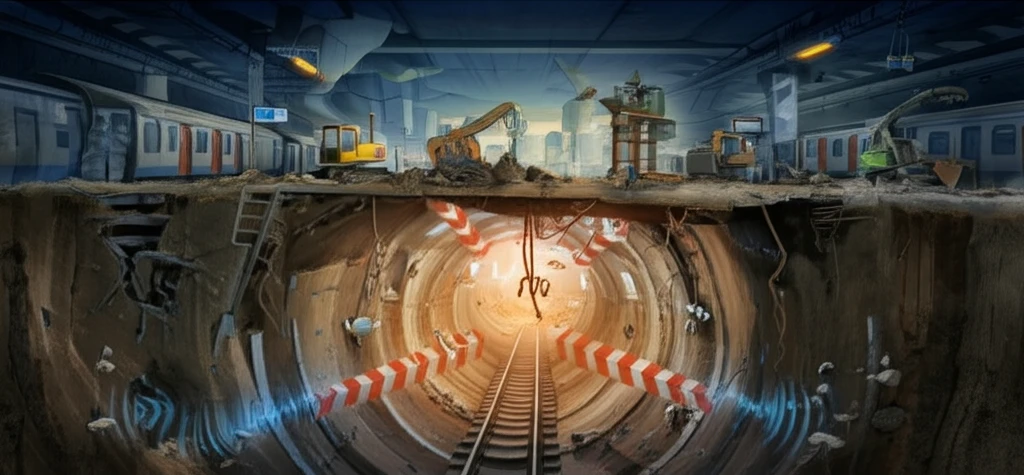
Underground Structures: How to Protect Them from Construction Vibrations

"Learn how to safeguard underground subway and stations from collapse vibration with our guide."
In rapidly growing urban environments, the construction and demolition of structures are becoming increasingly common, often occurring in close proximity to existing underground infrastructure. This proximity poses significant risks, particularly concerning the impact of vibrations on the structural integrity of underground spaces such as subways and utility tunnels. The controlled blasting, while efficient, can generate ground vibrations that, if not properly managed, may lead to costly damage or even structural failures.
Throughout history, failures due to construction-related vibrations have underscored the importance of understanding and mitigating these risks. Examples range from damage to mountain tunnels and expressways to the severe destruction of subway stations during earthquakes, emphasizing the need for robust preventative measures and careful construction practices. Protecting these vital underground networks requires a comprehensive approach that considers both the dynamic responses of structures and the characteristics of induced vibrations.
This article delves into the analysis and mitigation of dynamic responses in underground stations subjected to vibrations from nearby construction activities. By exploring the principles of vibration propagation and structural dynamics, we aim to provide insights into safeguarding urban underground infrastructure, ensuring the safety and longevity of these essential systems.
The Scale and Vulnerability of Underground Structures
Japan built the world's largest underground flood tunnel, a massive structure that silently protects Tokyo from flooding every year, representing one of the greatest engineering achievements ever created. Deep underground engineering structures face a series of serious threats including high-strength water intrusion, rock bursts, large deformation of soft rock, and boulder collapse under the action of unloading forces. A nearby subsurface detonation can induce significant in-structure shock in underground structures, affecting both the rigid body motion of the entirely buried structure and the local response of individual structural elements.
Underground Infrastructure as a Practical Alternative
Underground infrastructure offers a practical and scalable alternative for overcoming barriers that traditional above-ground approaches face, particularly in locations where conventional methods encounter recurring limitations. This is especially relevant in dense urban environments where surface space is constrained and existing infrastructure creates conflicts for new deployment. The domain reduction method (DRM) provides an efficient computational approach for simulating blast damage effects in large-scale underground sites, representing a standard numerical technique for assessing structural response to dynamic loads.
Geological Origins of Underground Structures
A mysterious underground structure was discovered near the so-called 'Appalachian blob' in New York, formed by hot material rising beneath the blob while colder, denser rock descended through a column-like formation, much like a conveyor belt operating over millions of years. This geological phenomenon illustrates how subsurface structures can form naturally through deep earth processes over vast timescales. However, the research does not prove that the structures are connected or that one created the other, highlighting the challenges in understanding subsurface origins.
Understanding Ground Vibration and Its Impact
Ground vibration, a common byproduct of construction activities, can significantly affect underground structures. The intensity and frequency of these vibrations depend on several factors, including the type of construction activity, the geological conditions of the site, and the distance from the source of the vibration. Controlled blasting and demolition, in particular, generate intense vibrations that propagate through the ground, potentially affecting nearby underground facilities.
- Vibration Monitoring: Real-time monitoring systems can track vibration levels during construction, providing early warnings when levels exceed safe thresholds.
- Isolation Techniques: Installing vibration barriers or using damping materials can help reduce the transmission of vibrations from the source to the underground structure.
- Modified Construction Methods: Adjusting construction techniques, such as using non-explosive demolition methods or modifying blasting patterns, can minimize vibration generation.
- Structural Reinforcement: Strengthening existing underground structures with additional support or reinforcement can enhance their ability to withstand vibration-induced stresses.
Advances in Safety Monitoring and Seismic Design
Recent technical research focuses on safety monitoring and early warning systems for deep underground engineering structures, which face disasters such as water intrusion, rock bursts, and soft rock deformation under unloading conditions. Performance-based seismic design of underground structures increasingly treats the structure and surrounding soil as a coupled system, using different numerical methods to analyze their joint behavior under earthquake loading. Underground structural engineering projects now emphasize compliant, constructible design solutions aimed at protecting existing infrastructure during new construction activities.
Waterproofing and Material Limitations
Bitumen membranes used for underground structure protection must withstand persistent ground moisture exposure while maintaining structural integrity. Key performance factors include elongation—how much the membrane can stretch before failure—which is especially critical where limited surface or thermal movement may occur. Heat resistance under elevated temperatures also determines whether waterproofing solutions will hold up in demanding underground conditions where temperature fluctuations can compromise barrier performance.
Depth and Construction Methods Compared
A real-scale size comparison of underground structures reveals the vast range of depths among mines, caves, cities, tunnels, and installations built beneath the earth's surface. Underground shelter construction involves excavation, timber framing, underground roof support, and natural concealment techniques to create functional spaces hidden below ground level. These comparative perspectives show that underground structures span from shallow utility corridors to extremely deep installations, each requiring different engineering approaches to manage structural loads and environmental pressures.
Protecting Our Future
As cities continue to grow and infrastructure demands increase, protecting underground structures from construction-related vibrations becomes ever more critical. By implementing proactive strategies and leveraging advanced technologies, we can safeguard these vital assets, ensuring the resilience and sustainability of urban environments for generations to come. The collaboration between engineers, policymakers, and the public is essential to create solutions that balance progress with the safety and preservation of our built environment.
Structural Response Spectrum Analysis
Expert analysis of structures like gravity dams employs response spectrum methods using linear elasticity models, 3D flow elements, and fluid-structure interfaces to assess dynamic structural behavior. This phased analysis approach applies structural response spectrum techniques in three-dimensional models to evaluate how underground and heavy civil structures respond to vibration and seismic forces. Such computational modeling represents the current state of expert practice for predicting structural performance under dynamic loading conditions.
A Bright Future Underground
Land is becoming increasingly scarce, not just in Switzerland but globally, and the subsurface offers alternatives ranging from underground freight transport to data centers to underground farming. Industry experts see a bright future in underground structures as surface space constraints drive innovation in subsurface utilization. As renewable energy technologies continue to advance, the potential for truly sustainable underground living environments grows ever more promising, opening new frontiers for how humans interact with the space beneath their feet.
Corrosion, Contamination, and Governance
Cathodic protection systems for underground structures face significant challenges in maintaining effectiveness over time, requiring ongoing monitoring and solutions to ensure structural longevity. Groundwater contamination has emerged as a widespread and systemic challenge across multiple regions, including states in India such as Odisha, Madhya Pradesh, Kerala, Karnataka, and Gujarat, transcending differences in geography, urbanization, and institutional capacity. On the governance side, organizations are now measuring carbon footprints, monitoring climate risks, and managing ESG regulatory requirements that increasingly affect underground construction and infrastructure projects.
Water and Moisture Threats to Underground Cables
In underground cable-in-duct installations, water and moisture can come into contact with cables depending on the underground environment in which they are installed. This moisture exposure can wreak havoc on a system, potentially impacting the operational lifetime of the cable and leading to costly repairs. These real-world consequences underscore why protecting underground structures from environmental and construction-related forces is not merely an engineering concern but a practical matter affecting communities and service reliability.