
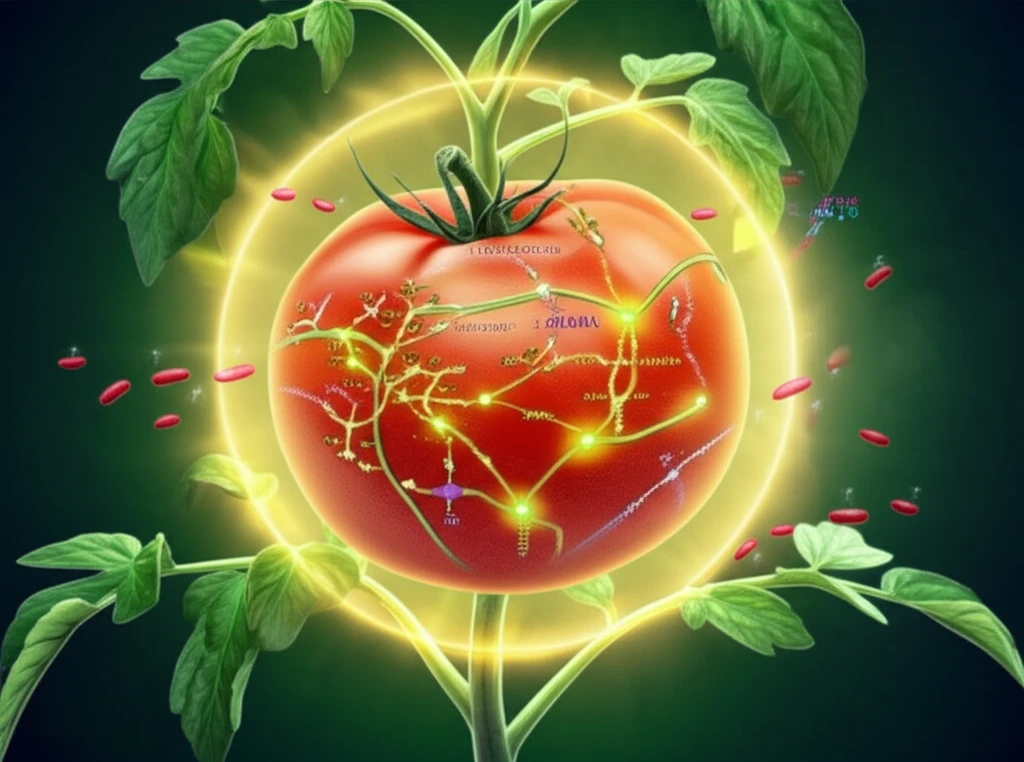
Tomato's Secret Weapon: How Boosting Natural Defenses Fights Bacterial Wilt

"Unlocking the genetic potential of tomatoes to resist Ralstonia solanacearum through methionine and GABA pathways."
Bacterial wilt, caused by the pathogen Ralstonia solanacearum, poses a significant threat to tomato crops worldwide, leading to substantial economic losses. This devastating disease affects over 200 plant species, making it a persistent challenge for farmers.
The quest for resilient tomato varieties has led scientists to investigate the intricate interactions between the plant and the pathogen. A recent study published in The Plant Journal has uncovered a fascinating link between tomato's natural defenses and two key metabolic pathways: the methionine cycle and the y-aminobutyric acid (GABA) biosynthesis pathway.
This article explores these groundbreaking findings, explaining how manipulating these metabolic pathways could unlock new strategies for enhancing tomato resistance to bacterial wilt. This approach could lead to more sustainable and eco-friendly agricultural practices.
Global Tomato Production and Breeding Advances
Between 1999 and 2019, the global area harvested for tomatoes increased by 27% while production rose by 66%, reflecting significant productivity gains. This growth is largely attributable to improvements in tomato varieties through targeted breeding efforts. Breeders have focused on developing cultivars with resistance to multiple diseases, including Fusarium wilt strains, late blight, and other fungal and bacterial pathogens. Disease-resistant variety development remains a central strategy for protecting global tomato yields.
Conventional Breeding and Its Constraints
Traditional approaches to tomato disease management have relied on conventional breeding for resistance traits, chemical applications, and cultural practices such as crop rotation. While these methods have yielded meaningful gains, they carry inherent limitations. Breeding for single-disease resistance can leave crops vulnerable to evolving pathogen strains, and chemical controls may face environmental and regulatory constraints. An integrated approach combining multiple strategies is increasingly recognized as necessary for durable protection.
A Century of Tomato Disease Research
Tomato disease resistance research spans decades of work identifying resistance genes and developing screening protocols. Early efforts focused on major single-gene resistances to specific pathogens, but these were often overcome by pathogen evolution. Over time, the field shifted toward understanding quantitative disease resistance and the complex genetic networks underlying plant immunity. These foundational discoveries continue to inform modern breeding strategies for durable, multi-pathogen resistance.
Decoding Tomato's Metabolic Defense System Against Bacterial Wilt
The study began with a detailed proteomic analysis, comparing tomato stems infected with highly aggressive (RsH) and mildly aggressive (RsM) strains of R. solanacearum. Researchers observed significant changes in protein expression related to the methionine cycle (MTC) and the downregulation of y-aminobutyric acid (GABA) biosynthesis in infected plants. This initial observation suggested that these pathways play a crucial role in the plant's response to the pathogen.
- SAMS2, SAHH1, MSI (involved in the methionine cycle)
- GAD2 and SSADHI (involved in GABA biosynthesis)
Advances in Understanding Plant Defense Mechanisms
Recent research has deepened understanding of how tomato plants deploy natural defenses against pathogens, including the molecular pathways regulating immune responses. Scientists are investigating how boosting innate plant immunity can provide durable protection without relying on single resistance genes. Studies on gene expression and metabolic regulation are revealing new targets for enhancing disease resistance. This growing body of work supports the concept that priming or activating plant defense systems can be a viable strategy against bacterial wilt and other diseases.
Challenges in Achieving Durable Resistance
Despite advances, breeding for disease resistance in tomatoes faces persistent challenges. Pathogens can evolve to overcome single-gene resistances, and some resistance traits may carry yield penalties or quality trade-offs. Current approaches are working to address these limitations through genetic engineering and CRISPR-based techniques that can introduce multiple resistance mechanisms simultaneously. The goal is to develop cultivars with durable, broad-spectrum resistance without compromising agronomic performance.
Comparing Resistance Mechanisms Across Tomato Species
Research comparing disease resistance responses in different tomato species has revealed that gene network rewiring plays a significant role in quantitative disease resistance. Studies deploying weighted gene correlation network analysis have shown differences in resistance responses between susceptible and resistant cultivars. These comparative approaches are providing valuable genetic insights into combating biotic stress and forming foundations for sustainable breeding strategies. Such species-level analyses help identify the most promising genetic pathways for transfer into commercial varieties.
Future Implications: A New Era of Disease-Resistant Crops
This research provides a solid foundation for developing targeted strategies to improve tomato resistance to bacterial wilt. By manipulating the methionine cycle and GABA biosynthesis, scientists can potentially enhance the plant's natural defenses, reducing the need for chemical interventions.
Integrating Defense Enhancement into Modern Agriculture
The convergence of molecular biology, genomics, and traditional breeding is creating new opportunities to enhance tomato disease resistance through natural defense mechanisms. Experts emphasize that durable resistance requires layered approaches combining multiple genetic and management strategies. As climate change and global food security pressures intensify, the ability to boost plant immunity becomes increasingly important for sustainable tomato production.
Sustainable Disease Management on the Horizon
Future approaches to tomato disease management are moving toward eco-friendly alternatives to synthetic fungicides, including microbial-based strategies and natural defense inducers. Research into sustainable postharvest disease control is identifying biological and physical methods that can reduce reliance on chemical inputs. These innovations are part of a broader shift toward integrated, environmentally conscious production systems that maintain fruit quality while minimizing environmental impact.
Plant Immunity as a Cornerstone of Disease Control
Inducing the plant immune system to fight pathogens is recognized as an eco-friendly strategy that should be a major component in disease management. Research on tomato as a model plant has identified key stimulators and responsive genes involved in systemic acquired resistance. Studies examining biological control agents like Bacillus thuringiensis have shown potential for promoting systemic immunity in tomato plants against multiple pathogen types. These approaches represent a paradigm shift from reactive chemical control to proactive immune system enhancement.
From Lab to Field: Realizing the Promise
Translating laboratory discoveries about tomato defense mechanisms into field-ready solutions remains a critical challenge. Growers need varieties that not only resist disease but also perform well under diverse environmental conditions and meet market demands. The success of enhanced natural defense strategies will ultimately depend on accessibility to farmers, affordability, and integration with existing agricultural practices.
The proteomic and transcriptomic data offer valuable insights into the complex interactions between R. solanacearum and tomato plants. These findings open new avenues for breeding programs, focusing on selecting and enhancing desirable traits related to MTC and GABA pathways.
Ultimately, this research contributes to a more sustainable and resilient agricultural system, ensuring a stable supply of tomatoes in the face of persistent disease challenges. This approach may be applicable to other crops and diseases, ushering in a new era of disease-resistant agriculture.