
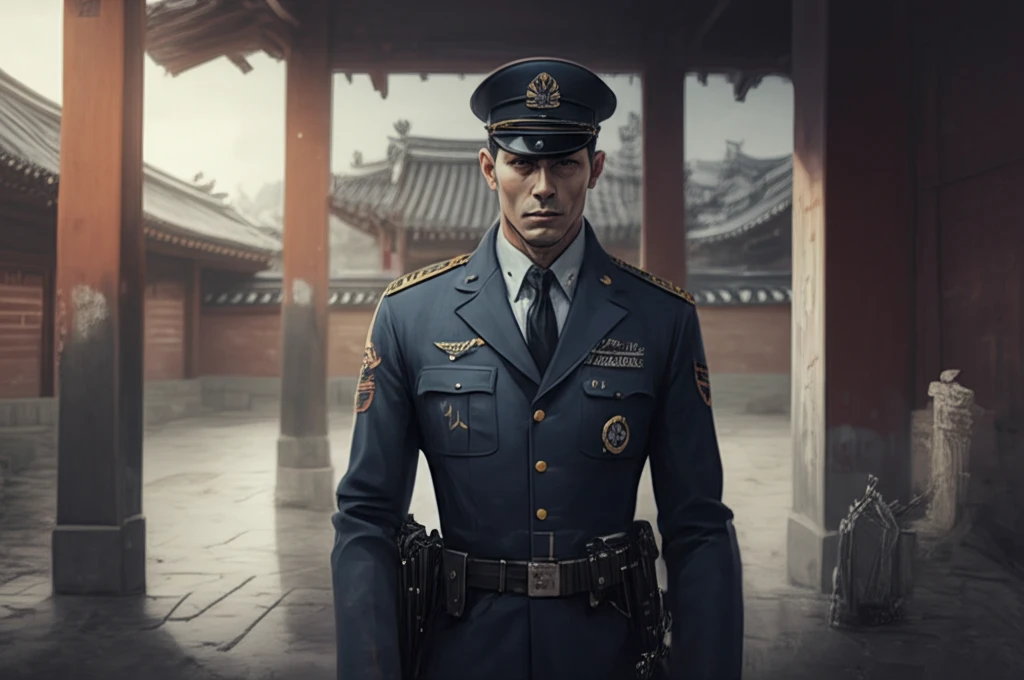
Threads of Power: How Police Uniforms Reveal Korea and Japan's Divergent Paths Through History

"Unraveling the complex relationship between fashion, authority, and national identity through the lens of police uniforms in Imperial Japan and Colonial Korea."
Clothing offers a fascinating window into history, revealing intricate details about social structures, cultural values, and power dynamics. Ancient tombs, with their murals and clay figurines, provide invaluable insights into the clothing styles and customs of past civilizations, such as Korea and Japan, centuries ago.
In particular, the evolution of uniforms offers a unique perspective on how societies project authority and embrace change. This is especially evident in the history of police uniforms in Imperial Japan and Colonial Korea, where these garments became powerful symbols of modernization, national identity, and, at times, colonial oppression.
By examining the transformation of police uniforms in these two nations, we can gain a deeper understanding of their distinct historical trajectories and their complex relationships with tradition, modernity, and each other.
Growth That Slowed Too Early
The final point of divergence from Japan's path as an economic model is 'less rosy' for South Korea. South Korea's growth and its growth potential have slowed at an earlier period than Japan's did, marking a measurable shift in the two economies' trajectories. This deceleration frames how each state's institutions project authority today.
Uniforms as a Visible Layer
Analysts caution that police uniforms are not really the issue in themselves; they are just a visible layer of a mostly invisible system. That system, which the state uses to exert control, is defined by history, institutions, policies, and culture. Reading uniforms without that underlying system risks mistaking surface appearance for the forces that actually shape policing.
Two Millennia of Entangled Histories
Sino-Korean relations date back to prehistoric times, a relationship marked by both periods of cooperation and antagonism. Korea's own arc runs from ancient kingdoms to modern times, a span in which institutions and their trappings evolved under neighboring influence. This deep background is the foundation for understanding why Korean and Japanese state institutions diverged in the modern era.
A Tale of Two Empires: Clothing and National Identity
The relationship between clothing and national identity in Korea and Japan was deeply intertwined with their historical interactions with China. For centuries, both nations adopted elements of Chinese dress, adapting them to their own cultural contexts. However, their approaches to these influences differed significantly.
- Korea: Strong Sinocentric sentiments, close adherence to Chinese dress codes.
- Japan: Gradual divergence from Chinese styles, development of unique Japanese attire.
- Police Reforms : Police force in Korea under Japanese governance was considered a sign of intervention.
- Cultural identity was seen through clothes and was considered Japanese Imperialism.
Shared Scarcity, Divergent Responses
Korea and Japan are both resource-poor when it comes to energy sources, and powering their economies has required both to develop global supply chains for fossil fuels, nuclear power, and renewable energy. Recent analysis tracks how each country responded to that shared constraint in its own way. These differing strategic responses mirror the broader institutional divergence visible in how each state presents authority.
The Unflattering Comparison
The optimistic story of Japan as an economic model breaks down at a specific point: South Korea's growth and its growth potential have slowed at an earlier period. The same source material that frames the Korea-Japan divergence describes this outcome as 'less rosy' than the rest of the narrative. It is a reminder that convergence narratives often obscure where the two paths actually parted.
Divergent Agendas on a Global Stage
Speeches by the leaders of China, South Korea, and Japan to the World Economic Forum revealed their differing ambitions, a moment of direct comparison between the region's powers. The framing highlights how each state projects distinct priorities even when addressing the same global audience. Such public stagings echo the way uniforms communicate different institutional identities at home.
Uniforms as Reflections of Power
The history of police uniforms in Imperial Japan and Colonial Korea offers a compelling case study of the intricate relationship between fashion, authority, and national identity. In Japan, Western uniforms symbolized modernization and a break from the past, while in Korea, they represented both modernization and the imposition of colonial power. By examining these seemingly simple garments, we gain a deeper understanding of the complex historical forces that shaped these two nations and their evolving identities.
Reading the State Through Its Dress
Commentary on how we dress the law concludes that police uniforms are simply a visible layer of a mostly invisible system defined by history, institutions, policies, and culture. On this reading, comparing Korean and Japanese police dress is a way to read each state's underlying model of control. The uniforms are legible only because the systems behind them differ.
The Shape of Enforcement to Come
The Trump administration is offering grants of tens of millions of dollars to cities across the US to create more Memphis-style enforcement surges, on condition of adopting certain practices. This suggests that the visual and operational style of policing is being deliberately standardized from the top. The trend is a live example of how political decisions shape the uniforms and tactics citizens encounter.
Resource-Poor States, Globalized Power
Korea and Japan must both secure fossil fuels, nuclear power, and renewables through global supply chains because neither is resource-rich in energy. This shared vulnerability forces each state to build far-reaching institutions of economic management. The result is state power that is exercised as much through supply chains and regulation as through uniformed authority in the streets.
Contrasts That Define Everyday Life
Side-by-side imagery of North and South Korea reveals the stark contrasts between the two nations, in landscapes, cultures, and daily conditions. The divergent paths these images capture are not abstractions but lived realities for the people within each system. Uniforms, infrastructure, and public order are among the most visible markers of that divide.