
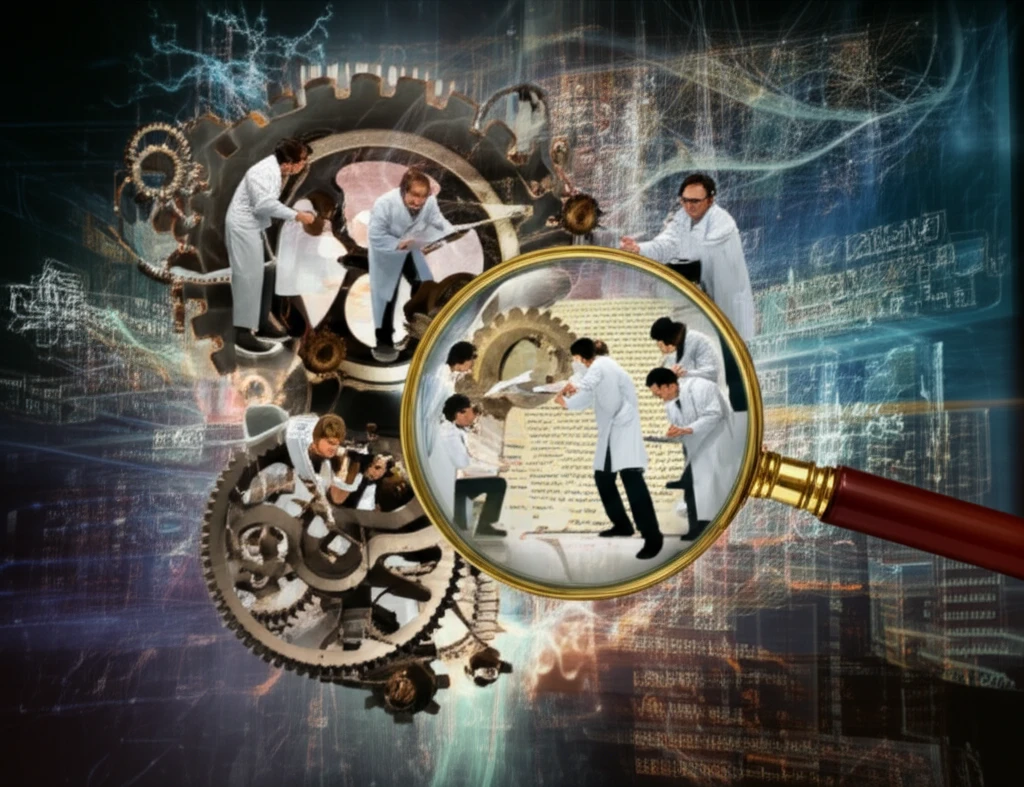
The Unsung Heroes of Scientific Advancement: Acknowledging the Reviewers

"Why peer review is crucial for maintaining quality and fostering innovation in scientific research, and how reviewers contribute to the growth of knowledge."
In the realm of scientific publishing, the spotlight often shines on researchers and their groundbreaking discoveries. However, behind every published article lies a team of dedicated individuals who play a crucial role in ensuring the quality, accuracy, and impact of the work: the reviewers.
Peer review, the process by which experts in a field evaluate scholarly work, is the cornerstone of scientific integrity. It's a critical step that helps to validate research findings, identify potential flaws, and ultimately advance knowledge. Without the meticulous efforts of reviewers, the scientific landscape would be rife with inaccuracies and unreliable information.
This article delves into the significance of reviewers in the scientific process, highlighting their contributions and shedding light on their often-unseen work. We'll explore how their constructive feedback shapes research, maintains quality, and fosters continuous growth within scientific disciplines. This is an exploration of the E-E-A-T of experts.
A Massive, Hard-to-Measure Workforce
Precise statistics on the scale of peer review and the volume of reviewing work done by scientists are hard to come by, and commonly cited figures often vary from one analysis to another. What can be stated with reasonable confidence is that peer review touches nearly every published paper in most scientific fields, making reviewers an enormous and largely invisible workforce. Because reliable, methodologically rigorous tallies remain scarce, any specific number should be treated as an estimate rather than settled fact. The qualitative picture, however, is consistent across accounts: reviewer contributions are massive in scale, largely uncompensated, and rarely credited.
Indispensable, Yet Poorly Understood
Peer review is embedded in the core of our knowledge-generation systems and is widely perceived as the method by which research gains quality and scholarly legitimacy, while also distributing academic prestige and standing to individuals; a springer-published analysis from 2020 emphasizes that, despite its critical importance, the process curiously remains poorly understood in a number of dimensions. A candid perspective written by scholars from diverse disciplinary backgrounds adds that trust in peer review for scholarly journal articles is being eroded by high-profile scandals, and that trust is built slowly and can be destroyed quickly. Taken together, these accounts suggest that the standard approach, while indispensable, operates with limitations that are only partially mapped and now faces a genuine credibility challenge. The honest implication for any effort to celebrate reviewers is that the process deserves scrutiny even as its workers deserve credit.
From Galvanic Action to a Modern Discipline
Since Volta's discovery of galvanic action, corrosion has been understood as an electrochemical phenomenon, and the histories of the field trace its evolution from ancient empirical observation to a sophisticated, interdisciplinary science. The emergence of electrochemistry in the 18th and 19th centuries marked a key milestone, followed by the establishment of predictive electrochemical theories in the late 19th and early 20th centuries. Modern corrosion science and The Electrochemical Society share a common beginning and have been intertwined ever since, with significant work on electrolytic corrosion reported at Society meetings during the first two decades of the twentieth century. Later decades translated these electrochemical foundations into practical designs and technologies for protecting metals from degradation.
The Vital Role of Reviewers in Corrosion Science
The document acknowledges the contributions of reviewers to 'Recent Patents on Corrosion Science' journal during 2013. This acknowledgment underscores the importance of peer review in maintaining the quality and integrity of scientific publications. Reviewers volunteer their time and expertise to evaluate manuscripts, providing critical feedback that helps authors improve their work.
- Constructive Feedback: Reviewers provide valuable comments and suggestions that help authors refine their research and improve the clarity of their manuscripts.
- Quality Control: The peer review process acts as a filter, ensuring that only high-quality, well-supported research is published.
- Expert Validation: Reviewers, as experts in their respective fields, assess the validity and significance of research findings.
- Ethical Oversight: Reviewers help identify potential ethical concerns, such as plagiarism or data manipulation.
A Growing but Partially Settled Evidence Base
Current research on peer review continues to expand rapidly, with reviews and empirical studies appearing across many fields and building on one another. Findings about reviewer workloads, recognition practices, and the effects of acknowledgment programs are nonetheless mixed, and many rely on limited or self-reported data. Because no single authoritative synthesis yet exists, conclusions from individual studies should be read as provisional rather than definitive. The clear, if cautious, trajectory is toward more systematic evidence on how review contributes to scientific advancement and how reviewers might be credited.
The Case Against the Status Quo
Peer review is not without critics, and its failures are well documented across the broader literature on scholarly publishing. Anonymity, inconsistent quality, delays, and occasional high-profile breakdowns of trust continue to generate debate about whether the standard model is the right one. Attempts to reform or replace the process have also produced mixed outcomes, and researchers disagree about what recognition of reviewers should actually look like. These counterarguments are a useful reminder that praising reviewers does not require defending every feature of the current system.
Recognition Practices Vary Widely
Different disciplines and publishers have adopted strikingly different approaches to reviewer recognition, though systematic comparisons remain limited. Practices range from journal-level acknowledgment policies to community-driven recognition efforts, with no clear consensus on which is most effective. Because much of this variation is documented anecdotally rather than through controlled studies, it is hard to say which approaches genuinely improve fairness, quality, or reviewer retention. Comparing experiences across fields is nonetheless valuable for identifying promising practices worth testing more rigorously.
The Enduring Legacy of Peer Review
The acknowledgment of reviewers in 'Recent Patents on Corrosion Science' serves as a reminder of the vital role these individuals play in the scientific ecosystem. Their contributions extend beyond simply evaluating manuscripts; they are active participants in shaping the direction of research and ensuring the reliability of scientific knowledge.
Agreement on the Problem, Debate on the Fix
Across the literature, a broad consensus emerges that reviewers provide essential, under-acknowledged labor that sustains scientific advancement, but expert opinion diverges on how best to correct the imbalance. Some commentators argue for structural changes to how review work is recognized, while others caution that symbolic gestures may accomplish little without deeper reform. Given the uneven evidence base, an authoritative synthesis is difficult, and much expert commentary reads as reasoned opinion rather than settled conclusion. Still, the direction of expert discussion is consistent: reviewers deserve far more visible recognition than they currently receive.
Incremental Change, Uncertain Pace
Looking ahead, the most plausible near-term developments involve greater transparency in how review work is tracked and credited, supported by evolving digital publishing platforms. Whether such tools translate into durable recognition will depend on how widely they are adopted and whether they hold up under scrutiny. Projections about the speed and shape of change remain uncertain, and reformers disagree about how quickly the culture around reviewer credit will shift. On present evidence, the likely scenario is incremental rather than radical progress.
Reviewer Recognition Under Systemic Pressure
The question of reviewer recognition sits within wider, structural pressures on scholarly publishing, including rising submission volumes, expectations of rapid publication, and the pervasive reliance on unpaid scientific labor. These systemic forces make individual calls for recognition harder to satisfy in practice, since credit for reviewers competes with many other demands on journals and funders. The challenges also span sectors and regions, so solutions that work in one publishing ecosystem may not transfer easily to another. Nonetheless, the scientific community increasingly treats reviewer fatigue and invisibility as problems that require coordinated rather than purely individual responses.
When Reviewed Research Meets Real Infrastructure
A 2025 review of recent advances aims to provide a comprehensive literature study of iron/steel corrosion mechanisms using computational tools and their contribution to understanding and prevention of corrosion. The real-world stakes surface starkly on Highway 3 in Northfield, Minnesota, where four decorative light poles installed in 2004 fell within a three-day period in 2011, making corrosion the likely culprit in the absence of extreme wind or impact. The evidence base such work rests on is enormous: ResearchGate alone lists 45,614 PDFs under corrosion science, and Springer Nature's 'Corrosion' subject hub surfaces the latest and most impactful discoveries in the field. Literature like this is precisely what careful, largely uncredited review work helps bring to engineers and policymakers.
As the volume of scientific publications continues to grow, the importance of peer review will only increase. It is essential to recognize and appreciate the efforts of reviewers who dedicate their time and expertise to upholding the standards of scientific integrity.
By acknowledging and supporting the peer review process, we can collectively contribute to the advancement of knowledge and the betterment of society.