
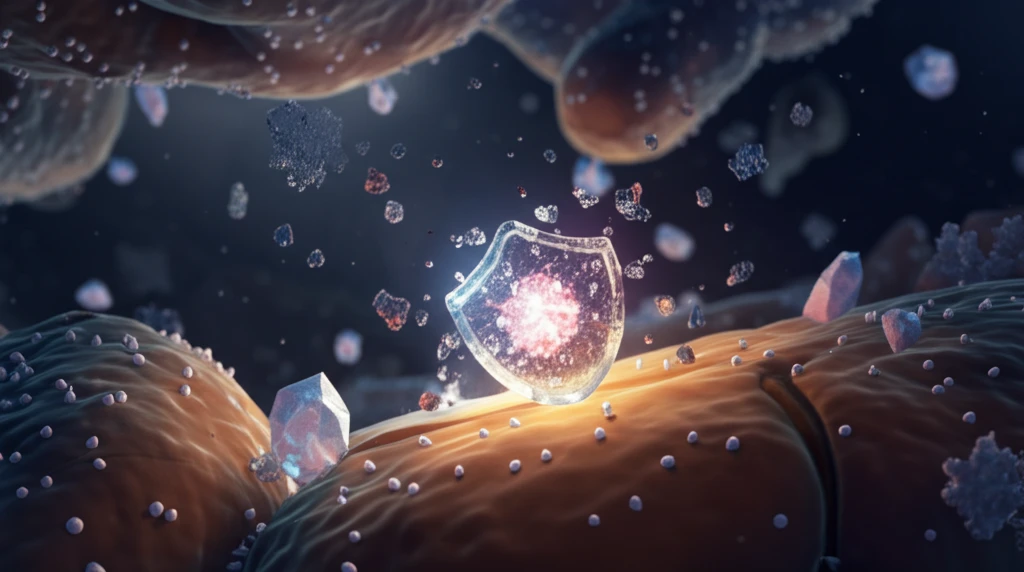
The Unsung Hero of Cellular Survival: How YocM Protects Against Salt Stress

"Discover the surprising role of YocM, a small heat shock protein, in shielding cells from the harsh effects of salt stress and maintaining cellular balance."
Every living cell faces a barrage of environmental challenges, from heatwaves to chemical exposure. One of the most pervasive stressors is salt, which can disrupt cellular function and even lead to cell death. To combat these threats, cells have evolved intricate defense systems, including a class of proteins known as small heat shock proteins (sHsps).
These molecular guardians act as cellular first responders, stabilizing damaged proteins and preventing them from clumping together into harmful aggregates. In the bacterium Bacillus subtilis, a specific sHsp called YocM has emerged as a key player in the fight against salt stress. While sHsps are known to generally protect cells from harm, YocM's role is especially fascinating.
This article explores how YocM uniquely helps Bacillus subtilis cells survive high-salt environments. We will dive into the mechanisms behind YocM's protective actions, shedding light on how this protein maintains cellular equilibrium when the salt levels surge.
Salt Stress's Measurable Toll on Crop Physiology
Experimental data show that salt stress—rather than varietal or seed-priming differences—drives the most significant changes in key growth metrics such as dry shoot weight. Salt stress also suppresses the expression of the brassinosteroid biosynthetic genes D2 and D11 in rice, and mutants deficient in brassinosteroid synthesis or reception display impaired salt tolerance. Beyond gene expression, salinity reshapes epigenetic patterns, with CHH-type cytosine methylation increasing under salt stress in one rice substrate but decreasing in another. Together, these findings paint salt as a dominant systemic stressor that alters physiology, hormone signaling, and methylation dynamics simultaneously.
The Limits of Conventional Salt-Tolerance Screens
For the past two decades, molecular genetics and genomics approaches have identified many determinants of salt tolerance, which imposes osmotic, ionic, and secondary stresses on plants. A common strategy is quantitative trait locus (QTL) mapping, but its limits are becoming clear: in wheat, only three QTLs detected under standard nitrogen supply co-localized across salt-stressed and non-saline environments, and no single QTL was detectable across all nitrogen-salt combinations. In response, researchers are complementing such screens with field tools such as low-cost sensors that flag salt stress by comparing moderately and strongly stressed plants against controls, while genomic and metabolic studies of halotolerant microbes such as Brevibacterium sp. K11ICPPYGO002 reveal coordinated osmoprotectant pathways like ectoine biosynthesis.
Milestones in the Long Effort to Beat Salt Stress
The word "milestone" entered the language in 1746 to describe the stone markers set along highways to track distance—an apt metaphor for how researchers measure progress against salt stress. One enduring and foundational technique in that effort is seed priming, which has shown promise for modulating salt-stress responses. Work on lettuce, for example, has investigated how silicon-based seed priming influences the antioxidant systems of seedlings under stressful saline conditions. Such studies reflect a historical shift from simply documenting salt damage toward proactively conditioning seeds to withstand it.
YocM: A Cellular Shield Against Salt
Salt stress throws cells into disarray. When a cell is exposed to high salt concentrations, water rushes out, causing the cell to shrink and its internal machinery to become highly concentrated. This crowding effect can force proteins to unfold and clump together, disrupting their normal functions. The accumulation of compatible solutes acts as chemical chaperones, which, together with the protein quality control system, are critical for cellular survival.
- Aggregate Formation: It appears to facilitate controlled protein clumping, which might sound counterintuitive, but helps sequester damaged proteins.
- Stress Response: Triggers cellular defense mechanisms to counteract the effects of salt stress.
- Synergistic Effects: Works in tandem with chemical chaperones, naturally occurring compounds that stabilize proteins.
Fresh Advances in the Fight Against Salinity
Recent reviews of plant salt-stress research catalog the adverse effects of salinity—including suppressed photosynthesis, disturbed ion homeostasis, and membrane peroxidation—while also outlining new advances in plant salt-stress control. Ongoing experimental work continues to probe specific mitigants, such as the application of selenium, and their effects on the morphological traits of salt-affected crops, with reviews also surveying salt tolerance in ornamental species like roses. To help researchers navigate this expanding literature, aggregators such as ScienceGate track the latest papers, hot topics, top authors, and most-cited documents on salt stress.
Where Salt-Stress Experiments Fall Short
Salt-stress experiments do not always yield clean, generalizable results, since germination rates and other responses are highly variety-dependent. Methodologically, induction protocols must be carefully optimized: studies on eggplant have calibrated salt induction cycles across 60, 80, 100, and 125 mM NaCl at 120-minute intervals before exposing seeds to treatments. The need for such dose-and-timing optimization underscores why findings on salt tolerance are often difficult to transfer directly from one species, variety, or experiment to another.
What Tolerant Plants Do Differently
Direct comparisons of salt-tolerant and salt-sensitive germplasm reveal consistent physiological signatures of tolerance. In potato, tolerant accessions exhibited superior reactive oxygen species (ROS) scavenging capabilities and better ionic balance than sensitive accessions, and in rice, tolerant genotypes maintained higher K+/Na+ ratios than susceptible genotypes under both control and salt-stress conditions. At the molecular level, research in Arabidopsis has identified a CDK8-AHL10-SUVH2/9 module that dynamically regulates salt tolerance. Such comparative studies help clarify which traits—and which underlying genes—separate resilient plants from vulnerable ones.
A New Perspective on Cellular Defense
The discovery of YocM's role in salt stress response adds a new layer to our understanding of how cells adapt and survive in challenging environments. By acting as a molecular chaperone with a unique aggregase activity, YocM orchestrates a complex defense strategy that involves both protein aggregation and stabilization. This novel insight could pave the way for innovative approaches to enhance cellular resilience in various biotechnological and biomedical applications.
Salt as a Universal Stressor
Expert commentary converges on salt as a genuine stressor across both plants and animals. In mammals, researchers at the University of Edinburgh found that mice switched to a high-salt diet—reflecting typical human intake—showed elevated resting stress hormone levels and a heightened hormone response to stressors. Human health commentary likewise links salt to raised blood pressure and describes excess intake as a contributor to stress. In plants, salt stress amplifies osmotic and oxidative stress, reduces the expression of salt-responsive genes, and ultimately depresses growth and crop productivity.
New Molecular Levers on the Horizon
Emerging research points to novel molecular levers for salt tolerance. In tomato, salt stress induces SFT expression, which promotes early flowering and inhibits floral organ development by disturbing the cell cycle—and plants with silenced SlSFT do not exhibit early flowering under salt stress. Other work shows that stressed plants modify RNA molecules to make them more resistant to degradation, a newly recognized protective response to salinity. On the applied side, market analyses project continued growth in salt-spray testing equipment through 2033, driven by quality-testing demand in North America, research-and-development investment in Asia-Pacific, and adoption of advanced equipment in Europe.
Osmotic Strain on the World's Farms
Salt stress creates systemic challenges for agriculture because salinity often triggers osmotic stress, impairing a plant's ability to take up water and nutrients. Research on the BoRR gene family in cauliflower shows that specific members of this gene family enhance the plant's physiological responses to high salinity, thereby improving overall growth and vitality. Deciphering which genes govern such resilience is part of the broader effort to sustain crop production on increasingly saline soils.
Salty Fields, Real Stakes for Growers
The human stakes of salt stress are concrete: studies of crops such as Roselle show that salinity alters physiological, morphological, and phytochemical characteristics, with ripple effects for growers, including the salt-farm owners whose livelihoods depend on affected lands. More broadly, abiotic stresses such as salt deteriorate agro-ecological conditions and negatively impact agricultural production worldwide. In response, technologies such as CRISPR/Cas9-mediated gene editing are being applied to develop crops better able to withstand these stresses and safeguard those livelihoods.