
The Secret to Stronger Titanium: How Alloy Composition Impacts Brazing Joints

"Unlock the potential of titanium-Ag28Cu brazing by understanding the influence of titanium alloy composition on joint strength and fracture behavior."
Titanium brazing is emerging as a key technique for assembling high-performance aerospace components. This method joins parts using a filler metal with a lower melting point than the base materials. It's particularly useful for creating complex geometries and joining dissimilar metals.
However, brazing titanium isn't without its challenges. The formation of brittle intermetallic phases at the joint interface can compromise the structural integrity. Overcoming these challenges is essential for ensuring the reliability and safety of aerospace structures.
Recent research has focused on understanding how the composition of titanium alloys influences the formation of these intermetallic phases and, consequently, the strength of the brazed joints. By carefully selecting and manipulating the alloy composition, engineers can optimize the brazing process to create stronger, more durable joints.
A Growing Market for a Demanding Metal
Verified Market Reports projects the Titanium Brazing Filler Metals Market will grow from USD 250 million in 2024 to USD 400 million by 2033, a CAGR of 6.0%. The titanium composites brazing market is segmented by product type (foil, paste, and powder brazing), application (aerospace, automotive, electronics, medical, and others), and region. The appeal is clear: titanium brazing can deliver lightweight, high-sealing, and corrosion-resistant connections, and titanium brazing alloys serve as intermediate-input materials for assemblies that must withstand high temperatures, corrosive media, and cyclic mechanical loads. At the same time, titanium's sensitivity to oxygen and nitrogen, which quickly forms a dense oxide film as temperature rises, keeps the process demanding.
Vacuum Brazing Leads the Field
Vacuum brazing has emerged as the predominant method for joining titanium, primarily because the metal requires protection against oxidation; studies of titanium aluminides likewise identify vacuum brazing as one of the most heavily investigated routes to reliable joints. Alternative approaches include silver chloride-lithium fluoride fluxes and TIG brazing for specific applications. For temperature-sensitive work, brazing below the α↔β transformation temperature using commercial and experimental aluminum-based fillers is possible, including both traditional and ultrasound-assisted techniques. Each method carries trade-offs, so the right choice depends on the joint's service requirements.
From Early Constraints to Capability
A materials guide documenting titanium's milestones records that the metal's porous nature makes ordinary soldering impractical. It notes that special high-temperature brazing equipment operating in an oxygen-free environment, at temperatures of 900 degrees or higher, is required to securely bond titanium solder points. This early guidance highlights the two constraints that have defined titanium joining ever since: elevated heat and strict protection from oxygen.
Decoding Interfacial Reactions: The Key to Brazing Titanium
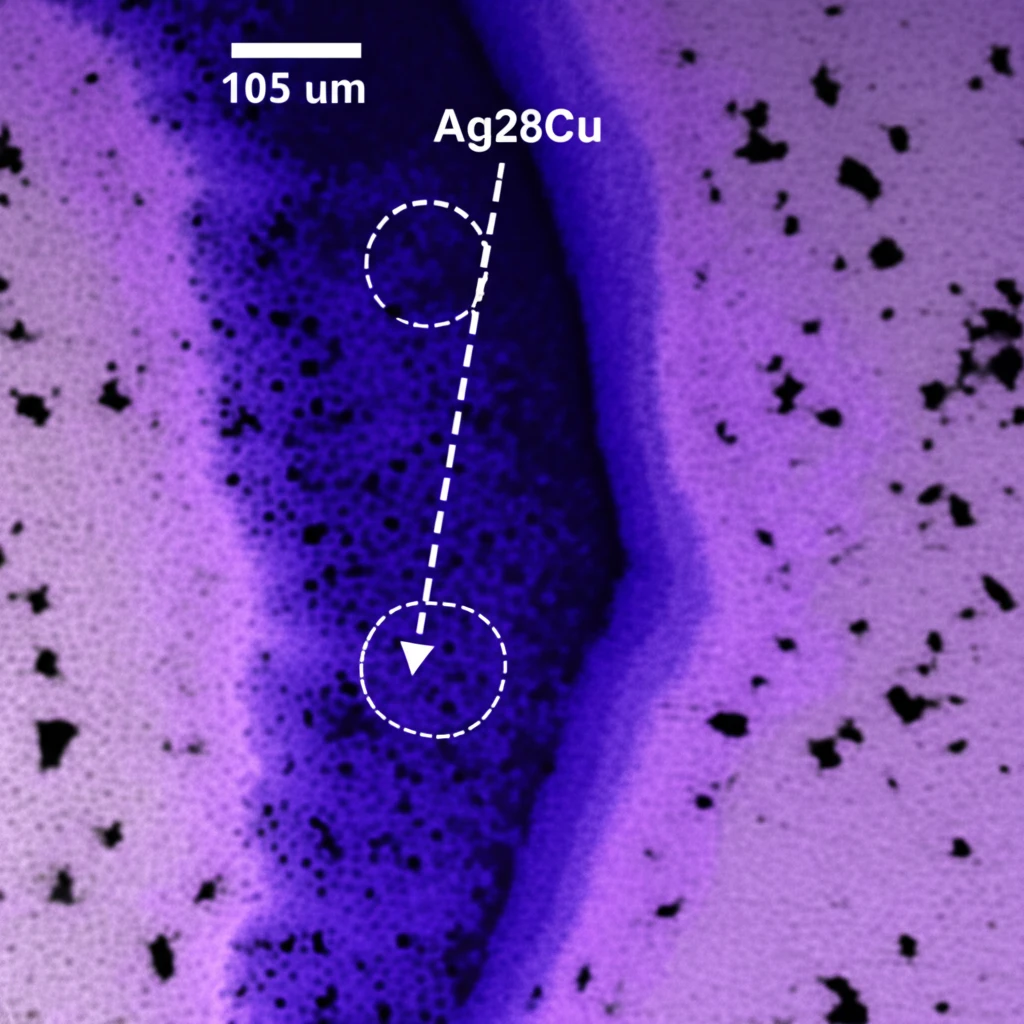
A recent study investigated the interphase formation in brazed joints made from various titanium alloys (Ti-CP2, Ti-CP4, Ti-6Al-4V, Ti-6Al-2Mo-4Zr-2Sn) and Ag28Cu. The findings revealed complex reactions leading to the formation of several intermetallic phases, including a Ti2Cu-TiCu boundary zone. The composition of the titanium alloys significantly influenced the resulting microstructures, which were characterized using advanced techniques like synchrotron X-ray microtomography.
- Complex reactions leading to intermetallic phase formation.
- Influence of titanium alloy composition on microstructure.
- Enhanced Ti2Cu-TiCu boundary strength with specific alloys.
- Changes in crack propagation paths for improved joint toughness.
Fillers, Low Temperatures, and Faster Adoption
Research into titanium-based braze filler metals has increased steadily over the past two decades, yet comprehensive reviews of the topic remain relatively few, with researchers noting that zirconium and titanium belong to the same element family and behave similarly. A notable strand of this work examines aluminum-based fillers that enable brazing below the α↔β transformation temperature, including both traditional and ultrasound-assisted procedures. Observers expect adoption of titanium composites brazing to accelerate through 2025, driven by demand for lightweight, high-strength assemblies. Advances in automation and process control are projected to reduce costs and improve reliability, broadening industrial use.
The Invisible Saboteur in Failed Joints
One furnace manufacturer describes titanium as greedy for its environment: the metal readily picks up oxygen and other impurities, and this contamination is called the 'invisible saboteur' behind failed brazes. Restoring material integrity, the same source argues, can require furnaces built with high-purity quartz tubes that minimize contamination. Brazing problems also surfaced historically as the 'glamour metal' moved into increasingly complex applications. The shared lesson is that contamination control, not just heat and filler selection, often decides whether a titanium joint holds.
Fillers and Furnaces Compared
In a comparative study, vacuum-brazed commercially pure titanium and low-carbon steel were evaluated using one copper-based alloy (Cu-12Mn-2Ni) and two silver-based braze alloys (Ag-34Cu-2Ti and Ag-27.25Cu-12.5In-1.25Ti). At the process level, heat-treating specialists note that batch vacuum furnace brazing eliminates the distortion typical of torch brazing and welding because of hot zone uniformity. Suppliers meanwhile develop unique brazing alloys aimed at improving performance at elevated temperatures while ensuring adhesion and strength in demanding environments. Together, these comparisons show that filler metal choice and furnace method both materially influence joint quality.
Implications for Future Aerospace Manufacturing
These findings highlight the critical role of titanium alloy composition in determining the strength and fracture behavior of brazed joints. By carefully controlling the alloy composition and microstructure, engineers can optimize the brazing process to create stronger, more reliable joints for demanding aerospace applications. Further research into the effects of specific alloying elements on intermetallic phase formation and boundary strength will pave the way for even more advanced titanium brazing techniques.
What the Experts Agree On
Industry analyst summaries frame titanium composites brazing as joining titanium materials with composite matrices to enhance performance in high-temperature applications. Market commentary ties the technique's expansion to rising demand in the aerospace, automotive, and medical sectors. Expert surveys such as Alexander E. Shapiro, Ph.D.'s 'Brazing of Conventional Titanium Alloys' for Titanium Brazing Inc. provide practical, fact-filled guidance on brazing commercially pure and alloyed titanium with itself and with other materials. The consensus across these commentaries: titanium brazing is demanding but well-understood when processes are properly controlled.
Aerospace and Automotive Lead the Way
A market outlook through 2031 identifies the growing demand for lightweight and durable materials in the aerospace and automotive industries as the primary force shaping the titanium composites brazing market. Because these sectors continuously pursue weight reduction without sacrificing strength, titanium composites brazing is positioned to become more widely adopted. The trajectory points toward expanding application across industrial segments as process cost and reliability improve.
Why Welding Struggles With Titanium
Across the broader joining landscape, traditional welding of titanium alloys runs into recurring problems: oxidation, thermal cracking, and embrittlement. Vacuum brazing technology, by contrast, offers significant advantages for joining titanium alloys, according to furnace manufacturers. This systemic advantage, protection from the atmosphere throughout the entire cycle, helps explain why vacuum brazing has become the default route for production titanium assemblies.
In the Lab: Hands-On Experiments
Hands-on experimental programs have shaped practical knowledge of titanium brazing, as seen in an experimental study of vacuum brazing that examined the effects of changes in brazing alloys and process conditions. The same study also explored how post-braze hot isostatic pressing influences the final properties of titanium joints. Parallel work on vacuum diffusion brazing joined Grade 2 titanium with 6082 (AlMg1Si0.6Cu0.3) aluminum alloy using a B-Ag72Cu-780 (Ag72Cu28) silver brazing metal interlayer, assessing the mechanical and structural properties of the resulting joints. These lab-scale investigations translate directly into shop-floor practice, guiding how engineers select fillers and cycles for real components.