
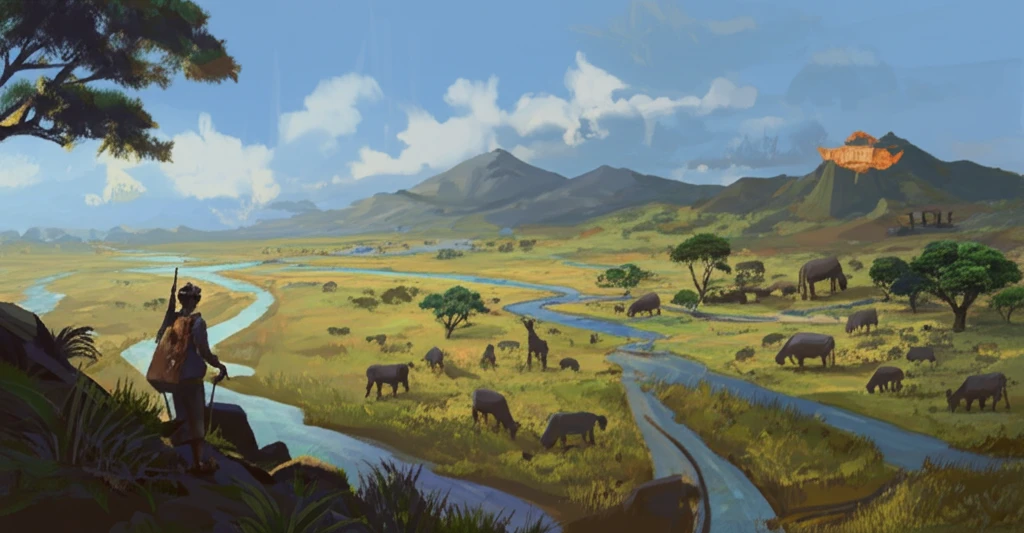
The Paradox of Parks: Balancing Conservation and Traditional Life in West Africa

"Exploring the complex relationship between pastoral communities and protected areas in Niger, Burkina Faso, and Benin."
Across the Sahel-Sudan region of Africa, tensions often run high between pastoral communities and the protected areas established to conserve biodiversity. What should be safe havens for wildlife and natural resources frequently become zones of conflict, marked by illegal grazing, unauthorized fires, and deforestation on one side, and forceful evictions, fines, and arrests of herders on the other.
Historically, conservation efforts primarily targeted farmers and poachers. However, today, pastoralists are increasingly seen as the main threat to classified forests, reserves, and national parks. This shift is especially perplexing given that these communities are often the most knowledgeable about the natural environment and have traditionally lived in close harmony with it.
This article delves into the apparent paradox: How did practitioners of traditional ecological stewardship become perceived as adversaries of nature conservation? We will explore this question through the case study of Parc du W, a protected area spanning Niger, Burkina Faso, and Benin, examining the historical, social, and political factors that have shaped this complex dynamic.
The Numbers Behind Pastoral Life
Fresh statistical work is giving researchers a clearer picture of pastoral life, though the term itself covers very different meanings. The Catholic Record Society has released a new set of statistics for England and Wales, Scotland and Ireland under its "Catholicism in Numbers" project, tracking participation in public expressions of religion such as sacraments and documenting ways religion engages with society, including through education. Dedicated statistics portals also report on practitioners themselves, covering issues such as addiction among ministers and the leading reason pastors leave ministry. Broader longevity research reports that 95 percent of pastoral longevous individuals have no history of cancer, and links their lifestyle of daily physical labor and strong community bonds to a 30 percent lower incidence of cardiovascular disease.
The Mobile Livelihood Model and Its Limits
Mobile pastoralism is the standard livelihood approach in dryland environments around the world, with rough figures indicating there are 100-200 million pastoralists today. The approach is small in scale by necessity: in a pastoral economy, population size remains relatively small because the arid regions where pastoralism thrives have a limited carrying capacity and can support only a limited number of people on scarce resources. The method has clear limitations, as seen in Mongolia's Eastern Steppe, where societal transformation led many pastoralists to hire herders who often had limited experience of nomadic pastoralism and little local knowledge. The term "pastoral" is also governed very differently across contexts, with codes such as the Model Code of Pastoral Conduct setting standards for priests, deacons, pastoral ministers, administrators, staff and volunteers.
Roots of a Way of Life
Pastoralism has deep historical roots, traced by scholars across centuries and regions. The Cambridge World History devotes a chapter to pastoralism, while the UN Food and Agriculture Organization's account of the present situation of pastoralists makes reference to the historical literature. Historically, nomads did not live in one place but moved from one area to another to earn their living, and the lives of poor pastoralists could be harsh: in times of war and famine, they lost nearly everything. Some historical patterns leave measurable traces in the present; one study reports that historical reliance on pastoralism predicts adherence to more restrictive norms about women's promiscuity, as captured by reported numbers of sexual partners across a sample of 447,834 people from 37 countries.
The Emergence of Transhumance Towards Parc du W
Unlike many protected areas in the Sahel, Parc du W wasn't historically a central part of major pastoral routes. However, the park's resources have become increasingly important for seasonal transhumance, offering crucial grazing during the dry season. Even though this use is only seasonal, it's vital for the pastoral systems that depend on it. These systems are carefully balanced, and disrupting even one element can threaten the entire way of life.
- For many years, the park existed in theory only. Local people were unaware of restrictions on access and use.
- Enforcement of the park through village evictions only began in the 1950s.
- Transhumant herders likely became aware of the park even later than settled villagers.
- Pastoral societies don't typically think of land in terms of ownership or control.
Fresh Findings on Pastoral Peoples
Recent research is reshaping understanding of pastoral peoples' long history and contemporary lives. New UCL-led research reports that humans did not accelerate the decline of the "Green Sahara" and may even have managed to hold back the onset of the Sahara desert by around 500 years. Archaeological work on the pastoral period shows that pastoral peoples left behind sandstone-based ceramics, distinct from the granite-based materials of the Late Acacus, along with bone implements. More recent change is also under study: a new study in the SpringerOpen journal Pastoralism: Research, Policy and Practice explores the impact of colonization on pastoral women's roles, while a book based on anthropological research carried out between 2008 and 2016 addresses the spatial features of nomadic pastoralism among the Mongol herders of Mongolia and Southern Siberia.
When the System Comes Under Fire
Pastoral systems draw criticism from several directions. A Nigerian study of cattle ranching notes that a central criticism of pastoralism is its tendency against limited use rights of pastureland, since in this context all pastureland is communal and open to limitless grazing. Research on pastoralism in the semi-arid tropics of Africa contrasts the system with its modernized alternative, ranching, and catalogues the problems pastoralism has been encountering, warning that development practices that fail to recognize these dynamics may result in increased deprivation and failure. Critics have also argued that the field lacks a clear and consistent methodology, while practitioners in pastoral roles are advised to filter the criticism they receive, with one veteran minister offering a framework to help pastors wade through the kinds of criticism they will face in ministry.
Pastoralism Versus the Alternatives
Comparisons between pastoralism and alternative land uses yield striking results. Based on a review of many studies, pastoralism has been shown to be between 2 and 10 times more productive per unit of land than the capital-intensive alternatives that have been put forward. Comparative analysis is complicated, however, because the only dataset available for a global comparison does not distinguish between ranching, pastoral and agropastoral systems, and it excludes Europe and North America. Researchers also stress integration, arguing that national integration of pastoralism must be promoted, and noting that pastoralism at the household level is a highly complex system involving the animals kept, household self-sufficiency, migration strategies and diversification into alternative livelihoods.
Finding a Path Forward
The relationship between pastoral communities and Parc du W is a microcosm of the broader challenges of balancing conservation and human livelihoods. Finding solutions requires acknowledging the complex historical, social, and ecological factors at play. By fostering dialogue, respecting traditional knowledge, and promoting sustainable development in the park's periphery, it may be possible to reconcile the needs of both people and nature, creating a future where conservation and pastoralism can coexist.
Experts on a Misunderstood System
Experts argue that pastoralists are masters of managing uncertainty and that their system has been persistently misread by developers. Andy Catley of Tufts University notes that pastoralists are experts in managing uncertainty, and that far more participatory, context-specific analysis is needed if the dismal performance of decades of "pastoral development" is to be reversed. Analysts point to climate as the system's core advantage: pastoralism is a productive agricultural system because it can manage climate uncertainty, whereas irrigation cannot, since it must rely on predictable flows of water to irrigated plots and depends on stable and plentiful supplies. A Kenya-based expert praised World Vision for rethinking how its programming affects this marginalized group, stressing that pastoralists need mobility and flexibility as well as an acknowledgement of their value to society.
The Road Ahead
The future of pastoralism is a growing focus of research and policy. The CTCN highlights the future of pastoralism in a changing climate as a dedicated resource, and the FAO's Pastoralists Knowledge Hub supports research initiatives assessing pastoralism's contribution to ecosystems, highlighting its key role for the future of the livestock sector and, more broadly, for world food systems. Historical depth informs these prospects: a review of the pastoralism system in Greece through the millennia stresses the variety of driving forces on pastoralism and its importance to the formation of present-day biodiversity. In the Horn of Africa, many pastoralists are responding to change, with significant benefits to themselves and the economy.
Systemic Pressures and Deep Roots
Pastoralism sits within a web of systemic pressures that reach far beyond any single herd or community. In the Sahel, pastoralism is a unique, ancient system of activity that sustainably exploits a very restricted agroclimatic territory, yet the adaptive power that pastoral societies have shown over the past 4,000 years is now threatened. The Lower Omo Valley in Ethiopia illustrates the collision of interests in a region of extremely high biological, cultural and archaeological value, where conflicts play out between pastoralism, agriculture and wildlife conservation. Social organization adds another layer: pastoralist systems are commonly organized into patrilineal clans and lineages, with 54 percent of the Standard Cross-Cultural Sample patrilineal, that function as corporate livestock-owning units. Meanwhile, surveys of ministers report worrying trends in attitudes toward the vocation, with one Barna study finding that 40 percent of pastors considered leaving full-time ministry in 2022, up from 29 percent in 2020.
Lives Behind the Labels
Pastoral identity is deeply personal, and the human beings behind the labels carry their own stories. Fernando García-Dory, a researcher who studied Arts and Rural Sociology and is working on a PhD on Agroecology and the Cultural Strategies of Pastoralism, has been involved since 1999 in the Spanish peasant movement Plataforma Rural, which is part of La Via Campesina. His path illustrates how pastoralism connects to broader movements for rural livelihoods and cultural strategy. The word "pastoral" also carries very different human meanings elsewhere, reaching into religious ministry, as in Richard Rohr's reflections on the themes of his book The Universal Christ, and into behavioral science, where a study models habit formation in the real world. In every case, the pastoral is ultimately about how people live, organize and believe.