
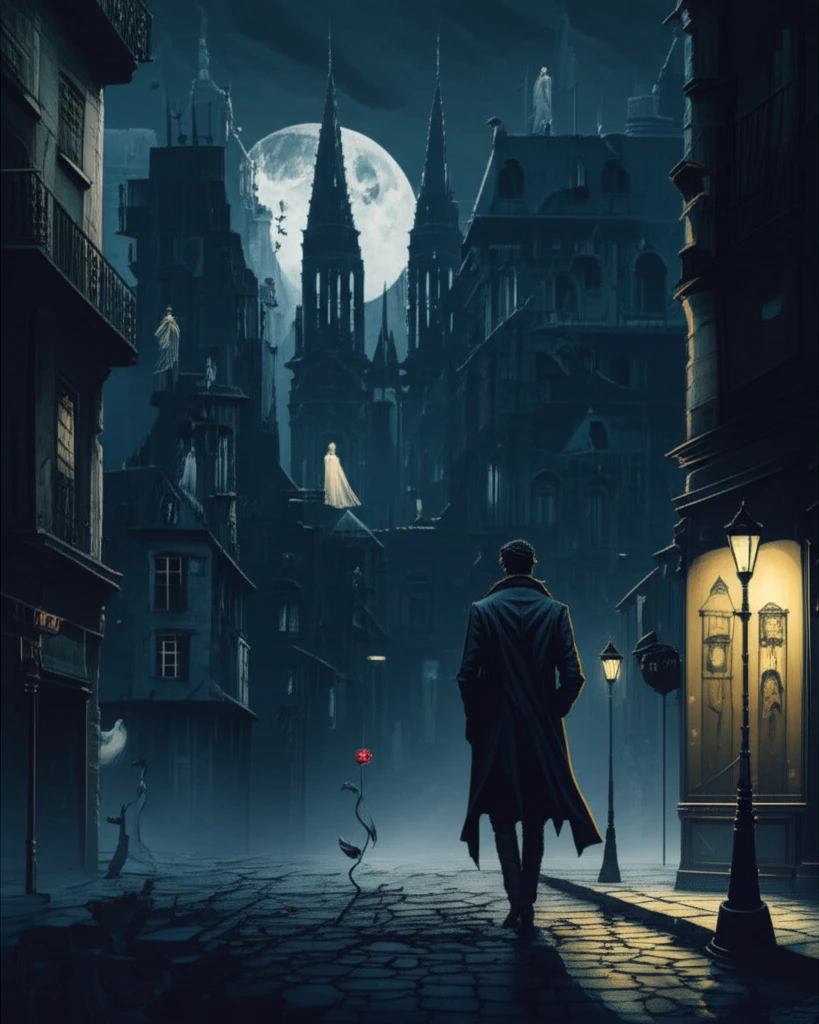
The Modern City's Dark Ballad: How Baudelaire Found Beauty in Decay

"Explore how Charles Baudelaire, defied conventional beauty standards by finding poetry and artistic inspiration in the gritty realities of modern urban life."
In the realm of poetry, Charles Baudelaire stands as a revolutionary figure who dared to challenge conventional notions of beauty. Instead of seeking inspiration in idyllic landscapes or idealized forms, Baudelaire turned his gaze towards the gritty realities of the modern metropolis. His work explores how urban decay, social alienation, and the darker aspects of human existence can be fertile ground for artistic expression.
Baudelaire's poetry delves into the heart of a rapidly changing Paris, a city grappling with industrialization, social upheaval, and moral ambiguity. As traditional beauty standards crumbled, Baudelaire sought to capture the essence of this new urban landscape, embracing its contradictions and finding beauty in its imperfections.
This article explores how Baudelaire defied the traditional norms of poetry and aesthetics. Delving into his vision of the city, focusing on his innovative techniques, like the flâneur, and his ability to transform the mundane and macabre into compelling art. Join us as we explore the world of Baudelaire, and discover his lasting impact on modern art and literature.
Baudelaire's Urban Snapshots and the Poetics of Decay
Baudelaire's poetry asserts the individual's place in modern metropolises, challenging aesthetic norms through what scholars describe as visual snapshots capturing fleeting moments in urban life academia.edu. His work focuses on the poet as an engaged social observer whose verse gradually becomes involved in a critical practice, opening up modern experience to greater scrutiny academia.edu. The 'modernity' of his street poems arises from the fact that the street stands both for the question of the meaningfulness of urban experience and for a language in which poetic meaning is subject to chance, with disintegration and randomness at the heart of both problems academia.edu.
Scholarly Approaches and Their Limitations
Traditional scholarship on Baudelaire has relied heavily on Marxist cultural criticism and psychoanalytic frameworks, with Walter Benjamin's writings serving as the dominant interpretive lens for understanding Baudelaire's urban poetry. These approaches have been productive but also limiting, as they sometimes impose theoretical structures that flatten the complexity of Baudelaire's engagement with the city. More recent scholarship has begun to move beyond these established methods, though consensus on alternative frameworks remains elusive.
Baudelaire's Foundational Role in Modern Urban Poetry
Charles Baudelaire (1821–1867) occupies a key position in the development of modern writing, not just as the author of the most celebrated collection of verse in the history of modern French poetry, *Les Fleurs du mal* (1857), but as the proponent of a new aesthetic based on the experience of city life en.wikipedia.org. According to the Marxist cultural critic Walter Benjamin, Baudelaire's poetry transforms the shocks of modern life into form, with the crowd, the sudden encounter, and the electric jolt of the new all becoming aesthetic events culturalstudiesnow.blogspot.com. His poems exhibit mastery of rhythm and rhyme, containing an exoticism inherited from the Romantics, and are based on observations of real life, making him a pivotal figure in reconciling poetic practice with urban modernity en.wikipedia.org.
The Poet as Urban Explorer: Unveiling Beauty in the Grime
Baudelaire's Paris was a far cry from the romanticized visions of the past. It was a city transformed by industrialization, teeming with both progress and despair. In his collection "Les Fleurs du Mal" (The Flowers of Evil), Baudelaire confronts this urban reality head-on, finding inspiration in the unlikeliest of places.
- Embracing the Contradictions: Baudelaire's poetry thrives on paradox, juxtaposing beauty and ugliness, the sacred and the profane. This tension is evident in his vivid descriptions of urban life, where the splendor of Parisian boulevards is contrasted with the squalor of the city's underbelly.
- The "Tableaux Parisiens": This section of "Les Fleurs du Mal" offers a series of snapshots of Parisian life, capturing the city's diverse characters and fleeting moments. From beggars and prostitutes to street musicians and fashionable crowds, Baudelaire paints a portrait of a city in constant flux.
- Finding the Sublime in the Decadent: Baudelaire's poetry often explores themes of decay, death, and moral corruption. However, he doesn't merely dwell on the negative aspects of urban life. Instead, he seeks to find a strange beauty in the midst of degradation, transforming the macabre into something strangely compelling.
Contemporary Scholarship on Baudelaire's Modernity
Recent research highlights that *Les Fleurs du mal* is the first book of poetry to use not only words of ordinary provenance but words of urban origin as well, marking a decisive break from classical poetic diction link.springer.com. Matthew Beaumont's work on the flâneur has identified a parallel archetype—the convalescent hero of modernity—who emerges from the sickbed into city streets with a renewed capacity for observation, complicating earlier understandings of Baudelaire's urban漫步 publicdomainreview.org. Walter Benjamin's long-term engagement with Baudelaire's poetry has been reassessed, showing how Benjamin's translations and interpretations transformed our understanding of modern experience through the lens of urban verse .
Challenging the Myth of Urban Beauty
Peter Brooks argues that all the things of urban existence—the things that Baudelaire cites as the object of attention for the painter of modern life—are made fully significant in human terms, yet this significance is not inherent but constructed through poetic artifice enotes.com. Critics have noted that Baudelaire's romanticization of urban decay risks aestheticizing poverty and suffering, turning the lived experience of the marginalized into raw material for artistic consumption. The tension between Baudelaire's claim to observe 'real life' and his selective, often fetishistic approach to urban subjects remains a point of contention in literary criticism.
Baudelaire Among Urban Thinkers
Baudelaire's urban vision stands in sharp contrast to the nature poetry of his predecessors; as he himself wrote, he declared himself incapable of being moved by plants and vegetables, finding that in the woods he could only think of cathedrals link.springer.com. His prose-poem collection functions as the making-readable of time itself as the secret atmosphere of daily life in the form of noise, aligning with the contemporary journalistic genre of the collectively written 'urban diary' academic.oup.com. Unlike pastoral traditions, Baudelaire's 'urban eclogues' present cityscapes of melancholy where Paris represents less the alienation caused by Second Empire modernization than a site of profound aesthetic and existential engagement link.springer.com.
The Enduring Legacy of a Modern Visionary
Baudelaire's impact on modern art and literature is undeniable. His exploration of urban life, his embrace of unconventional beauty, and his willingness to confront the darker aspects of human existence paved the way for future generations of artists and writers.
Benjamin's Revolution in Understanding Baudelaire
Walter Benjamin's essays on Baudelaire revolutionized not just the way we think about Baudelaire, but our understanding of modernity and modernism as well, challenging the image of Baudelaire as late-Romantic dreamer and evoking instead the modern poet caught in a life-or-death struggle with the forces of the urban commodity hup.harvard.edu. Benjamin's interpretations reveal a complex dialectic between the flâneur and the chaotic crowd dynamics, with Baudelaire's poetry articulating the tension between solitude and multitude, reflecting modern urban trauma and beauty academia.edu. This critical legacy underscores how Baudelaire's work remains central to ongoing debates about the relationship between art, capitalism, and the experience of modern urban life.
Uncharted Territory in Baudelaire Studies
Future scholarship may benefit from interdisciplinary approaches that connect Baudelaire's poetics to contemporary urban studies, digital culture, and environmental humanities. The growing interest in the flâneur as a figure for navigating information overload suggests new relevance for Baudelaire's insights into urban attention and distraction. As cities continue to evolve, Baudelaire's method of finding beauty in decay offers a framework for understanding how aesthetic experience persists amid rapid urban transformation.
Baudelaire's Critical Practice and Modern Experience
Baudelaire's activity as poet of the city constituted an engaged social observation whose poetry, facing the challenge of encompassing the contemporary scene, gradually became involved in a critical practice, opening up modern experience to greater scrutiny doaj.org. This critical stance required Baudelaire to navigate between aesthetic idealization and unflinching observation of urban reality—a tension that defines much of modernist literature. His work demonstrates how poetry can serve as both mirror and critique of systemic urban conditions, anticipating later developments in social realism and documentary aesthetics.
The Poet Confronting Urban Noise
Baudelaire's evolution traces a movement from an aesthetics of fetishizing—in which the function of poetry is to produce beauty out of the ordinary by means of the poet's artifice—to a poetics of allegory that reads the modern city's atmospherics as a product of urban noise jstor.org. The mid-nineteenth century Paris that Baudelaire inhabited was crucial for the development of French literary tradition, as his analysis of urban themes revealed the significance and role of the city in shaping poetic form and consciousness semanticscholar.org. What happens to poetic beauty when history turns the poet from one who contemplates natural beauty to one who attempts to reconcile the practice of art with the hustle and noise of the city remains a question Baudelaire's work continues to pose.
By challenging traditional aesthetic norms and seeking inspiration in the realities of the modern world, Baudelaire expanded the possibilities of art and poetry. His work continues to resonate with readers today, reminding us that beauty can be found in the most unexpected places.
As we navigate the complexities of our own modern cities, Baudelaire's vision offers a valuable perspective. He encourages us to look beyond the surface, to embrace the contradictions and imperfections, and to find beauty in the midst of decay. In doing so, we can gain a deeper understanding of ourselves and the world around us.