
The Future of Dental Implants: How Porous Design is Revolutionizing Bone Integration

"Discover how selective laser melting (SLM) and porous structures are transforming dental implant technology for better bone ingrowth and long-term success. Learn about the latest advancements and what they mean for you."
In recent years, biomaterials have become increasingly important in stomatological reconstructive surgery. A significant focus has been placed on dental implants, essential for restoring functionality and aesthetics for individuals with missing teeth. Traditional implants, typically made from solid materials like titanium, often present a challenge: their stiffness is much higher than that of natural bone. This stiffness mismatch can lead to bone resorption, potentially causing implant failure over time.
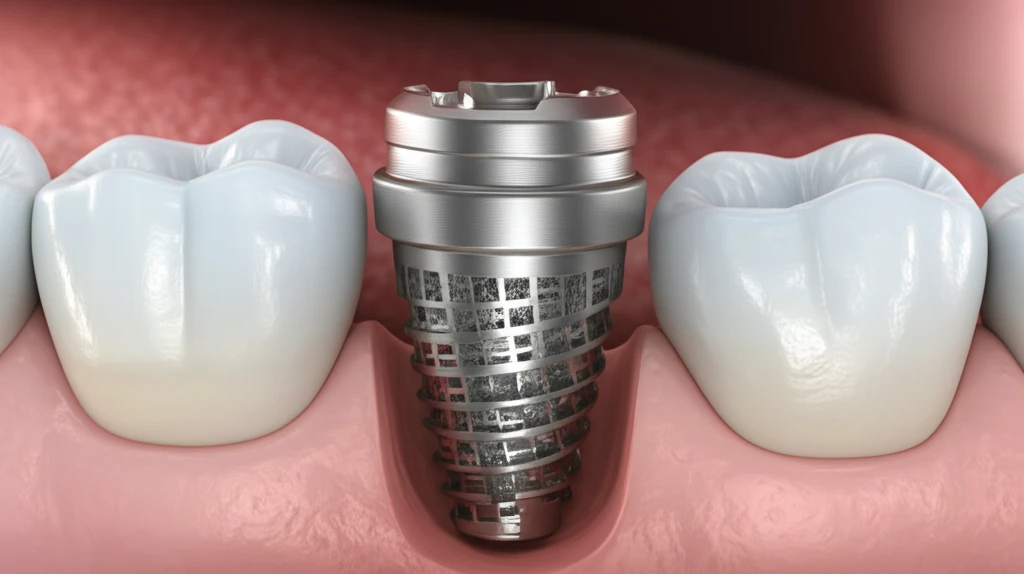
To combat this, researchers have been exploring porous-structured implants designed to mimic the properties of natural bone. The idea is that a porous implant allows bone to grow into its structure, creating a stronger, more integrated bond. This not only enhances stability but also reduces the stress shielding effect that can lead to bone loss. The design and fabrication of these porous implants involve sophisticated techniques, and one of the most promising is selective laser melting (SLM).
This article delves into the world of porous dental implants manufactured using SLM. We'll explore the science behind this innovative approach, examining how it aims to improve osseointegration, reduce stiffness-related complications, and ultimately provide more reliable and longer-lasting solutions for tooth replacement. By understanding the advancements in this field, patients and dental professionals alike can gain insights into the future of dental implant technology.
The Scale of Dental Implant Use and Failure
Dental implants are an effective and widely used treatment for replacing the root portion of a missing tooth, with demand continuing to grow across global patient populations. However, implant failure remains a meaningful clinical concern, and improving survival rates is an active area of research. Porous dental implants have emerged as a promising strategy to reduce failure rates by favoring osseointegration and enabling local drug delivery. Incorporating porous features into implant design does, however, weaken the mechanical capacity of the device, creating a trade-off that researchers continue to investigate. Understanding both the prevalence of implant use and the limitations driving failure is essential context for appreciating how porous design aims to improve outcomes.
Conventional Fabrication and the Porous Layer Alternative
Traditional dental implants are produced via standard additive or subtractive manufacturing methods, yielding solid titanium surfaces that rely primarily on osseointegration at the outer interface for stability. Porous implants produced by selective laser melting (SLM) present different surface and structural parameters compared to these conventionally made implants, which can influence both biological response and mechanical performance. Researchers have also explored coating conventional implants with porous layers—using techniques such as ammonium hydrogen-carbonate (NH4HCO3) as space-holder particles—to approximate the benefits of full porous designs. Fatigue testing and finite element analysis have been applied to predict the behavior of these porous-coated implants, revealing that while porous features can enhance bone contact, they introduce design constraints that solid implants do not face. The fundamental limitation remains balancing osseointegration benefits against structural integrity.
From Ancient Shells to Modern Porous Titanium
Dental implant history stretches back centuries and is itself a somewhat disputed topic, as there is no single clear indication of when the practice first began. Ancient Mayans as early as AD 600 used pieces of shell inserted into the jawbone as dental implants, while ancient Egyptians are also recorded as having used shells and ivory for the same purpose. By the 1700s, lost teeth were occasionally replaced with teeth donated from human donors, marking an early and crude form of transplant dentistry. In the eighteenth century, researchers began experimenting with gold and metal alloys for implant construction, laying the groundwork for the titanium-based implants that would eventually dominate the field. The evolution from biological materials to engineered metals to today's 3D-printed porous structures represents centuries of incremental progress toward more reliable tooth replacement.
The Science Behind Porous Implants and Selective Laser Melting
The key to a successful dental implant lies in achieving strong osseointegration—the direct structural and functional connection between bone and the implant surface. Traditional solid implants often struggle to achieve this seamlessly due to the significant difference in stiffness compared to the surrounding bone. This is where porous implants come in. By incorporating a network of interconnected pores, these implants allow bone cells to migrate into the structure, effectively interlocking the implant with the existing bone.
- Customization: SLM enables the creation of patient-specific implants tailored to individual anatomical needs.
- Design Freedom: Complex geometries and intricate porous structures can be achieved, optimizing bone ingrowth and mechanical properties.
- Material Control: SLM allows for precise control over the composition and microstructure of the implant material.
Porous Tantalum and Osseoincorporation Advances
Recent systematic reviews have begun evaluating the clinical outcomes of titanium dental implants enhanced with porous tantalum-based trabecular metal (PTTM) compared to conventional titanium implants. These PTTM implants are specifically designed to achieve osseoincorporation—a process that combines vascularized bone ingrowth into the porous structure with traditional osseointegration at the implant surface. Research published in peer-reviewed journals has assessed both hard and soft-tissue parameters to determine whether this enhanced design translates into measurable clinical benefits over standard implants. Additionally, biomechanical analyses have examined how porous and dense dental implant-supported bridges perform in both healthy and osteoporotic bone, highlighting the importance of bone quality as a variable. The body of evidence is growing but remains an area of active investigation as longer-term clinical data accumulates.
When Osseointegration Falls Short
While dental implant failure is uncommon, it can occur when osseointegration does not proceed as expected, leading to implant loosening or loss over time. Healthy bone normally continues to surround and support a well-integrated implant, but risk factors—including poor bone quality, surgical technique, and patient health—can compromise this process. Preclinical meta-analyses of porous-surface dental implants have shown that not all studies report the same direction of effect, with some finding no significant improvement in peri-implant bone response compared to conventional surfaces. The mechanostat hypothesis and finite element studies suggest that the biomechanical interaction between porous implants and surrounding bone is complex and highly dependent on individual patient anatomy and loading conditions. These findings underscore that porous design is not a universal solution and that careful patient selection and surgical planning remain critical.
Porous vs. Non-Porous: What the Evidence Shows
A meta-analysis of 21 comparisons using 348 implants found that porous-surface implants generally showed improved bone-to-implant contact (BIC%) compared to non-porous-surface implants, though the results were not uniformly positive across all studies. Research on implant design influence indicates that porous implants improve contact at the implant-bone interface and increase fixation to the bone, thereby enhancing osseointegration. These findings suggest that porous implants may be particularly advantageous in less favorable conditions, such as lower bone density, where conventional implants might struggle to achieve adequate stability. However, the variability in study outcomes reminds clinicians that surface porosity alone does not guarantee superior results. The comparative evidence supports porous design as a meaningful improvement over conventional approaches while acknowledging that context-specific factors determine the degree of benefit.
The Future is Porous
The study's findings are promising. Animal experiments revealed significant bone tissue ingrowth into the porous structure of the implants, indicating successful osseointegration. This suggests that porous dental implants fabricated using SLM have the potential to significantly improve implant stability and longevity. While further research and clinical trials are needed, the results offer a glimpse into the future of dental implant technology, where personalized, biocompatible implants seamlessly integrate with the patient's natural bone, providing a secure and lasting solution for tooth replacement.
Optimizing Porous Architecture for Stress Distribution
Finite element analyses comparing solid implants with diamond-like porous structures have demonstrated that porous architectures can achieve more favorable stress distribution at the implant-bone interface, reducing stress shielding and the risk of surrounding bone resorption. Current clinical implants are predominantly homogeneous porous alloys with relatively uniform properties, but researchers are now exploring gradient porous designs that vary porosity across the implant structure to better match local mechanical demands. Studies on TPMS-based (triply periodic minimal surface) porous implants suggest that porosity in the range of 40–60% offers an optimal balance between mechanical strength and stress distribution. These personalized design approaches aim to adapt implant architecture to individual patient bone quality, though long-term in vitro and in vivo validation remains necessary before widespread clinical adoption.
3D Printing and Material Diversification
Laser beam melting (LBM) 3D printing has enabled the fabrication of Ti6Al4V-based dental implant prototypes with precisely controlled porous scaffold structures and defined pore sizes such as 200, 350, and 500 micrometers. This manufacturing precision represents a promising strategy for improving the osteoinduction potential of implants by tailoring pore geometry to biological requirements. Beyond titanium alloys, the porous tantalum market is expanding into dentistry, where tantalum's excellent biocompatibility makes it suitable for implants and bone regeneration applications. The convergence of advanced additive manufacturing with new biomaterial options suggests that future implants will offer increasingly customized solutions. Ongoing research continues to establish the long-term biological performance of these next-generation porous structures.
Navigating the Road from Lab to Clinic
The translation of porous implant research into routine clinical practice faces several systemic challenges, including the need for rigorous long-term clinical validation, standardized testing protocols, and regulatory pathways for novel designs. Manufacturing complexity and cost remain significant barriers, as advanced 3D printing techniques and biocompatible materials such as tantalum are considerably more expensive than conventional titanium processing. Additionally, clinician training and adaptation to new implant geometries and surgical protocols will be necessary for widespread adoption. The field must also contend with the inherent difficulty of conducting large-scale, long-duration clinical trials to compare porous and conventional implant outcomes across diverse patient populations. While the scientific foundation is strong, bridging the gap between laboratory promise and clinical ubiquity requires coordinated effort across research, manufacturing, regulatory, and dental practice domains.
Realistic Loading and Patient Outcomes
Most existing studies on biomimetic porous dental implants have analyzed biomechanical performance under static loading conditions, which do not fully represent the dynamic and impact loads that implants experience during real-world chewing and function. Researchers have begun comparing static, dynamic, and impact loading behavior of porous versus conventional implants using 3D finite element analysis to provide a more realistic picture of in vivo performance. Studies examining bone remodeling around porous and dense implant-supported bridges also highlight that the implant's Young's modulus, implantation technique, and loading conditions all influence outcomes differently across varying bone qualities. This growing emphasis on simulating real-world conditions is essential for ensuring that laboratory findings translate into meaningful clinical benefits. Ultimately, the goal of porous implant design is to improve the daily function and long-term comfort of patients, a measure that will only be confirmed through continued biomechanical and clinical research.