
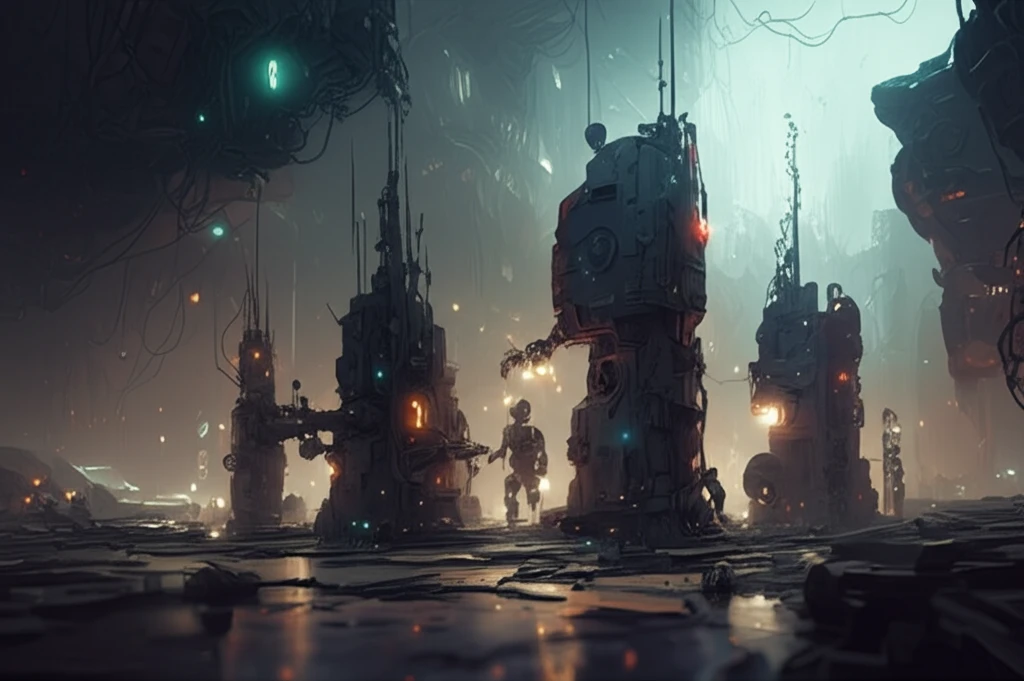
The Future is Now: How Swarm Robotics is Changing Everything

"Dive into the world of multi-agent systems and discover the revolutionary impact of swarm robotics on industries from agriculture to disaster relief."
Imagine a team of robots, each with simple instructions, working together to achieve complex tasks far beyond the capability of a single machine. This isn't science fiction; it's the reality of swarm robotics, a rapidly evolving field within multi-agent systems. Swarm robotics is inspired by nature. Just as ants collaborate to build colonies and birds coordinate their flight patterns, swarm robots rely on decentralized control and local communication to achieve coordinated behavior.
The beauty of swarm robotics lies in its scalability and robustness. Adding more robots to the team enhances the system's capabilities without requiring a complete overhaul. If one robot fails, the others can continue the mission, ensuring reliability in dynamic and unpredictable environments. This adaptability makes swarm robotics ideal for a wide range of applications.
From environmental monitoring and precision agriculture to search and rescue operations and advanced manufacturing, swarm robotics is poised to revolutionize numerous sectors. As research progresses and technology matures, we can expect even more innovative applications to emerge, shaping the future of automation and problem-solving.
Robotics on the Rise: Markets and Deployment
Industry data indicates that robots are operating with greater intelligence and endurance, with AI vision now present in over 50% of new industrial robots and mobile units working 24+ hours in 70% of warehouse deployments. The global military robot market is projected to reach $26.3 billion by 2027, with drones accounting for 80% of military robotics spending in 2023. Service robots now number in the tens of millions, and swarm robotics is on an upward trajectory. The field has also moved beyond the lab, with a swarm of micro flying robots demonstrated in the wild as recently as 2022.
Coordination Basics and the Constraints That Bind
Swarm robotics is generally understood as the study of large-scale systems in which many relatively simple robots work cooperatively toward a shared goal. Communication among units is commonly classified into explicit and implicit methods, an approach valued for its simplicity, limited information flow, and relatively low cost. Such systems are often applied to real-world problems that can be modeled as foraging tasks, such as disaster or trash cleanup and object gathering for construction. However, sources note that current swarm-robotic foraging approaches make limiting assumptions that restrict their applicability to selected scenarios only.
From Social Animals to Early Swarm-bots
Swarm robotics took off in the early 2000s, with an early milestone being the "s-bot" (short for swarm-bot), a fully autonomous robot capable of navigation, object grasping, and self-assembling into chains to cross gaps or pull heavy loads. The discipline is rooted in the study of how groups of small, autonomous robots collaborate toward a common goal, with each robot making its own decisions. Researchers draw direct inspiration from social insects, particularly ants, which cooperate to bridge gaps and form rafts to survive floods. More recent demonstrations show swarms of tiny robots guided by magnetic fields coordinating ant-like feats, from packing together into a floating raft to lifting objects.
Unlocking the Potential of Multi-Agent Systems
Multi-agent systems (MAS) provide a framework for understanding and designing complex systems composed of multiple interacting agents. Each agent operates autonomously, with limited knowledge and communication capabilities. The challenge lies in coordinating these agents to achieve global objectives that would be impossible for any single agent to accomplish alone.
- Decentralized Control: No central controller dictates the actions of individual robots.
- Local Communication: Robots communicate only with their immediate neighbors.
- Simple Rules: Individual robots follow simple rules that, when combined, lead to complex swarm behavior.
- Scalability: The system can easily adapt to changes in size and complexity.
Recent Work and a Persistent Adoption Gap
Recent literature reviews aim to identify new research trends in human-swarm interaction and work toward standardization of methodologies and tasks in swarm robotics. Survey results, however, indicate that swarm robotic applications are still rare today: many industrial projects continue to rely on centralized control, and even where multiple robots are used, the distributed-decision-making principle central to swarm robotics is often neglected. Meanwhile, market analysts report that the global swarm robotics market hit $1 billion in 2024 and is projected to reach $9.4 billion by 2033, with attention focused on safety risks versus operational scale in areas like wildfire monitoring and logistics. In the lab, researchers have moved beyond earlier spherical robots, which interact through point-to-point contact, to cube-shaped microrobots that share stronger magnetic attractions thanks to their larger contact surfaces.
Assumptions, Fault Tolerance, and Open Criticism
A central criticism is that current swarm-robotic foraging approaches rely on limiting assumptions that restrict their applicability to carefully selected scenarios. Researchers also note that fault tolerance and robustness to individual robot failures have often been used to justify swarm robotic systems, even though realizing these properties remains an open challenge. This has motivated work on mechanisms such as artificial immune systems designed to enable self-healing within swarms that operate with only limited communication and interaction abilities. Proponents still point to demanding settings, such as dangerous mining areas or future space mining missions, where fully autonomous swarms could reduce risks for workers and improve productivity, even as the gap between promise and practice narrows slowly.
Swarm Systems Versus Conventional Alternatives
Swarm robotic systems hold the potential to revolutionize various fields by executing complex tasks collectively, yet efficient navigation remains a pivotal challenge that can significantly impact their performance and applicability. Compared with software-driven automation, robotics offer physical capabilities that purely digital systems inherently lack, which is central to why multi-robot physical systems matter for tasks requiring real-world action. Sources frame the comparison around what each approach can physically do rather than which is universally better, highlighting navigation and coordination as decisive differentiators for swarm systems.
The Horizon of Swarm Robotics
Swarm robotics is more than just a collection of robots; it's a paradigm shift in how we approach automation and problem-solving. As technology advances and our understanding of swarm behavior deepens, we can expect to see even more groundbreaking applications emerge. From the depths of the ocean to the vast expanse of space, swarm robotics is poised to transform industries, enhance our lives, and unlock new possibilities for exploration and discovery.
Weight-Bearing Swarms and a Lighter Touch in Agriculture
In a striking demonstration, a swarm of 1,000 robots formed a floating raft on the water's surface, and some swarms transported objects across water that weighed 2,000 times more than the robots themselves, even launching individual robots over barriers. Such results underscore the collective capabilities that emerge when large numbers of simple units act together. In agriculture, experts argue that swarm robots, being small, simple, and inexpensive, promise to reverse the trend toward ever bigger machines, with these little workers behaving autonomously and interacting with each other and the environment. At the same time, commentary emphasizes that efficient navigation remains a pivotal challenge shaping how far these systems can actually go.
Smaller Robots, Smarter Connections, Bigger Tasks
Swarm robotics is expected to have a promising future in solving intricate and significant problems, since the approach emphasizes the contributions of many individual robots rather than a single complex unit. By enabling multiple robots to operate in concert, swarms can complete tasks beyond the capability of any individual unit, which sets the field apart from general distributed robotic systems. Trends shaping the market include the development of smaller and more agile robots, the integration of swarm robotics with other emerging technologies such as IoT and 5G, and an increasing focus on autonomous capabilities.
Collective Intelligence and the Human-Machine Interface
At the heart of swarm robotics lies the concept of collective intelligence, how thousands of individuals can solve a problem that one complex individual could not, drawing inspiration from ant colonies and bee swarms. Yet scaling these systems brings systemic challenges that extend beyond engineering. Research into active robot swarm size suggests it alters human time perception, flow, and perceived task difficulty, findings that can guide the design of more intuitive swarm interfaces for human operators.
From Simulations to the Real World
Scientists are increasingly studying how robot swarms collectively achieve goals, taking inspiration from ants that work together to bridge gaps or form rafts to survive floods. Research on innate motivation for robot swarms, where behavior is driven by minimizing surprise, has been carried from simple simulations through to real-world experiments. This line of work examines how evolved behaviors scale and how realistic robot simulations affect results, ultimately showing how the "reality gap" between simulation and physical robots can be bridged.