
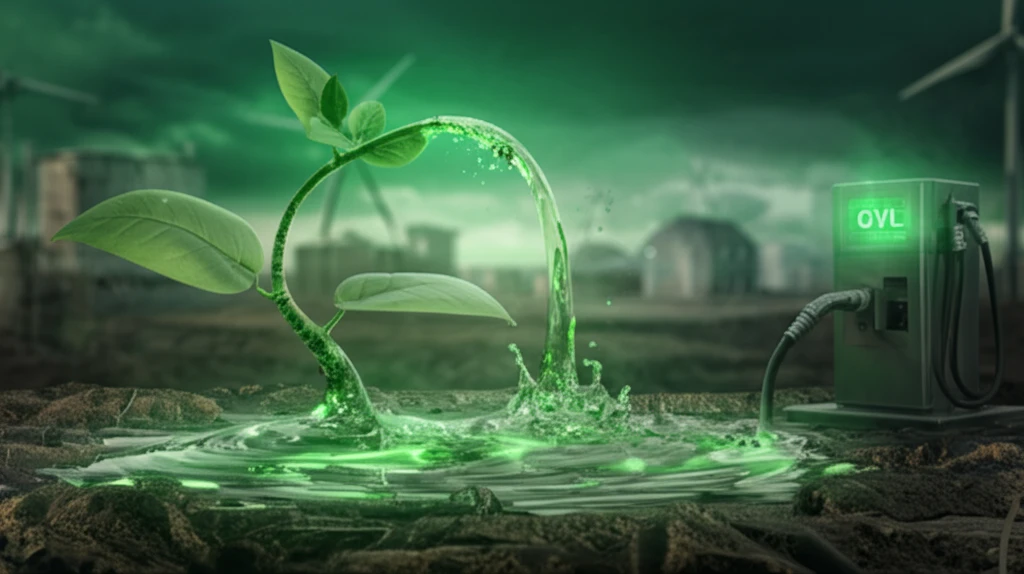
The Eco-Friendly Fuel Fix: How This Bio-Solvent Could Change the Game

"Y-Valerolactone (GVL) is emerging as a sustainable alternative to traditional solvents and fuel additives. But can it truly revolutionize our approach to green energy?"
In a world increasingly focused on sustainability, the quest for eco-friendly alternatives to traditional chemicals is more critical than ever. Enter y-valerolactone (GVL), a bio-based solvent that’s capturing the attention of researchers and industries alike. As concerns about climate change and the environmental impact of fossil fuels intensify, GVL presents a promising solution.
GVL, derived from biomass, offers a sustainable alternative to many industrial solvents and fuel additives. Unlike conventional solvents that often come from petroleum, GVL is produced from renewable resources, making it an attractive option for reducing our carbon footprint. Its versatility allows it to be used in various applications, from enhancing fuel performance to serving as a green solvent in chemical processes.
However, the path to widespread adoption isn't without its challenges. Understanding GVL's properties, particularly its solubility and miscibility with other substances, is crucial for optimizing its use. Recent research has delved into these aspects, exploring how GVL interacts with different compounds under various conditions.
GVL as a Green Platform Molecule
Gamma-valerolactone (GVL) is a colorless, water-soluble cyclic ester with the chemical formula C5H8O2 (CAS 108-29-2), classified as a green platform molecule with broad industrial relevance. GVL serves as an intermediate in chemical synthesis, a fuel additive, and a non-toxic non-polar solvent with favorable physical and chemical properties. Its classification as a platform molecule reflects its potential as a precursor for high-value materials derived from renewable biomass feedstocks rather than petroleum.
Biomass Conversion and GVL's Recyclability Advantage
GVL has been selected as a solvent in biomass conversion processes precisely because it can be recycled, offering a meaningful environmental advantage over fossil fuel-derived alternatives and previously used solvents. Its designation as a promising platform biomolecule reflects its versatility as an additive for food and fuels, a green solvent, and a fuels precursor. As a colorless water-soluble organic compound, GVL occupies a niche that conventional petrochemical solvents cannot easily replicate without comparable environmental trade-offs.
From Natural Occurrence to Catalytic Conversion
GVL occurs naturally in fruits and has long been used as a food ingredient and fuel additive, establishing early practical applications before its emergence as a biomass-derived chemical. Research has demonstrated the catalytic conversion of GVL over gamma-alumina, which contains Lewis acid sites, to produce 1-butene with high initial selectivity—a milestone linking bio-derived platform molecules to petrochemical-equivalent outputs. The broader recognition that biomass can serve as a renewable energy source capable of causing far less damage than traditional fossil fuels provided the conceptual foundation for GVL research.
The Science Behind GVL: Solubility and Applications
Recent studies have focused on GVL's solubility behavior, especially in mixtures relevant to the fuel industry. One key area of investigation is how GVL interacts with hydrocarbons, which are the primary components of fuels like gasoline and diesel. Researchers are keen to determine the extent to which GVL can mix with these fuels, as this affects its potential as a fuel additive.
- GVL has limited solubility in long-chain hydrocarbons, potentially restricting its use as a diesel additive.
- GVL exhibits better miscibility in gasoline, making it a promising bio-additive.
- The solubility of GVL is influenced by temperature and the presence of other compounds.
- Models like NRTL and UNIQUAC can help predict GVL's behavior in mixtures, but have limitations.
GVL Metabolites in Human Microbiota Research
Recent research has identified phenyl-gamma-valerolactones as metabolites linked to dietary factors, nutrient biomarkers, metabolic status, and inflammation in older adults, connecting GVL chemistry to healthy ageing. Separate studies have shown that procyanidin dimers are metabolized by human gut microbiota, producing 5-(3,4-dihydroxyphenyl)-gamma-valerolactone as a major metabolite alongside 2-(3,4-dihydroxyphenyl)acetic acid. These findings suggest that GVL-derived compounds play a previously underappreciated role in the metabolic pathways connecting diet to health outcomes.
Production Challenges Without Hydrogen Supply
While GVL is widely recognized as a promising platform biomolecule, a key challenge lies in producing it from levulinic acid or its esters without requiring external hydrogen (H2) supply. Conventional hydrogenation routes demand significant energy inputs and infrastructure for hydrogen handling, which can offset the environmental gains of using a bio-derived solvent. Researchers have been exploring alternative pathways to obtain biomass-derived GVL that circumvent this dependency, though scalability and cost remain open questions.
GVL Among Bio-Derived Solvents
GVL occupies a distinctive position among bio-derived solvents due to its combination of low toxicity, water miscibility, and recyclability—properties that differentiate it from many conventional organic solvents. However, comprehensive head-to-head comparisons with competing green solvents such as ethyl lactate, 2-methyltetrahydrofuran, and supercritical CO2 remain limited in the published literature. The relative economic and environmental trade-offs between these alternatives depend heavily on feedstock availability, regional energy mixes, and the specific application context.
The Future of GVL: A Step Towards Sustainability
As research continues to uncover the potential of GVL, it’s clear that this bio-solvent could play a significant role in creating a more sustainable future. While challenges remain in optimizing its use and ensuring its compatibility with existing systems, the benefits of GVL – from reducing reliance on fossil fuels to providing a safer alternative to harmful solvents – are undeniable. Embracing GVL is a step towards a greener, more sustainable world, where renewable resources drive our industries and protect our planet.
Converging Evidence and Open Questions
The body of research on GVL converges on its promise as a multifunctional platform molecule bridging biomass chemistry and industrial application, though significant knowledge gaps persist. Much of the existing work focuses on production pathways and solvent performance, with comparatively less attention to long-term environmental fate, lifecycle assessments at industrial scale, and regulatory harmonization across jurisdictions. Translating GVL from laboratory demonstration to widespread commercial deployment will likely require interdisciplinary collaboration spanning chemistry, engineering, economics, and policy.
Market Growth and Strategic Risks
The global gamma-valerolactone market is projected at USD 0.78 billion in 2026 and is anticipated to reach USD 0.95 billion by 2035, registering a compound annual growth rate of 2.24%. Key risks to this growth trajectory include feedstock supply volatility, technological obsolescence as alternative bio-solvents advance, and policy shifts that could alter the competitive landscape. The relatively modest growth rate suggests a market that is expanding steadily rather than experiencing disruptive acceleration, underscoring the need for continued innovation to unlock GVL's full commercial potential.
Engineering Tolerance and Regulatory Hurdles
One systemic challenge in scaling GVL-based processes is biological tolerance: chemical genomic-guided engineering has been employed to develop yeast strains capable of withstanding GVL's solvent effects during biomass deconstruction. On the regulatory front, markets such as Germany's delta-valerolactone sector face hurdles arising from strict chemical safety and environmental guidelines that can slow adoption of newer bio-derived compounds. These intertwined biological and regulatory barriers highlight that the path from promising green chemistry to market-ready product requires solving constraints beyond the reaction vessel.
Practical Applications Across Industries
Valerolactone's significance extends beyond laboratory research into tangible real-world applications, driven by its derivation from renewable biomass resources. It is increasingly used across multiple industries as a sustainable manufacturing input, reflecting growing demand for alternatives to petroleum-derived chemicals. The compound's versatility—spanning solvent use, fuel blending, and chemical synthesis—positions it as a practical tool for organizations seeking to reduce their dependence on fossil fuel-derived feedstocks.