
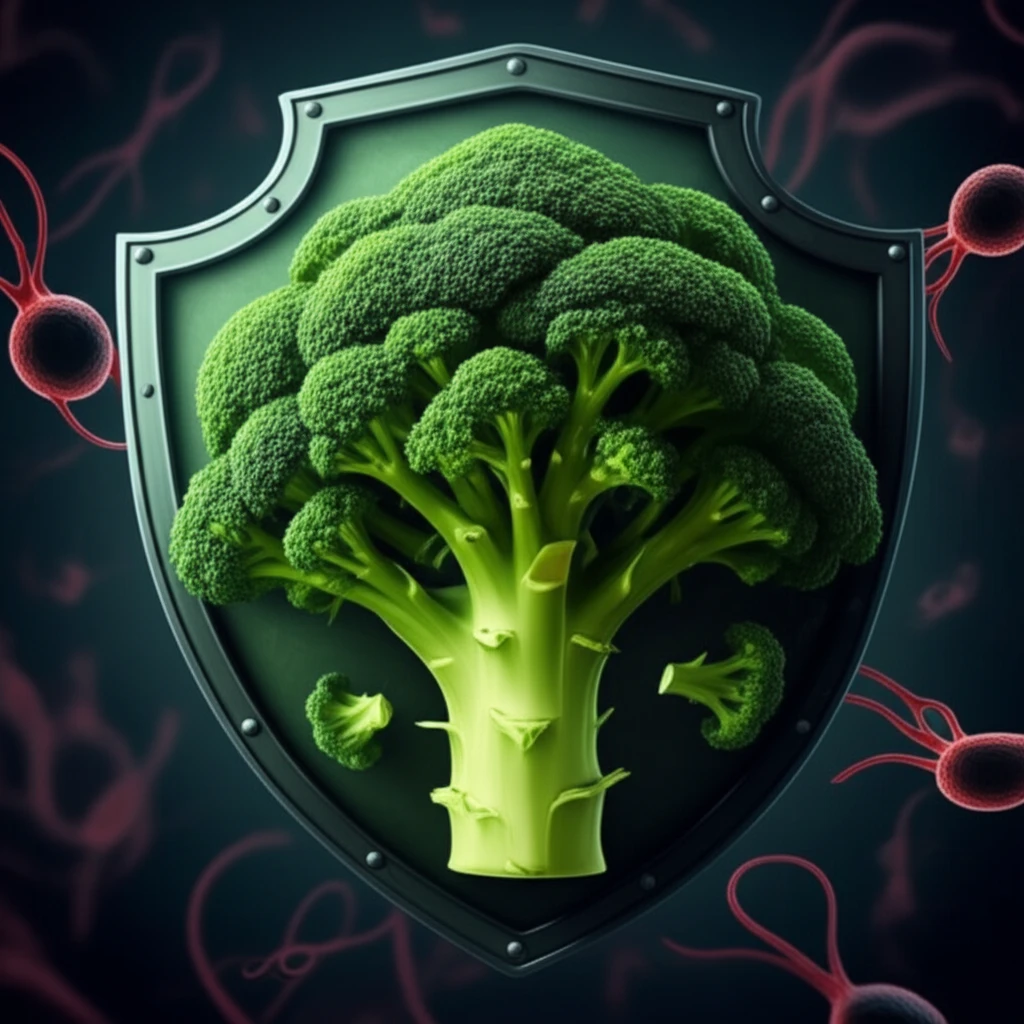
Sulforaphane: Can Broccoli Compound Help Fight Cancer?

"New research explores how sulforaphane, found in broccoli, triggers cell death in colon cancer cells, offering hope for novel cancer treatments."
The search for effective cancer treatments often leads scientists to investigate natural compounds found in everyday foods. One such compound is sulforaphane (SFN), abundant in cruciferous vegetables like broccoli. Previous studies have hinted at SFN's ability to inhibit cancer growth and induce apoptosis (cell death) in various cancer cell lines. But what about colon cancer cells that are deficient in p53, a crucial protein that normally suppresses tumor growth? This is a critical question because deficiencies in p53 can lead to drug resistance and poorer outcomes for cancer patients.
A recent study published in Molecular Medicine Reports delves into this very question. Researchers focused on SFN's effects on p53-deficient SW480 colon cancer cells, aiming to understand the specific mechanisms through which SFN might combat cancer in these challenging cells. Their work provides valuable insights into potential new avenues for cancer therapy.
The study sets out to verify a hypothesis: that SFN induces apoptosis in association with ROS generation and mitochondrial dysfunction. To verify this hypothesis, the effect of SFN on the mitochondrial membrane potential (MMP), and ROS and apoptosis levels was determined using p53-deficient SW480 cells. The results demonstrated that, SFN increased ROS generation, which subsequently lead to activation of Erk and p38 MAPKs and apoptosis induction via the mitochondrial-dependent apoptotic pathway.
Sulforaphane in Cancer Research
A 2024 review describes an ongoing need for new approaches to cancer prevention and treatment, noting that cancer cases and deaths worldwide continue to increase despite advances in diagnosis and treatment. It presents sulforaphane (SFN) as a compound under study for these goals. A 2025 review focuses on SFN’s potential role in cancer treatment, including its biological mechanisms and ability to regulate drug resistance. A 2026 review describes SFN as a chemopreventive dietary agent and discusses pathways including Nrf2–ARE activation and histone deacetylase inhibition.
How Sulforaphane Triggers Cancer Cell Death: The ROS-MAPK Connection
The researchers discovered that SFN effectively triggers apoptosis in p53-deficient SW480 cells by affecting key processes within the cell. SFN disrupts the mitochondria, the cell's powerhouses, leading to a decrease in mitochondrial membrane potential and an increase in the Bax/Bcl-2 ratio. These changes are strong indicators of apoptosis.
- Mitochondrial Disruption: SFN damages the mitochondria, leading to cell death.
- Increased ROS Production: SFN increases reactive oxygen species (ROS), contributing to apoptosis.
- Activation of Erk and p38 MAPKs: SFN activates these key signaling pathways.
Laboratory Findings and Reviews
A review of sulforaphane’s cancer-preventive potential summarizes pancreatic cancer cell-line studies, including experiments reporting cell death in AsPC-1, BxPC-3, and PANC-1 cells after 10 µM exposure for 24 hours. In PANC-1 and MIA PaCa-2 cells, studies using 1–100 µM over 24–72 hours reported reduced proliferation, invasion, and migration. A separate oral squamous cell carcinoma cell-line study reports that broccoli extract’s inhibitory effect on SCC9 cells, based on its 72-hour IC50, was comparable to effects reported for other cancer types. These are cell-line findings, while a 2025 review describes sulforaphane as interacting with signaling molecules involved in cancer-related pathways.
Limits of the Available Evidence
The supplied sources do not provide a direct comparison establishing that sulforaphane is effective or ineffective as a cancer treatment. One review reports that a broccoli soup intervention reduced prostate cancer progression and disease severity for at least one year, associating the finding with altered gene expression. The supplied snippet does not give the study size or other details needed to assess the result. The 2023 Frontiers source excerpt provides general background on cancer treatments, but no sulforaphane efficacy or tolerability findings.
A Different Compound and Cell Model
The supplied comparative source concerns 2,3,7,8-tetrachlorodibenzo-p-dioxin (TCDD), not sulforaphane. It reports that researchers assessed TCDD’s effects on ERK, JNK, and p38 MAPK activation and caspase-3 in RAW 264.7 cells. The source frames MAPK pathways as relevant to both cell survival and apoptosis. It therefore does not provide evidence for a direct comparison between sulforaphane and another compound.
The Promise of Sulforaphane: A New Weapon Against Cancer?
These findings offer a promising glimpse into the potential of sulforaphane as an anti-cancer agent, particularly for colon cancers where p53 function is compromised. By targeting the ROS-MAPK signaling pathway, SFN may provide a way to induce apoptosis in cancer cells that are otherwise resistant to conventional treatments.
While further research is needed, these results suggest that SFN could be a valuable addition to cancer treatment strategies, potentially enhancing the effectiveness of existing chemotherapy drugs like cisplatin. This study paves the way for future investigations into how SFN can be best utilized to combat colon cancer and improve patient outcomes.
The study reveals that SFN induces apoptosis in SW480 cells by increasing ROS generation and the activation of Erk and p38 MAPKs. By disturbing the homeostatic balance between the generation and elimination of ROS, leading to the accumulation of ROS.