
Sugar Rush: How Bacteria Snag Their Sweet Treats with H-Bonds

"Unlocking the Secrets of Bacterial Sugar Transport: New Research Reveals the Role of Hydrogen Bonds in Chitoporin."
Imagine tiny, single-celled organisms constantly battling for survival in a vast, competitive world. For many bacteria, sugars are the primary energy source, their 'sweet treats' that fuel life. But how do these microscopic beings efficiently grab and transport these vital nutrients across their outer membranes? This is where bacterial sugar-specific channels come into play, acting as gatekeepers for essential sugars.
Vibrio harveyi, a bioluminescent marine bacterium, offers a fascinating case study. Known to cause vibriosis, a devastating disease in fish and prawn farming, this bacterium relies on a specialized channel called VhChiP (Vibrio harveyi Chitoporin) for the uptake of chitin-oligosaccharides, a specific type of sugar. VhChiP exhibits a remarkable selectivity for chitohexaose, a six-unit chain of N-acetylglucosamine.
New research dives deep into the mechanics of VhChiP, specifically exploring the role of hydrogen bonds (H-bonds) in the sugar-binding process. By manipulating the channel's environment and observing how sugar transport changes, scientists are uncovering fundamental principles that govern bacterial nutrition and opening doors for innovative antimicrobial strategies.
Bacteria in Numbers and Global Significance
Bacteria are among the most abundant organisms on Earth, inhabiting virtually every environment from deep-sea vents to arctic ice. The human body alone is estimated to harbor trillions of bacterial cells, potentially outnumbering human cells. As microscopic, single-celled organisms, bacteria have an outsized impact on ecosystems, human health, and industry. Their ubiquity and adaptability make them both essential allies and formidable challenges in medicine, agriculture, and biotechnology.
Understanding Bacteria: Classification and Challenges
Bacteria are classified as prokaryotic organisms belonging to the domain Prokaryota, distinguished by their lack of a membrane-bound nucleus and organelles. As of 2021, scientists have described 1,513 bacterial pathogens, though these represent less than 7% of all known bacterial species. Standard methods for combating pathogenic bacteria include antibiotics that target cell walls or DNA, but this approach has limitations given the vast diversity of bacterial species and their adaptability. While bacteria aid in essential human functions like digestion and immunity, treating infections requires careful differentiation between beneficial and harmful strains.
Early Microscopy and the Discovery of Bacteria
The history of bacterial study spans centuries, beginning with early observations through primitive microscopes. Foundational work in bacteriology established the methods and frameworks still used today to classify and understand these microorganisms. Key milestones include the development of staining techniques and culture methods that allowed scientists to visualize and isolate bacterial species. These early discoveries laid the groundwork for modern microbiology and our understanding of bacteria's role in health and disease.
Hydrogen Bonds: The Unsung Heroes of Sugar Transport
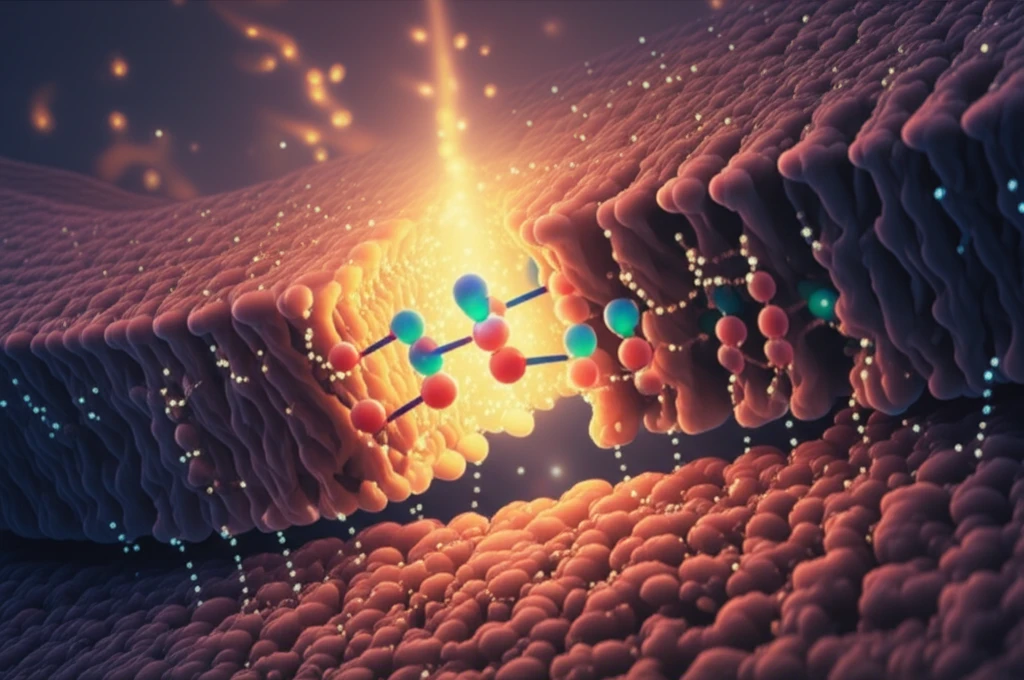
The study focuses on how hydrogen bonds facilitate the movement of chitohexaose through the VhChiP channel. Researchers compared the rate of sugar transport in normal water (H2O) versus heavy water (D2O), where deuterium replaces hydrogen. D2O has slightly different physical-chemical properties that affect the strength of hydrogen bonds. What they found was remarkable: replacing H2O with D2O significantly slowed down sugar penetration into the channel.
- Slowing Down Sugar: The research team found that H-bonds were essential for effective entry and exit of chitohexaose.
- Hydrophobicity Matters: The hydrophobic constriction zone was diminished and reduced the rate of sugar penetration.
- Mutant Insights: Mutant channels revealed the role of H-bonds in sugar permeation.
Naming and Characterizing Bacterial Species
The formal study and naming of bacteria has a rich history rooted in careful observation and classification. In 1838, German naturalist Christian Gottfried Ehrenberg coined the term 'bacteria' from the Greek word 'baktḗria,' meaning 'little stick,' reflecting their rod-like shape under the microscope. Later, Robert Koch's research through his famous postulates demonstrated that specific microorganisms cause particular infectious diseases, establishing a framework for identifying bacterial pathogens. This naming convention and Koch's systematic approach remain foundational to how scientists identify and classify bacterial species today.
Challenges in Bacterial Research and Treatment
Despite significant advances, bacterial research faces ongoing challenges. Antibiotic resistance continues to emerge as bacteria evolve mechanisms to evade drug treatments, threatening the efficacy of standard therapies. The difficulty in cultivating many environmental bacteria in laboratory settings limits our ability to study the full diversity of bacterial life. Additionally, distinguishing between beneficial and pathogenic bacteria in complex microbiomes remains a significant scientific hurdle.
Bacteria Across Domains and Ecosystems
Bacteria exhibit remarkable diversity in form, function, and habitat. While most bacteria are free-living organisms, they occupy nearly every ecological niche on Earth, from soil and water to the human gut. Their simple cellular structure contrasts with more complex eukaryotic organisms, yet this simplicity allows for rapid adaptation and evolution. Understanding how different bacterial species interact with their environments and hosts remains central to microbiological research.
Opening Doors for New Antimicrobials
This research not only illuminates the fundamental mechanisms of bacterial sugar uptake but also suggests exciting possibilities for developing new antimicrobial strategies. By understanding how bacteria rely on hydrogen bonds to capture essential nutrients, scientists can potentially design molecules that disrupt this process, effectively starving the bacteria and preventing infection.
Integrating Bacterial Science Across Disciplines
The study of bacteria continues to reveal new insights into fundamental biological processes. Advances in genomics and molecular biology have expanded our understanding of bacterial genetics and metabolism. Interdisciplinary approaches combining microbiology with ecology, medicine, and biotechnology are yielding innovative applications. These collaborative efforts are essential for addressing complex challenges in human health and environmental science.
Emerging Technologies in Bacterial Research
Future research in bacteriology promises breakthroughs in personalized medicine and targeted therapies. CRISPR and other gene-editing technologies offer new possibilities for manipulating bacterial genomes. The development of phage therapy as an alternative to antibiotics represents a promising frontier in combating resistant infections. These emerging approaches may revolutionize how we treat bacterial diseases and harness bacteria for beneficial purposes.
Global Implications of Bacterial Science
Bacterial research intersects with numerous global challenges, from public health to food security and climate change. Understanding bacterial contributions to nutrient cycling and ecosystem function is critical for environmental sustainability. The global burden of bacterial infections continues to demand investment in research and healthcare infrastructure. Addressing these systemic challenges requires coordinated international efforts and interdisciplinary collaboration.
Bacteria's Role in Human Health and Society
Bacteria are microscopic, unicellular, prokaryotic organisms that play essential roles in maintaining human health and ecosystem function. As members of the domain Prokaryota, they lack membrane-bound cell organelles and a true nucleus, representing one of the most ancient forms of life. In the three-domain system of classification, Bacteria constitutes the largest domain, reflecting their immense diversity and ecological importance. From aiding digestion to shaping environmental processes, bacteria remain fundamental to life on Earth.
The team's investigations into how different temperatures affect the energy needed for sugar transport revealed crucial details about VhChiP, highlighting the subtle dance of energy and molecular interactions at play. These findings pave the way for new approaches to combat bacterial infections, potentially sidestepping the growing problem of antibiotic resistance.
As our understanding of bacterial transport mechanisms deepens, the potential for innovative solutions to combat infectious diseases grows, promising a future where we can outsmart even the most resilient bacteria.