
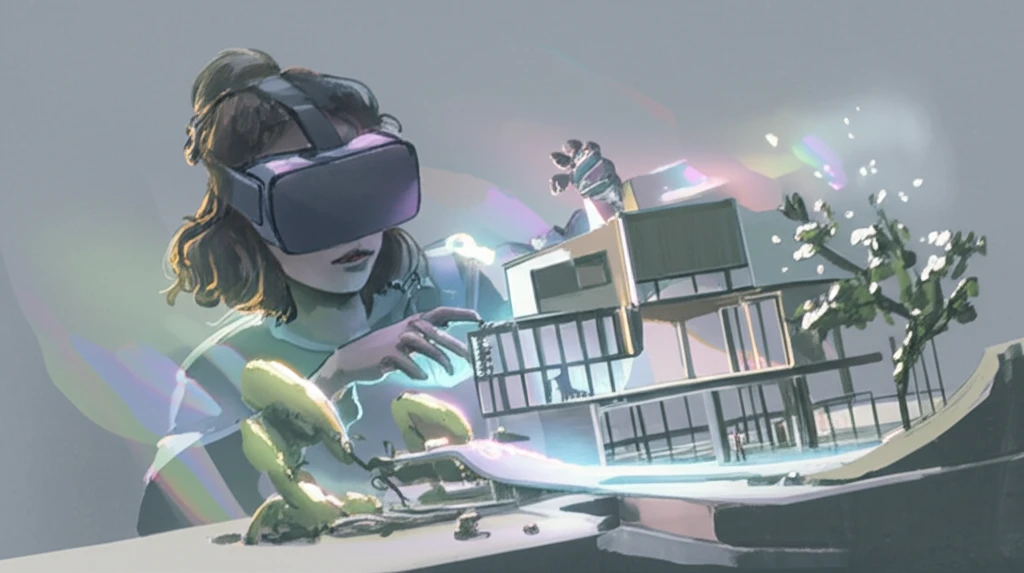
Step Inside: The Future of Design with VR and Scale Models

"Explore how virtual reality is revolutionizing architecture and design, offering immersive first-person perspectives within physical scale models."
For decades, architects and designers have relied on scale models to visualize, discuss, and refine their concepts for large-scale projects. These models offer a tangible representation, providing a bird's-eye view that aids in understanding spatial relationships. However, they often lack a realistic, first-person perspective, making it challenging to truly grasp the impact of design choices within the space.
Imagine being able to step inside a scale model and experience the space as if you were actually there. This is the promise of MacroScope, a cutting-edge tool that integrates virtual reality (VR) with physical scale models. By providing a real-time, 360° first-person perspective, MacroScope allows designers to collaboratively explore and evaluate their ideas in a more immersive and intuitive way.
This innovative approach has the potential to revolutionize various creative processes. Think of interior design, architectural planning, or even stage design—all enhanced by the ability to virtually inhabit and interact with a scaled environment before construction even begins.
Measuring VR's Reach: Where the Numbers Come From
Measuring virtual reality's real-world impact starts with reliable market data, and aggregators like Statista have become a standard reference point - the platform draws on more than 22,500 sources spanning over 60,000 topics statista.com. Official statistics bodies complement that picture; the UK's Office for National Statistics describes itself as the country's largest independent producer of official statistics ons.gov.uk. At the practitioner level, fotonVR reports that VR in education enhances learning and engages students through immersive 3D experiences. The variety of data points, from market aggregates to classroom outcomes, underscores why impact claims need to be weighed against the source behind them.
The Standard Toolkit: Realistic Environments and Their Limits
At its core, VR uses computer modeling and simulation to let a person interact within an artificial, three-dimensional sensory environment britannica.com. This makes it valuable for research: VR can build realistic-looking virtual environments while giving investigators greater control over experimental conditions and good ecological validity pubmed.ncbi.nlm.nih.gov. Yet the standard approach has practical limitations - an analysis of IKEA's research reported that 70% of customers did not know how big their houses were and 33% were unsure whether they had obtained measurements correctly, a reminder of how much spatial judgment is lost in translation. Such findings help explain why physical scale models remain a trusted complement to digital previews.
From Metaverse Visions to Head-Mounted Displays
The conceptual roots of immersive technology reach back decades before today's headsets. Capsule Sight traces the history of mixed reality through its origins and the early milestones laid by trailblazers in the field capsulesight.com. A pivotal moment arrived in 1992, when Neal Stephenson formulated the idea of a metaverse in his science fiction novel Snow Crash, imagining a virtual world organized around a downtown public area medium.com. These foundational ideas anticipated the immersive experiences that design studios now explore, from early advertising experiments to full-scale virtual prototyping.
MacroScope: Merging Physical and Virtual Realities
MacroScope bridges the gap between traditional scale models and immersive VR experiences. It addresses the limitations of conventional models, which only offer a top-down view, by allowing users to experience the space from a human perspective. This is achieved through a VR headset that displays a live, 360° video stream captured from within the physical scale model.
- Enhanced Collaboration: MacroScope facilitates more effective communication and collaboration among designers, clients, and stakeholders.
- Improved Design Evaluation: The first-person perspective allows for a more realistic assessment of design choices and their impact on the user experience.
- Early Issue Detection: By virtually experiencing the space, designers can identify potential problems and make adjustments before construction begins, saving time and resources.
- Versatile Applications: MacroScope can be applied to a wide range of design projects, including architecture, interior design, urban planning, and stage design.
What the Latest Research Finds
A structured narrative review covering 2020-2026 examined the impact of non-immersive virtual reality on student engagement in higher education, building on earlier work cataloguing design elements and lessons learned from immersive VR applications researchgate.net. A separate review synthesized research on VR exercise for anxiety and depression by searching ten electronic databases for studies published from January 2000 through October 2017 pubmed.ncbi.nlm.nih.gov. On the design side, Draw & Code reports that VR has significantly advanced engineering design and prototyping, particularly in 3D modelling, virtual prototyping, and user experience design. Laboratory work is also pushing beyond sight and sound, with researchers testing a device that could allow users to taste a cake in a virtual environment.
Counter-Arguments and the Limits of Hype
Critics note that the very design methods VR is meant to improve have their own problems - design thinking, for example, has raised high expectations alongside controversy, and commentators warn it will fail in its potential as a genuinely good creative problem-solving approach paul4innovating.com. Proponents respond that VR addresses real shortcomings elsewhere: at Tampere University, doctoral researcher Osku Torro studies how organizations use and adopt VR to overcome the limits of distance learning. In mental health, Risa Weisberg, chief clinical officer at BehaVR, describes VR as 'the goldilocks' the sector has been waiting for healthcareitnews.com. Together, these voices frame VR less as a miracle cure than as a targeted tool for specific, documented failures of existing methods.
Comparing Options Side by Side
Evaluating VR against alternatives now happens through dedicated comparison tools: platforms like Versus allow side-by-side comparison across more than 100 categories with detailed specifications, filters, and clear data visualizations versus.com. Product catalogs such as SourceForge extend this practice, letting teams weigh user ratings, reviews, and pricing of competing options sourceforge.net. Research adds a psychological dimension to such comparisons: one study found that a flirtatious virtual encounter made real-world alternative partners seem less attractive and reduced the time participants actually spent interacting with them. For designers choosing between virtual and physical models, the lesson is that what gets 'compared' depends as much on human perception as on technical specifications.
The Future of Immersive Design
MacroScope represents a significant step forward in the integration of VR technology into the design process. By providing an immersive, first-person perspective within physical scale models, it empowers designers to explore, evaluate, and communicate their ideas in a more intuitive and collaborative way. As VR technology continues to advance, we can expect to see even more innovative applications of this approach, transforming the way we design and experience the built environment.
What the Experts Emphasize
Expert commentary increasingly focuses on the quality of the immersive experience itself: immersive virtual reality is gaining ground in education and training because it provides a strong sense of presence, three-dimensional interaction, and controllable scenarios journals.plos.org. Emerging work pairs these environments with physiological sensing systems and AI-based signal analysis to read how users actually respond to what they experience. Practitioners can go deeper by booking consultations with the world's top design experts, who offer direct guidance through one-on-one sessions theexpert.com. The consistent message is that VR's value lies not in spectacle but in its capacity to place people inside experiences that feel genuinely real.
VR Rooms, Healthcare, and What Comes Next
Forward-thinking residential architects are already designing dedicated virtual-reality rooms where clients can slip on headsets and be instantly transported into their future homes, and the same impulse is driving automotive design, with Audi using VR at its Malibu Studio to design the future of cars yahoo.com. Long-term healthcare forecasts point to patient-centric VR innovations in behavioral health, immersive diagnostics, and rehabilitation, with scalable opportunities for cross-sector collaboration linkedin.com. Commercial momentum looks set to continue, with a significant share of the top tech companies invested in VR and AR yahoo.com. For design practice, the direction is clear: virtual environments are moving from novelty to a standard room in the studio.
Working Within Larger Systems
Adopting new design tools means confronting systemic challenges that no single technology can solve - guides like 'Designing with Purpose' outline a stepwise path from mobilization to scale, including building design hubs for 'making & testing' and opening collaboration for broader impact researchgate.net. The Real-Time Redesign process makes the same point differently, stressing action in the face of challenges and continuous improvement rather than waiting for the 'perfect time' to change fullscalelearning.org. The wider digital ecosystem adds its own complications, including the hidden costs and environmental impact of AI. Effective use of VR and scale models therefore depends as much on the surrounding systems, stakeholders, and measurement loops as on the hardware itself.
The Human Element: Closer Than It Feels
Virtual reality's most striking effect may be psychological: it reduces psychological distance, confronting people with issues - such as the planetary impact of our behavior - that they often feel too far removed from to worry about, as researchers Meijers and Sungur conclude techxplore.com. A pilot randomized controlled trial found VR meditation significantly more beneficial than video meditation among youth experiencing homelessness, and students in the same work reported that meditation delivered through either medium helped decrease pre-exam anxiety academia.edu. Marketing applications echo this human focus, with VR used to promote destinations such as Bali and to advance sustainable tourism for sites like Romania's wooden churches. By making distant experiences feel immediate, VR can change not just what people see but how they feel and act.